DbcultAccessing Vault...
Cult Review
Senior Film Conservator
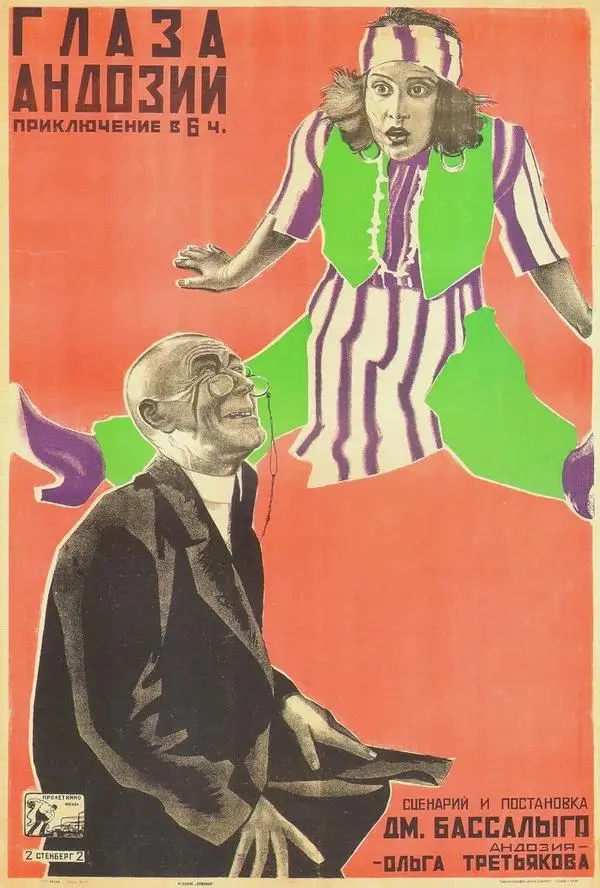
Is Glaza Andozii a lost masterpiece or a dusty relic of the Soviet silent era? Short answer: It is a fascinating visual experiment that prioritizes atmosphere over narrative clarity, making it essential only for history buffs and those obsessed with the evolution of the camera's eye. This film is for the viewer who finds beauty in the flicker of 35mm grain and the stark geometry of 1920s set design; it is certainly not for anyone looking for the polished emotional beats of a modern drama or even the accessible charm of something like Plain Jane.
Coming out of the Soviet Union in 1926, Glaza Andozii sits at a crossroads. It lacks the explosive montage energy of Eisenstein but possesses a brooding, observational quality that feels surprisingly modern. It is a film that demands your patience and then rewards it with images that stick in the back of your throat. The film is a ghost. It exists in the periphery of cinema history, yet its influence on the 'gaze' in film cannot be ignored.
1) This film works because: The cinematography utilizes high-contrast lighting to turn mundane industrial settings into expressionistic dreamscapes that mirror the characters' internal anxieties.
2) This film fails because: The narrative pacing is glacial, often lingering on symbolic imagery for so long that the actual plot momentum completely evaporates in the second act.
3) You should watch it if: You are a student of early Soviet cinema or you want to see how silent films used visual motifs to bypass state censorship through metaphor.
Dmitri Bassalygo, working from his own script, seems less interested in the 'what' and more in the 'how.' The way the camera lingers on the eyes of Vsevolod Massino is not just a stylistic choice; it is the film’s entire thesis. In one standout scene, Massino’s character stands before a massive industrial loom. The shadows cast by the machinery create a cage-like effect on his face. This isn't the soft, romantic lighting you'd find in The Song of the Soul; this is harsh, unforgiving, and deeply political.
The cinematography by the uncredited camera team (though likely influenced by the prevailing Kuleshov school) treats the human face as a landscape. We see every twitch of Aleksandr Polyakov’s brow, every flicker of uncertainty in Olga Tretyakova’s eyes. This focus on the micro-expression was revolutionary for 1926. While films like The Third Degree were experimenting with camera movement, Glaza Andozii was experimenting with the power of the static, intense close-up.
The pacing, however, is where the film will lose most modern audiences. There are sequences involving the documentation of labor that feel more like a newsreel than a feature film. This was common in Soviet cinema of the time—the 'Kino-Eye' influence—but here it clashes with the more expressionistic, dramatic elements. It creates a staccato rhythm that is occasionally jarring. One moment you are in a psychological thriller, the next you are watching a didactic lecture on factory efficiency.
The performances in Glaza Andozii are a far cry from the theatrical gesticulation often associated with the silent era. Vsevolod Massino delivers a performance of remarkable restraint. He doesn't need to wave his arms to convey despair; he simply allows the camera to catch the light in his pupils. It’s a haunting technique that makes the character feel trapped within the film frame itself.
Olga Tretyakova provides the emotional anchor of the film. In a scene where she confronts Nikolai Speranskiy’s character in a dimly lit hallway, her presence is monolithic. She commands the space through stillness. This is a sharp contrast to the more kinetic performances found in contemporary American films like Blue Jeans. In Glaza Andozii, the actors are part of the architecture. They are pillars of the state, or cracks in its foundation.
Nikolai Speranskiy plays the antagonist (if one can call him that) with a bureaucratic coldness that is chilling. There is no mustache-twirling here. His villainy is found in his efficiency. He represents the 'eyes' of the title—the surveillance that never sleeps. The interaction between him and Polyakov feels like a chess match where neither player is allowed to speak, only to stare. It is exhausting to watch, but undeniably effective.
Direct Answer: Yes, but only for those with a deep appreciation for silent film aesthetics and Soviet history. If you are looking for entertainment in the traditional sense, you will be disappointed. If you are looking for a visual meditation on the nature of power and observation, it is a goldmine. It is a difficult film, a slow film, and at times, a repetitive film. But it is also a film that refuses to be forgotten once you have seen its final, haunting frame.
Compared to the more melodramatic offerings of 1926, such as Slaves of Pride or The Snarl, Glaza Andozii feels like it belongs to a different century. It is colder, more intellectual, and significantly more experimental. It doesn't want you to cry; it wants you to think about the act of looking. It is a film that predicts the surveillance state of the 21st century with uncanny accuracy.
Pros:
Cons:
Dmitri Bassalygo was operating in a time of immense creative tension. The Soviet film industry was being squeezed between the need for mass-market appeal and the desire for high-art revolutionary expression. You can see this tension in Glaza Andozii. It tries to be a story for the people, but it is filmed with the eye of an avant-garde poet. This makes it a fascinating failure in some ways, and a brilliant success in others.
The film lacks the whimsicality of Castles for Two or the straightforward morality of The Woman God Sent. Instead, it offers a grim, almost nihilistic view of the individual within the machine. When Grigori Levkoyev appears on screen, his presence adds a layer of earthy realism that grounds the more abstract sequences. Bassalygo directs him with a focus on physical labor, making the sweat on his brow feel as significant as the dialogue cards.
One cannot discuss this film without mentioning the score—or lack thereof in its original state. Modern restorations often add a sweeping orchestral track, but the film works best in near-silence. The rhythmic editing of the factory scenes creates its own music. It is a percussive, mechanical symphony that echoes the works of Vertov. If you watch it, try to find a version that respects this inherent rhythm rather than drowning it in generic melodrama.
When placed alongside other films of the mid-1920s, Glaza Andozii stands out for its lack of sentimentality. While Fiskebyn was exploring rural isolation with a touch of romanticism, Bassalygo was exploring urban isolation with a cold, analytical lens. Even compared to the ruggedness of The Kentuckians, this film feels more clinical.
There is a recurring motif of a window in Andozia that looks out over a wasteland. This shot is repeated three times, each time with a slightly different light. This kind of structural repetition is something we expect from modern art-house directors like Tarkovsky or Antonioni, but to see it in a 1926 production is startling. It suggests a level of intentionality that goes beyond mere storytelling. It is a film about the passage of time and the erosion of the self.
Contrast this with the light-heartedness of Mr. Billings Spends His Dime or the high-stakes comedy of Never Say Die. Glaza Andozii is the antithesis of the 'dime-novel' movie. It is a heavy, leaden experience that wants to weigh you down. It succeeds in that goal. Whether that is a good thing depends entirely on your appetite for cinematic gravity.
Here is a surprising thought: Glaza Andozii is secretly a horror movie. While it is categorized as a social drama, the way it treats the 'eyes' of the title is pure psychological horror. The feeling of being constantly observed, of having your very thoughts scrutinized by an unseen force, is more terrifying than any monster in Mad Love. The 'monster' here is the collective, and its weapon is the gaze.
The film also features a strange, almost surreal sequence involving a character getting lost in a series of identical corridors. This predates the 'backrooms' aesthetic of modern internet horror by nearly a century. It captures a specific kind of bureaucratic dread that is rarely seen in cinema of this era. It is uncomfortable. It is alienating. It is brilliant.
Glaza Andozii is a difficult, uncompromising piece of work that demands more than it gives. It is a visual triumph trapped within a sluggish narrative. For those willing to look—really look—into the eyes of Andozia, there is a profound beauty to be found in its shadows. It is not a film to be enjoyed; it is a film to be experienced and analyzed. It remains a vital, if obscure, pillar of the silent era.
Final score: A challenging 7/10 for historians; a 4/10 for casual viewers. It is a masterpiece of a very specific, very cold kind. It works. But it’s flawed. The film is a ghost that still has something to say about how we see the world and how the world sees us.
IMDb —
1920
Community
Log in to comment.