DbcultAccessing Vault...
Cult Review
Senior Film Conservator
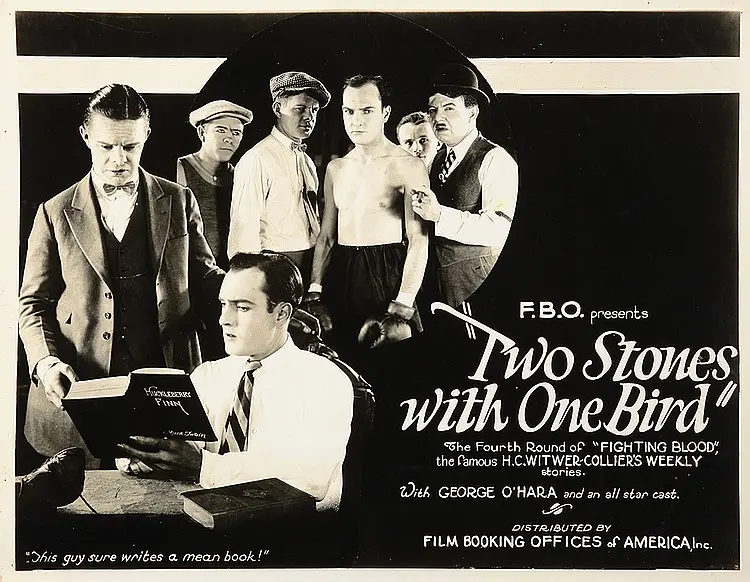
When the silent era’s Two Stones with One Bird unfurls its narrative, the audience is thrust into a world where the fight arena is as much a battlefield of wits as it is of fists. The film opens with Galen (Al Cooke), a bruised‑but‑unbowed pugilist whose reputation teeters on the edge of legend, preparing for a bout that could catapult him into stardom. Yet, lurking in the shadows, his rival’s camp orchestrates a devious scheme: two burly goons, hired to ensure Galen never steps foot inside the ring, set a trap that is as theatrical as it is treacherous.
The trap materialises in the form of a towering Ferris wheel, a symbol of amusement turned instrument of menace. Galen and his loyal confidante, Judy (Clara Horton), are coaxed onto the rotating platform under the pretense of a celebratory ride. The wheel creaks, gears grind, and the duo finds themselves locked in a cage that spins inexorably toward a precipice of disaster. The film’s director, Malcolm St. Clair, uses the vertiginous setting to amplify tension, turning the simple act of a ride into a claustrophobic crucible of suspense.
Al Cooke’s portrayal of Galen is a masterclass in silent‑film physicality. Without the crutch of dialogue, Cooke conveys desperation, determination, and a simmering fury through clenched jaws, furrowed brows, and a relentless drive that propels him forward. Kit Guard, as one of the brutish henchmen, provides a stark contrast with his lumbering presence, his movements deliberately slow to emphasize the looming threat. Clara Horton’s Judy shines as the emotional anchor; her eyes flicker with concern, her gestures speak volumes about loyalty and love. George O'Hara, though in a supporting role, adds a layer of nuance, embodying the morally ambiguous world that surrounds the central conflict.
The screenplay, co‑crafted by H.C. Witwer, Beatrice Van, and the legendary Darryl F. Zanuck, weaves a narrative that is both straightforward and richly textured. The dialogue cards, though sparse, are peppered with witty quips that hint at deeper character motivations. Zanuck’s early involvement is evident in the film’s brisk pacing and its deft balance of comedy and peril—a hallmark that would later define his illustrious career.
St. Clair’s direction is complemented by a visual style that embraces chiaroscuro, casting long shadows that dance across the Ferris wheel’s metal ribs. The cinematography captures the dizzying height of the wheel, the claustrophobic cage, and the frantic scramble of the protagonists with a kinetic energy that feels remarkably modern. The use of tight close‑ups on Galen’s clenched fists and Judy’s trembling hands heightens the emotional stakes, while wide shots of the fairground provide a stark juxtaposition between the ordinary and the extraordinary.
When Galen finally breaks free, the film erupts into a high‑octane chase that sees him sprinting through bustling midway stalls, leaping over cotton‑candy stands, and dodging startled children. The kinetic montage, set to a pulsating ragtime score, mirrors the frantic heartbeat of a man racing against an unforgiving clock. The climax—Galen’s arrival at the ring just as the bell tolls—delivers a cathartic payoff that reverberates long after the final frame fades to black.
While Two Stones with One Bird stands as a singular achievement, its thematic concerns echo across the silent era. For instance, the relentless pursuit and underdog triumph found in The Fighting Grin share a kinship with Galen’s desperate dash. Similarly, the comedic undertones of a high‑stakes chase recall the spirited antics of The Jazz Hounds. Even the atmospheric tension of a carnival setting finds a parallel in Twin Lizzies, where a fairground backdrop becomes a crucible for drama.
The film’s narrative structure also bears resemblance to the classic showdown in La bataille, where protagonists confront adversaries in a public arena, underscoring the timeless allure of spectacle versus subterfuge.
At its core, Two Stones with One Bird explores the notion of agency in the face of manipulation. Galen’s struggle is not merely physical; it is a battle for autonomy, a fight to dictate the terms of his own destiny. This theme reverberates in contemporary cinema, where protagonists often grapple with institutional forces seeking to curtail their ambitions. The film’s portrayal of camaraderie—exemplified by Judy’s unwavering support—adds an emotional dimension that transcends the silent medium.
The title itself, a clever twist on the idiom “kill two birds with one stone,” encapsulates the duality of the narrative: the antagonist aims to eliminate both Galen’s chance at victory and his morale, while Galen’s eventual triumph simultaneously rescues his reputation and reasserts his personal honor.
Produced during the waning years of the silent era, the film showcases a technical proficiency that foreshadows the imminent transition to sound. The meticulous set design of the Ferris wheel, the fluid choreography of the chase sequence, and the nuanced performances all attest to a studio willing to push the envelope of visual storytelling. Moreover, the involvement of Darryl F. Zanuck—later a titan of Hollywood—imbues the work with an added layer of historical intrigue.
The film’s preservation status is a testament to its cultural importance. Restorations have allowed modern audiences to experience the original intertitles, the grainy yet evocative black‑and‑white imagery, and the lively accompaniment that once filled theater auditoriums. Its continued relevance is evident in the way scholars reference it when discussing early examples of genre‑blending narratives that combine sport, thriller, and romance.
Upon its 1928 release, contemporary reviews praised the film’s brisk pacing and the palpable chemistry between Cooke and Horton. Critics highlighted the ingenuity of the Ferris wheel set piece, noting it as a “dazzling feat of cinematic engineering.” Modern retrospectives, however, tend to focus on the film’s subtextual commentary on exploitation within the sporting world—a theme that resonates in today’s discussions about athlete welfare and corporate interference.
Fans of vintage cinema often cite the film’s ability to sustain tension without spoken dialogue as a hallmark of its brilliance. The reliance on visual storytelling forces viewers to engage more actively, interpreting gestures and facial expressions to piece together the narrative puzzle. This immersive quality makes Two Stones with One Bird a compelling study for film students and enthusiasts alike.
In the grand tapestry of silent cinema, Two Stones with One Bird occupies a distinct niche—a film that marries high‑stakes drama with a dash of levity, all while delivering a potent commentary on agency and perseverance. Its deft direction, robust performances, and innovative set pieces render it a timeless artifact, inviting repeated viewings and scholarly analysis. Whether you are drawn to the adrenaline‑pumping chase, the nuanced character dynamics, or the historical significance of Zanuck’s early involvement, the film offers a rich, multi‑layered experience that continues to echo across decades.
IMDb 8
1920
Community
Log in to comment.