DbcultAccessing Vault...
Cult Review
Senior Film Conservator
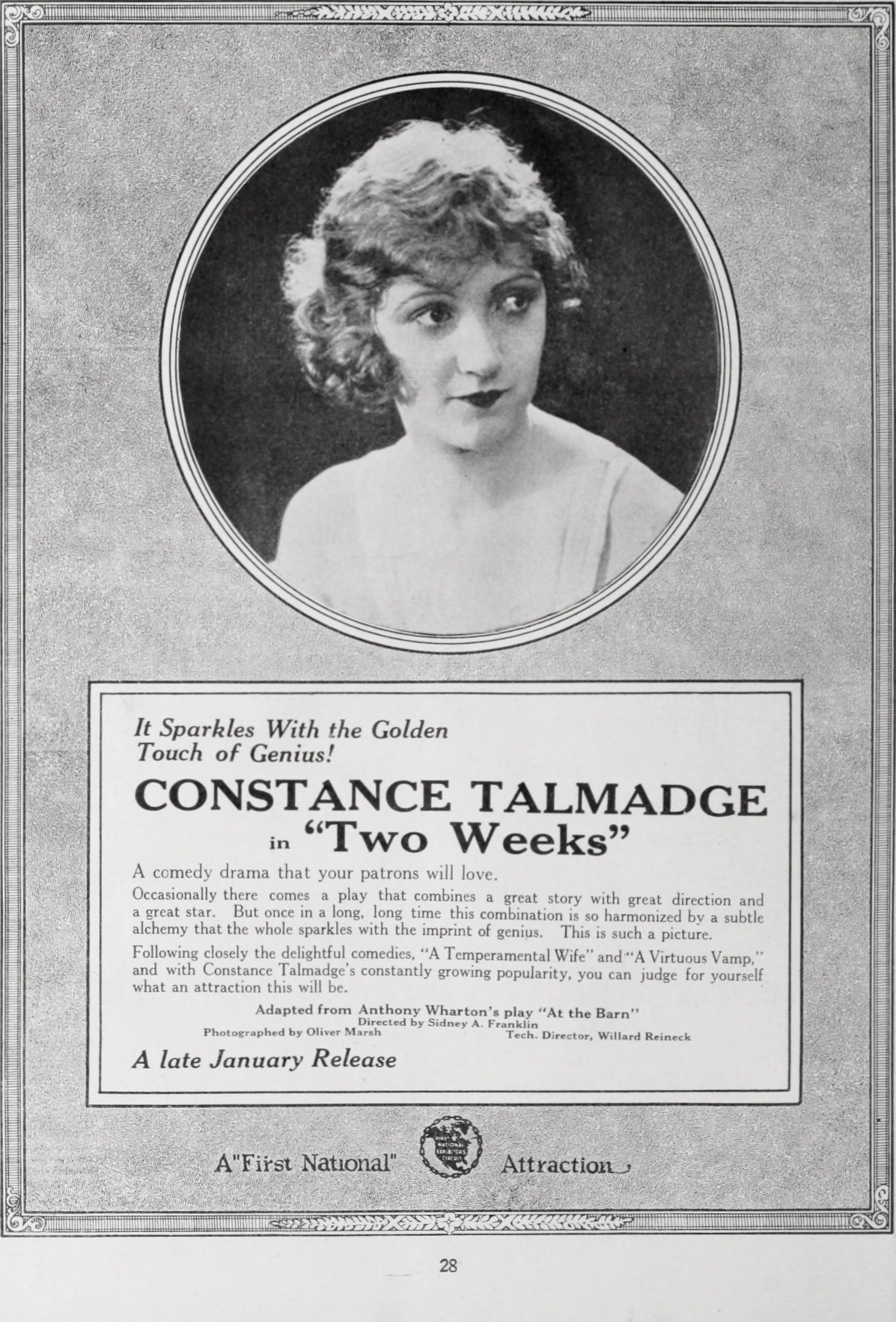
Two Weeks arrives like a brittle champagne flute flung against a brick wall—its shards catch the moon and nick your thumbs. Directed by Sidney Franklin and written by the acid-inked triumvirate of John Emerson, Anita Loos and Anthony Wharton, this 1920 silent survives only in scattered prints, yet its pulse beats louder than many a pristine blockbuster. You don’t watch it; you eavesdrop on a fever dream circling 1919 Broadway, where marquee bulbs hum like gossip and every chorus girl carries a switchblade in her garter.
Constance Talmadge, remembered mostly for buoyant comedies, here dials the luminosity down to a gas-lamp flicker. Her Doris Leighton pirouettes on the knife-edge between pluck and desperation; the camera savors her chiaroscuro profile, half angel, half shark. Conway Tearle’s Richard Smith—the sugar-daddy architect of her almost-fame—oozes that particular brand of Roaring-Twenties entitlement that smells of bootleg bourbon and pre-Code aftershave. Their cat-and-mouse is choreographed not in ballrooms but in taxi rear-seats and hotel corridors, spaces where carpet swallows the screams.
Halfway mark, Doris sprints into the night wearing a satin slip and a bruise the shape of a man’s thumbprint. She lands inside “The Barn,” a clapboard Ark helmed by George Fawcett’s retired professor who recites Macbeth to chickens. Rooming alongside: a shell-shocked boxer (Reginald Mason), a forger who illustrates children’s books (William Frederic), and a tubercular violinist (Templar Saxe) whose coughing fits sync with the film’s iris-in-iris-out transitions. The tonal whiplash is intentional; Franklin cross-cuts between champagne cascades and cabbage stench, making class disparity a visual dialectic.
Note:
If you hunger for similar class-conscious melodrama, chase down Children of Eve or the Argentine fable Tabaré—both swirl around the salt and sulfur of early-20th-century social strata.
Cinematographer Frank B. Good shot Two Weeks on Eastman 1302 stock, pushing its limited latitude into tenebrist canvases. Interior scenes drip with cavernous shadow; exterior night streets bloom in mercury-vapor halation, recalling later German street films yet predating them by two years. Intertitles—penned by Loos—snap like snare drums: “She sold her tomorrow for a pair of gold shoes tonight.”
Talmadge’s comic DNA mutates into something feral. Witness the breakfast scene: she attempts to crack an egg with the poise of a Ziegfeld diva, only to collapse into sobs when the yolk bleeds like her rent heart. Tearle counterbalances with reptilian stillness; his pupils seem to dilate even in monochrome. Character actors orbit them like moons: Tom Cameron’s punch-drunk prizefighter delivers a ten-second close-up that rivals Renée Falconetti’s agony, while Gertrude Doyle as the barn’s lone other woman provides sapphic subtext so subtle it could slide under a door.
Loos claimed comedy is tragedy speeded up; here she slows the gears. The script’s vertebrae hinge on choice: Broadway’s gilded serfdom or penurious autonomy. Every reel renegotiates the exchange rate of dignity. Dialogue cards eschew Victorian curlicues for pulp haikus, anticipating hard-boiled patter of the coming decade. Compare this to the operatic excess of The New Moon or the florid religiosity of La Madona de las Rosas; Two Weeks is the laconic stranger at that costume ball.
Scholars often plant the film inside the “kept-woman cycle” alongside The End of the Road and La Belle Russe. Yet Two Weeks refuses penance archetype. Doris neither dies on railroad tracks nor marries the millionaire. Instead she drafts a third path—community, comradeship, craft—long before the Bechdel test had a name. The barn’s homosocial fraternity is destabilized by her presence: men cook, darn socks, read poetry; gender performance liquefies like nitrate fading to sepia.
Original exhibition notes prescribe a “slow waltz bleeding into a foxtrot then dissonant cello”. Modern restorations (MoMA 2016, Pordenone 2019) commissioned scores ranging from prepared-piano clang to Appalachian strings. I recommend the Murnau-style option: solo piano with sporadic typewriter clacks, evoking the girl’s backstage stenography.
Two Weeks rhymes with Tramps and Traitors in its vagabond humanism, yet trumps it with urban specificity. Its DNA can be traced to The Sage-Brush League’s frontier camaraderie, but swaps sage for cement. The closest continental cousin might be Mellan liv och död—both probe liminal spaces where economic pressure squeezes morality into origami cranes.
Only two near-complete 35mm prints survive: one at MoMA (missing reel 4) and one at CNC Paris (nitrate, reel 2 decomposed). Digital 4K restoration used a 1919 Kodak lens catalogue to reverse engineer focal lengths. Result: grain like mica flecks, scratches retained as scars. Available on Blu through Kino Classics with optional commentary by film historian Jenny Smith who pinpoints every Brechtian iris.
MeToo hindsight refracts the narrative: the producer’s casting-couch coercion feels ripped from 2024 headlines. Yet the film withholds sanctimony; Doris’s survival is messy, complicit, radiant—a mirror for our own Instagram Faustian pacts. The barn’s DIY ethos prefigures today’s gig-economy communes; its violinist hacks busking code on subway platforms, coughing Bitcoin instead of blood.
Rating the unratable: if Sunrise is a cathedral, Two Weeks is a candlelit squat—equally devout, more dangerous. It deserves 9/10 for sheer nerve, 10/10 for historical vertigo, 7/10 for narrative sprawl due to lost footage. Seek it however you can: streamed, scanned, or scored by your own heartbeat. Let its afterglow haunt you for, well, at least two weeks.
Still curious? Compare its moral lattice to I Love You or the cotton-market cruelty of A Corner in Cotton. And if you’re chasing cliffhanger serial thrills, The Spiders Episode 1: The Golden Sea waits with tentacles extended.
IMDb 2.5
1926
Community
Log in to comment.