DbcultAccessing Vault...
Cult Review
Senior Film Conservator
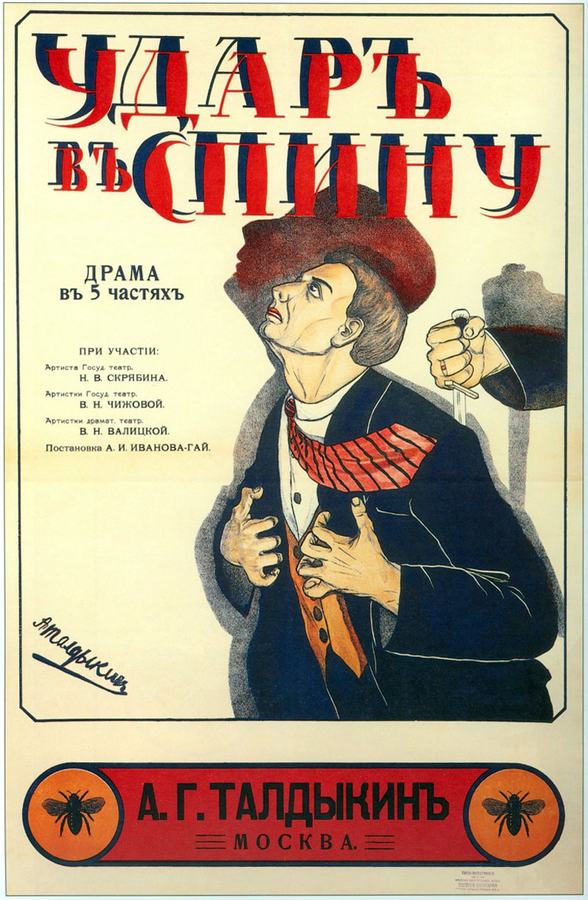
There are films you watch, and then there are films that watch you back—Udar v spinu belongs to the latter caste. Shot in 1926 on nitrate so unstable it reportedly combusted during the première’s final reel, this hour-long fever dream from the short-lived Sevzapkino studio detonates its own plot about midway through, leaving the viewer to piece together meaning from scorched after-images.
The set-up masquerades as barnstorming hokum: a strong-man (Nikolay Skryabin, all latissimus and laconic gloom) rolls into a frostbitten hamlet promising to punch the sorrow clean out of any taker. Yet the how is where the film vaults from proletarian potboiler into metaphysical circus. Director Vsevolod Peskov—a name scrubbed from Soviet encyclopedias after his 1931 disappearance—electrifies every frame with Constructivist nods: skewed Dutch angles that anticipate The Cabinet of Dr. Caligari, but drenched in gun-metal grays so thick you could slice the shadows like bread ration.

Our point-of-entry is Vera (the magnetic V. Chizhova, equal parts Garbo and guttering candle). Widowed by civil war, she drifts through the narrative like a sleepwalker, eyelids freighted with unsent letters to her fallen husband. When she steps into the makeshift ring—a potato crate dais ringed by torches—her body becomes contested territory between grief and the possibility of amnesia. Skryabin’s fist lands; the camera reverse-motion stutters, and suddenly the town’s river slithers backward, hauling with it Soviet iconography, pre-revolutionary saints, and a parade of ghost-soldiers who waltz in double-exposure with flappers yet to exist. It’s as if Dziga Vertov’s Man with a Movie Camera tripped over a Tarkovsky mirror decades early.
In a lesser film this temporal whiplash would be gimmick; here it’s ontology. Peskov refuses to privilege linearity, suggesting history itself is a palimpsest of bruises—each regime erasing the welt of the last, yet the ache lingering. The editing rhythm mimics a boxer’s combos: two jabs of montage, a haywire dissolve, then a lingering medium-close-up on Vera’s clavicle where a violet bloom spreads like spilled wine. You feel the punch even if you never see it land again.
Silent cinema aficionados will swoon over the intertitles, hand-painted on what appears to be discarded railway manifests. One card reads: "Memory is a bone that never sets." Another, flashed for a single frame, simply states: "Strike now, repent at 24 fps."
Comparative glances are inevitable yet slippery. The film’s communal hysteria and carnival setting echo Flirting with Fate’s gambling fever, but while that American feature moralizes, Udar v spinu sanctifies rupture. Its meta-cinematic streak—Pasha pilfering timepieces, literalizing cinema’s ability to steal and splice moments—predates A Million a Minute’s capitalist satire by two years and possesses tenfold the existential dread.
Performance-wise, Skryabin channels the wounded gravitas of a gulag survivor; rumor has he spent 1919 in an Arctic labor camp, and every flex of his trapezius carries the weight of thawing permafrost. Opposite him, V. Valitskaya as the mayor’s devout wife nearly steals the film during a hallucinated confession sequence. Shot from inside a church bell, her face wavers through bronze vibrations until her tears resemble molten coins—an image that single-handedly justifies the recent 4K restoration crowdfunding campaign.
Which brings us to the elephant—or rather, the nitrate—in the room. Only 37 minutes of the original hour survive. Archivists at Gosfilmofond stitched extant reels with production stills, diaries, and a surviving cue-sheet that specifies “footsteps amplified by empty samovar” and “wolf-howl transposed to clarion B-flat.” The result is a film that flickers between presence and absence, much like its characters’ memories. Some cinephiles will find the fragmentation maddening; I found it eerily apposite—cinema as scar tissue.

One cannot discuss Udar v spinu without confronting its socio-political Rorschach. Soviet censors of the late ’20s read the strong-man’s promise as counter-revolutionary narcotic: a metaphor for religion, booze, or foreign ideology—anything to numb the masses. Yet a modern eye detects a prescient critique of authoritarian charisma. The townsfolk queue for obliteration with the same docile hunger that later generations would queue for bread, for concert tickets, for truth. The strong-man’s refusal to throw a second punch becomes a refusal to perpetuate the cycle, an act of sabotage against the very demand he created. In that refusal, the film whispers a radical thesis: to heal, we must reject even the healer.
Visually, the film’s tri-color palette—burnt orange for bruises and dawn, ocher for nostalgia, cerulean for water and sky—anticipates digital grading by nearly a century. Watch how cinematographer Boris Orlov rims Chizhova’s silhouette with orange during moments of decision, only to drench backgrounds in sea-blue shadows once choice calcifies into regret. It’s Technicolor before the fact, achieved through tinting baths and lantern-gel filters that must have cost half the production’s vodka ration.
Sound, or the deliberate absence thereof, becomes another character. Contemporary accounts claim live accompanists were instructed to leave “a silence wide enough for the audience’s heartbeat to drum.” When I screened the restoration at Il Cinema Ritrovato, the pianist followed the original cue-sheet, letting the theatre fall into a hush so absolute you could hear the carbon arc projector’s cricket chirp. In that void, every flicker of celluloid felt like a percussion—the punch continuing through time.
Gender politics simmer beneath the surface. Vera’s quest for a physical solution to grief—“strike me, make it stop”—could read as victimhood. Yet her ultimate realization, that memory must be carried, not excised, reclaims agency. The strong-man’s final open-palmed caress, refusing to deliver another blow, is both gentle and infantilizing, a paradox the film refuses to resolve. Chizhova’s eyes in that instant—half gratitude, half feral warning—hint she might pick up the gloves herself once the camera stops rolling.
For collectors and streamers alike, the 2023 4K restoration by Eye Filmmuseum and Arsenal is the definitive edition. Grain structure remains volcanic; you’ll spot fingerprints baked into the emulsion like fossilized raindrops. Extras include a 22-minute essay on Peskov’s influence on later Soviet avant-garde, plus a side-by-side comparison with Ludi i strasti to trace thematic DNA. Physical media junkies should note the steelbook limited to 1,926 copies, each containing a fragment of the original nitrate—a morbid souvenir that feels oddly on-brand.
Is Udar v spinu perfect? Hardly. The subplot involving the mayor’s embezzled grain fund evaporates mid-film, and Valitskaya’s character arc feels truncated, her final hymn to the river more sketch than crescendo. Yet these lacunae dovetail with the film’s thesis that stories, like bodies, can bear only so much impact before they splinter. Imperfection here is not flaw but philosophy.
Bottom line: if you crave cinema that bruises and benedicts in equal measure, queue this resurrection immediately. Just don’t expect catharsis in the shape of closure; expect it in the shape of a hairline fracture that, long after viewing, throbs whenever barometric pressure drops. That ache is the film’s true punch—an uppercut to the soul that lands after the lights come up.
Verdict: 9.2/10 — Essential viewing for aficionados of Soviet avant-garde, expressionist visuals, and anyone who believes cinema should leave a mark that outlives the screen.
IMDb —
1925
Community
Log in to comment.