DbcultAccessing Vault...
Cult Review
Senior Film Conservator
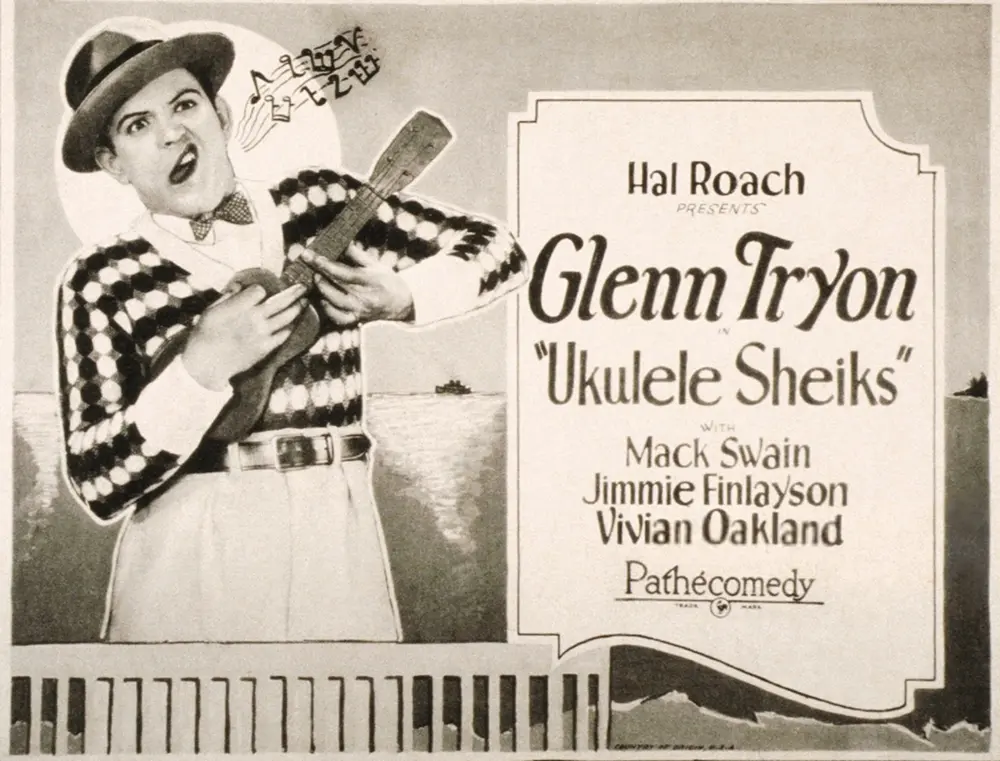
Is Ukulele Sheiks worth watching today? Short answer: yes, but with a significant asterisk. This frenetic silent comedy offers a fascinating, often hilarious, glimpse into the slapstick sensibilities of its time, though its narrative thinness and relentless pace might test the patience of modern viewers.
It is undeniably a film for enthusiasts of early cinema, particularly those who appreciate physical comedy and the raw, unpolished energy of the era, but it is emphatically not for those seeking deep character development or a meticulously crafted plot.
This film works because of its unbridled energy and the sheer commitment of its lead performers, particularly Glenn Tryon's athletic absurdity. It fails because its plot, while serving as a vehicle for gags, often feels secondary to the relentless chase, lacking emotional stakes or genuine character arcs. You should watch it if you have an appreciation for the historical context of silent film, enjoy broad physical comedy, and are willing to overlook narrative shortcomings for moments of pure, unadulterated farce.
From its opening moments, Ukulele Sheiks announces itself as a film primarily concerned with motion. The narrative, penned by H.M. Walker, functions less as a story and more as a springboard for a series of escalating chases and physical gags. This is pure, unadulterated slapstick, a genre that thrived in the silent era, and the film leans into it with gusto.
The pacing is relentless, a rapid-fire succession of events designed to keep the audience breathless. Glenn’s initial escape from his father, Mack, in nothing but his BVDs, sets a tone of immediate, almost desperate, urgency. There’s no time for contemplation; only action. This kinetic energy is both the film’s greatest strength and, for some, its most significant hurdle.
The film’s tone is lighthearted and chaotic, embracing the absurd with open arms. When Vivien’s car careens out of control, the scene isn’t designed to invoke genuine fear but rather to set up Glenn’s heroic (and comically convenient) intervention. This establishes a world where consequences are fleeting and the next gag is always just around the corner.
The shift to the shipboard setting amplifies this sense of confined chaos. The boiler room sequence, where Jimmie is mistakenly put to work, becomes a grimy playground for further misunderstandings and physical comedy. It’s a testament to the era’s filmmaking that such a simple premise could sustain so much frantic energy.
The success of any silent comedy hinges almost entirely on the expressiveness and physical prowess of its cast, and Ukulele Sheiks is no exception. Glenn Tryon, as the lovestruck protagonist Glenn, is a whirlwind of youthful exuberance and athletic desperation. His performance is a masterclass in silent-era physicality, combining earnestness with outright lunacy.
Tryon’s ability to convey Glenn’s instantaneous infatuation with Vivien, followed by his relentless pursuit, is commendable. Consider his facial expressions when he first sees Vivien; they communicate an entire world of adoration without a single spoken word. His subsequent actions, from saving her to stowing away on her honeymoon ship, are driven by this almost childlike, yet utterly determined, obsession.
Mack Swain, as the enraged father, provides a fantastic comedic foil. His bulk and bluster are perfectly suited to the role of the perpetually annoyed patriarch. The image of him chasing Glenn, particularly in the confined spaces of the ship’s engine room, is genuinely humorous, highlighting the generational clash through physical comedy. His determination to 'teach the youngster a lesson' is a classic trope, here executed with a delightful, almost cartoonish, ferocity.
Vivien Oakland, as the object of affection, Vivien, navigates her role with a charming blend of innocence and understated exasperation. She’s not just a damsel in distress; her reactions to Glenn’s intense declarations and Jimmie's predicaments provide a grounded, albeit still comedic, counterpoint to the male characters' antics. Her performance is less about grand gestures and more about subtle reactions that anchor the chaos.
James Finlayson, as Jimmie, brings his signature bewildered charm. Mistaken for a stowaway and relegated to the boiler room, Finlayson’s wide-eyed confusion and frantic attempts to escape are highlights. His comedic timing, even without dialogue, is impeccable, turning what could be a bland plot device into a source of genuine amusement. The scene where he first finds himself covered in coal dust is a perfect example of his ability to elicit sympathy and laughter simultaneously.
H.M. Walker’s direction in Ukulele Sheiks is marked by a clear understanding of silent comedy’s demands: keep it moving, keep it clear, and exploit every physical opportunity. The film’s visual language is straightforward, prioritizing action over stylistic flourishes. This isn't a film trying to be avant-garde; it's a film trying to make you laugh through sheer momentum.
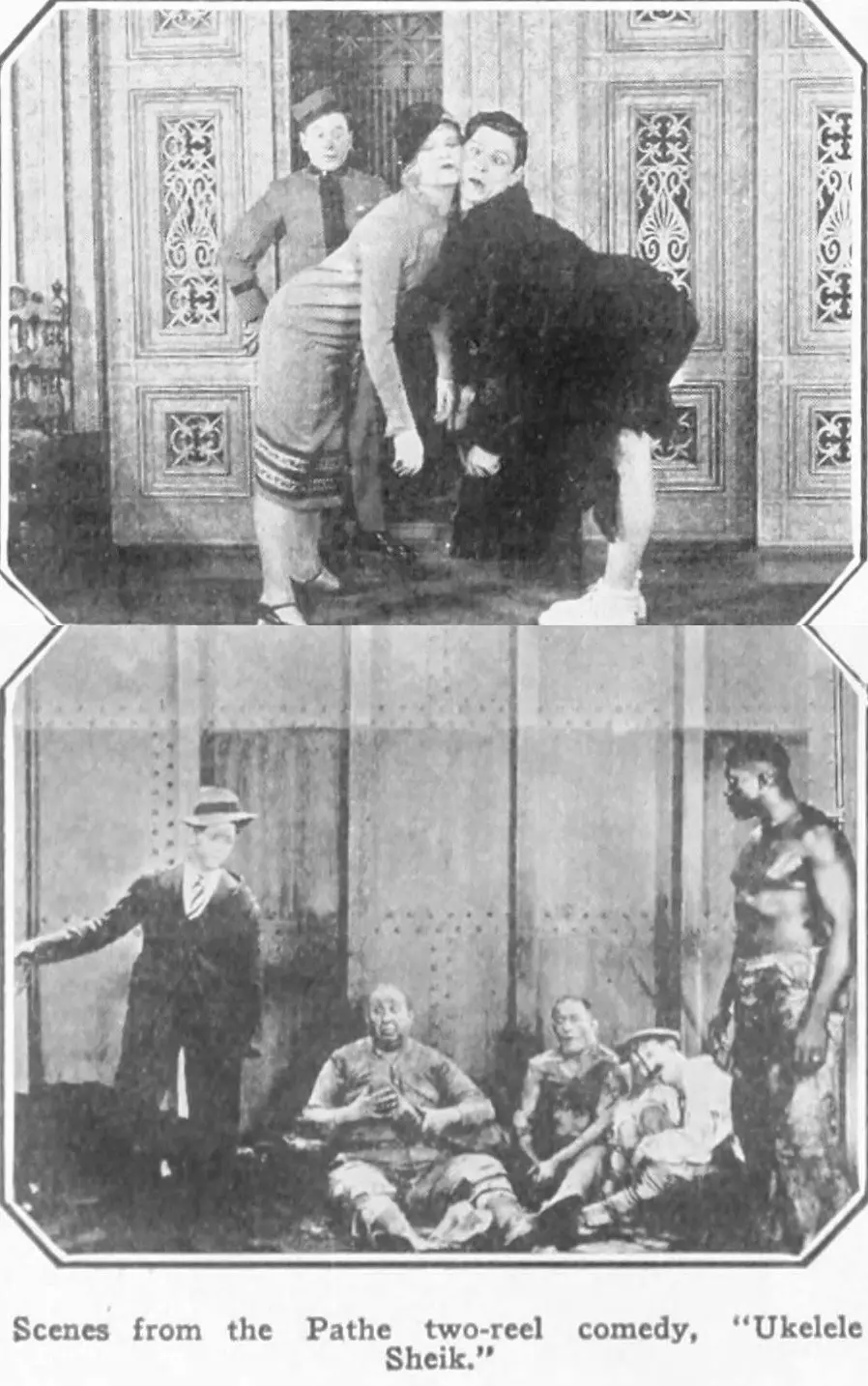
The cinematography, while not groundbreaking, is effective in conveying the frantic energy. Shots are generally wide enough to capture the full scope of the physical gags, allowing the audience to appreciate the choreography of the chases. There’s a particular effectiveness in the way the camera captures the confined spaces of the ship, making the pursuit feel even more desperate and inescapable.
Editing is brisk, cutting between concurrent chases and reactions to maintain a high level of tension and comedic timing. The sequence where Glenn, his father, and Jimmie are all independently moving through the ship, often just missing each other, is a testament to the editor’s ability to weave together multiple threads of action into a cohesive, if chaotic, whole. Intertitles are used sparingly but effectively, primarily to advance the plot or deliver key lines of dialogue, ensuring the visual comedy remains paramount.
One surprising observation: despite the title, the ukulele itself plays virtually no role in the narrative. This suggests the title was more a nod to the prevailing cultural zeitgeist of the 'sheik' era, implying a certain youthful, perhaps rebellious, spirit rather than a literal musical element. It’s an interesting misdirection that speaks to the marketing sensibilities of the time, focusing on an evocative image rather than strict plot accuracy.
While Ukulele Sheiks excels in its physical comedy and relentless pacing, its narrative depth is, by modern standards, exceptionally thin. The plot serves almost exclusively as a framework for gags, with character motivations rarely extending beyond primal urges: love, anger, and escape. This isn't necessarily a flaw for a film of its type and era, but it’s a crucial distinction for contemporary viewers.
The 'boy chases girl' trope is central, but here it's taken to an almost absurd extreme. Glenn's instant declaration of love and subsequent pursuit of a woman he barely knows, even onto her honeymoon, is less about romance and more about a comedic exploration of infatuation. There's no real emotional arc for Glenn; his desire for Vivien is a constant, unwavering engine for the plot's progression.
The father's role is equally one-dimensional: the embodiment of parental authority and a source of comedic opposition. His relentless pursuit of Glenn is driven by a simple, stated desire to 'teach the youngster a lesson,' providing a clear, if unsophisticated, antagonist for Glenn's romantic quest. This simplicity allows the audience to focus entirely on the physical comedy without being bogged down by complex character dynamics.
Some might argue that the film's refusal to delve into deeper character motivations is a missed opportunity, especially given the potential for comedic tension between the three main pursuers. However, to critique Ukulele Sheiks for its lack of narrative complexity is akin to critiquing a roller coaster for not being a leisurely stroll. Its purpose is to thrill, to excite, and to provoke laughter through sheer, unadulterated velocity. It works. But it’s flawed.
Yes, Ukulele Sheiks holds significant value for today’s audience, but primarily as a historical document and an exemplar of early silent comedy. It offers a clear window into the comedic sensibilities and filmmaking techniques of its era. For those interested in the evolution of film, it's a fascinating watch.
It's a testament to the raw energy and physical artistry of silent performers like Glenn Tryon and Mack Swain. The film's relentless pace and commitment to physical gags can still elicit genuine laughs, even a century later. However, its narrative simplicity means it might not resonate with viewers accustomed to more intricate storytelling.
It is an enjoyable, albeit brief, foray into a bygone era of cinematic entertainment. It’s a film that demands an appreciation for its context rather than a purely contemporary viewing lens. It’s not a lost masterpiece, but it’s far from a forgettable curio.
Ukulele Sheiks is a boisterous, if somewhat shallow, relic of the silent comedy era. It doesn't aim for the sophisticated character work of a Chaplin or the elaborate stunts of a Keaton, but rather revels in pure, unadulterated farce. Its charm lies in its relentless energy and the committed, often hilarious, physical performances of its cast, particularly Glenn Tryon's athletic desperation and Mack Swain's blustery pursuit.
While its narrative is little more than a vehicle for gags, and its constant, breakneck pace can occasionally feel more exhausting than exhilarating, the film remains an important historical artifact. It offers a valuable glimpse into the unpretentious, high-energy entertainment that captivated audiences nearly a century ago. It’s a film that asks little of its viewer beyond a willingness to embrace its specific brand of chaotic joy.
For those who appreciate the foundational elements of cinematic comedy and the sheer physicality of silent-era acting, Ukulele Sheiks is a worthwhile, if not essential, viewing experience. It's a testament to the enduring power of a well-executed chase and a perfectly timed pratfall. Go in with an open mind and an appreciation for its historical context, and you might just find yourself swept up in its delightful, if slightly dated, madness.
IMDb 5.1
1931
Community
Log in to comment.