DbcultAccessing Vault...
Cult Review
Senior Film Conservator
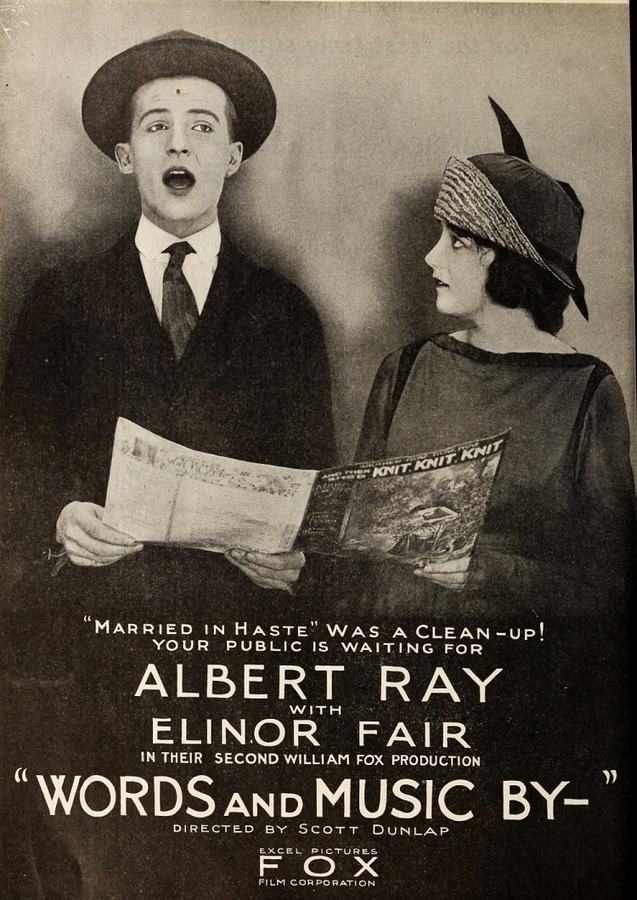
When the silver screen of the early 1930s turned its gaze toward the American heartland, few pictures managed to capture the paradox of ambition and authenticity as deftly as Words and Music By. Directed by the collaborative duo of William Charles Lengel and Charles Kenyon, the film unfolds like a lyrical overture, each scene a distinct movement that together compose a resonant symphony of love, betrayal, and artistic redemption.
The narrative catalyst arrives in the form of Thomas Sullivan (Albert Ray), an impresario whose itinerant spirit mirrors the restless energy of the era’s burgeoning entertainment industry. Sullivan’s arrival in Ossawatomie, Kansas, is not merely a plot device; it is a metaphorical bridge between provincial earnestness and metropolitan glamour. He is a man who believes that raw talent, once polished by the right mentor, can transcend geographic and socioeconomic boundaries.
Enter Millicent Lloyd (Elinor Fair), a vocalist whose timbre carries both the innocence of small‑town life and the latent power of a future star. Her audition piece, a tender ballad authored by her boyfriend Brian McBride (Edwin B. Tilton), is more than a love song—it is a manifesto of artistic yearning. The chemistry between Millicent and Brian is palpable, their shared glances and whispered rehearsals hinting at a partnership that could redefine both their destinies.
Sullivan’s decision to whisk Millicent away to New York City is executed with the brisk efficiency of a seasoned show‑man. The transition from the dusty streets of Kansas to the neon‑lit avenues of Manhattan is rendered with a visual contrast that underscores the film’s central theme: the collision of authenticity with commercial spectacle. In New York, Millicent’s ascent is swift; her voice, now amplified by sophisticated orchestration and savvy publicity, becomes a household name. Yet, the film never loses sight of her humble origins, a narrative anchor that prevents her stardom from feeling hollow.
Parallel to Millicent’s meteoric rise, Brian arrives in the city bearing an opera—a work of grandiose ambition that reflects his own internal struggle between modesty and greatness. He chooses anonymity, a strategic concealment that allows his composition to be judged on merit rather than personal connections. This decision, however, sets the stage for the film’s most compelling moral dilemma.
Gene Harris (Eugene Pallette), the playwright who initially inspired Sullivan’s Kansas venture, becomes the story’s antagonist not through overt villainy but through a desperate act of creative theft. Unable to complete an opera of his own, Harris pilfers Brian’s manuscript, presenting it as his own to Sullivan. The deception is executed with a smoothness that mirrors the cut‑and‑paste techniques of early Hollywood studios, where ideas were often recycled without attribution. Sullivan, blinded by the opera’s brilliance, casts Millicent in the lead role, unwittingly becoming a pawn in Harris’s scheme.
The tension reaches its apex when Gus Hertz (Robert Bolder), a savvy music publisher, enters the fray. Hertz’s role is pivotal; he embodies the industry’s capacity for both exploitation and redemption. By aligning with Brian, Hertz not only exposes Harris’s plagiarism but also restores artistic integrity to the narrative. Their collaboration is a masterclass in how external allies can catalyze personal vindication, a theme that resonates with contemporary discussions about whistleblowing and intellectual property rights.
When the truth surfaces, the film delivers a cathartic reunion between Millicent and Brian. Their reconciliation is not merely romantic; it is an affirmation of mutual respect for each other’s creative visions. The opera, now rightfully credited, enjoys a triumphant run, its success serving as a testament to the power of authenticity over artifice. The final curtain call is both a literal and figurative celebration of perseverance, echoing the film’s title in a literal sense—words (the libretto) and music (the score) finally harmonize.
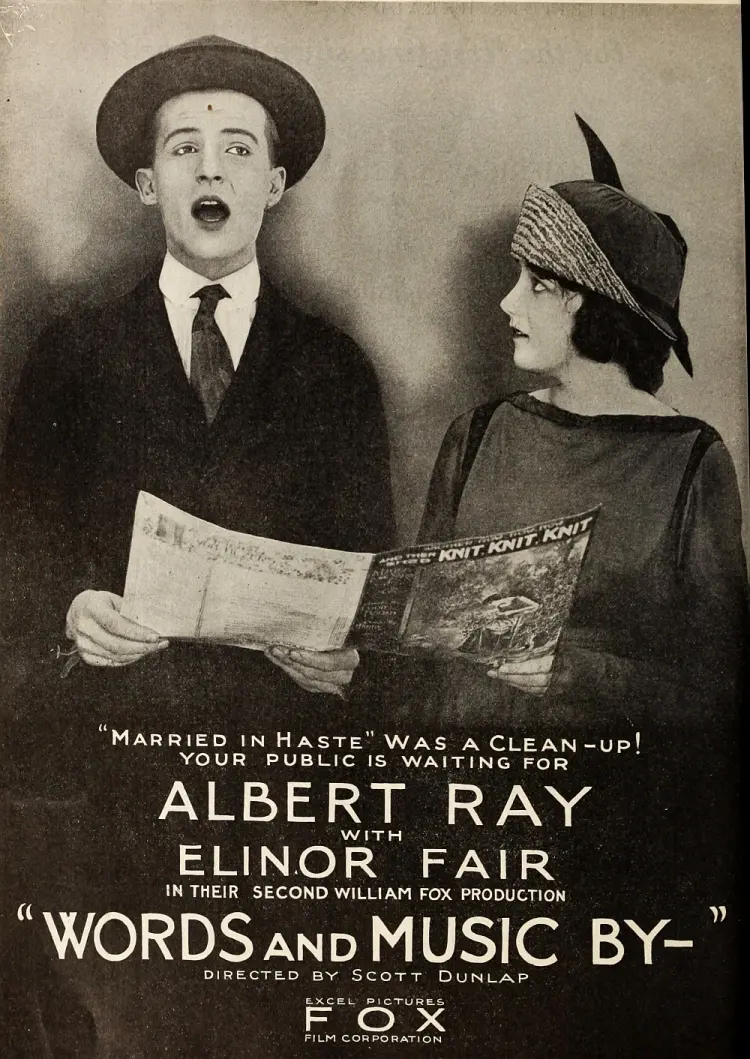
From a technical standpoint, the film’s cinematography employs chiaroscuro lighting to accentuate the stark contrast between Kansas’s sun‑baked horizons and New York’s shadow‑laden studios. The use of deep focus shots during Millicent’s performance sequences allows the audience to appreciate both her emotive facial expressions and the orchestral backdrop, a technique reminiscent of the visual language employed in A Kiss for Susie and The Home Trail. Moreover, the sound design—remarkably clear for its era—captures the nuanced timbre of Fair’s vocal performance, ensuring that the musical numbers remain the film’s emotional core.
The ensemble cast delivers performances that are both nuanced and resonant. Albert Ray’s portrayal of Sullivan balances charisma with a subtle undercurrent of opportunism, preventing the character from descending into caricature. Elinor Fair’s Millicent is a study in controlled passion; her vocal crescendos are matched by restrained body language, suggesting a woman who has learned to navigate the treacherous waters of fame without losing her essence. Edwin B. Tilton’s Brian, while occasionally overshadowed by the film’s larger-than-life musical set pieces, provides a grounded counterpoint—a man whose quiet determination anchors the narrative’s moral compass.
The screenplay, penned by William Charles Lengel and Charles Kenyon, excels in its layered dialogue. Lines such as “A song is a promise, a note a vow” (delivered by Millicent) encapsulate the film’s thematic preoccupation with the sanctity of artistic expression. The script’s pacing is deliberate; it allows moments of introspection to breathe between the more flamboyant musical interludes, a structural choice that mirrors the ebb and flow of an actual opera.
When contextualized within its historical period, Words and Music By offers a window into the 1930s cultural zeitgeist. The Great Depression had forced many artists to confront the tension between commercial viability and creative integrity—a conflict embodied by Harris’s theft and Brian’s eventual triumph. The film’s resolution, wherein honesty prevails, can be read as an aspirational narrative for audiences yearning for moral clarity amidst economic uncertainty.
Comparatively, the film shares thematic DNA with The Dawn of a Tomorrow, where personal sacrifice and artistic ambition intersect, and with Her Greatest Performance, which also explores the cost of fame on intimate relationships. However, Words and Music By distinguishes itself through its meta‑commentary on the music publishing industry—a layer often absent in its contemporaries.
In terms of legacy, the film may not have achieved the iconic status of later musical epics, yet its influence can be traced in the narrative structures of modern cinema that grapple with plagiarism, artistic ownership, and the dichotomy between rural authenticity and urban sophistication. Its nuanced portrayal of a female protagonist who navigates fame without surrendering her agency anticipates later feminist readings of classic Hollywood.
Ultimately, Words and Music By stands as a compelling artifact of its time—a film that marries melodious spectacle with a thoughtful examination of the ethical dimensions of creation. Its 150‑minute runtime (including intermissions) is justified by a script that never feels padded, a score that never feels superfluous, and performances that remain emotionally resonant decades later. For cinephiles interested in the evolution of the musical drama genre, this film offers both a nostalgic journey and a timeless lesson: that the truest art is born of honesty, collaboration, and an unwavering belief in one’s own voice.
If you are intrigued by the interplay of ambition and integrity, consider exploring other period pieces such as The Hellion or the atmospheric The Haunted House, each of which, in its own way, interrogates the cost of artistic pursuit. Yet none capture the delicate balance of song and story quite like Words and Music By, a film that reminds us that when words and music finally align, the result is nothing short of transcendent.
IMDb —
1922
Community
Log in to comment.