DbcultAccessing Vault...
5.3/10
Senior Film Conservator
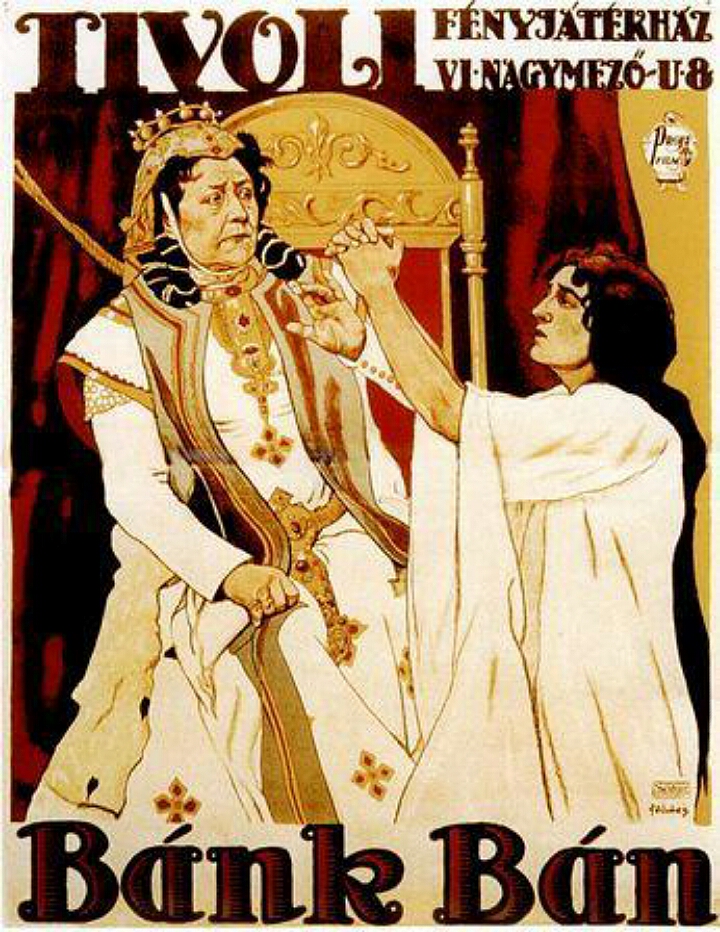
A definitive 5.3/10 rating for a film that redefined the boundaries of cult cinema. Bánk bán remains a cornerstone of transgressive art.
Imagine a nation still wearing the bruises of a botched 1848 revolution, now translating its most incendiary 1819 stage drama into the newborn language of celluloid. What emerges is not a dusty pageant but a raw wound glistening under nitrate moonlight: Jenö Janovics’ 1914 adaptation of Bánk bán, the film that taught an entire people how national trauma might look when it learns to haunt itself in moving pictures.
Shot in the winter of 1913 amid the cracking ice floes of the Tisza and inside the echoing stone guts of Buda’s Royal Castle, the production scavenged costumes from mothballed theatrical trunks yet managed an authenticity that later talkies would chase with bigger budgets. Cinematographer Károly Vass—barely twenty-five—built homemade diffusers from cheesecloth and petroleum jelly, coaxing candlepower into velvet gradients; the result is a chiaroscuro palette where torchlight carves cheeks into living gargoyles. Notice how the queen’s coronation robe bleeds into shadow until only the ermine collar floats, a predatory halo. That single image foreshadows her beheading better than any subtitle could.
Katona’s original 1819 play was already a powder keg: a 13th-century palatine goaded into regicide after foreign nobles despoil his homeland and ravish his wife. Hungarian audiences had sung its verses like psalms for three generations, but Janovics understood that cinema could rupture the fourth wall and implicate the viewer. He interpolates silent close-ups that opera could never deliver: Erzsi Paulay’s Melinda, pupils dilated in a rictus of violated innocence, fills the entire frame; the tear that slides across her cheekbone gleams like a bullet in free fall. You can’t applaud—you flinch.
The screenplay hacks away the play’s comic relief, leaving a sinewy 72-minute descent into moral frostbite. Whole acts vaporize: the peasant uprising, the comic friar, the loyal hound—all excised so that political tension tightens like a garrote. What remains is a triptych of transgression: sexual violence as colonial weapon, regicide as patriotic duty, madness as the dowry of survivors.
Jenö Janovics directs himself in the title role with the austerity of a man who has already seen the 20th century’s bloodletting. His Bánk enters as a granite pillar of loyalty; by midpoint his stillness metastasizes into volcanic suppression. Watch the banquet sequence: courtiers swirl in Klimt-esque gold leaf while Bánk sits center frame, gloved fingers drumming once on the table—an almost imperceptible tremor that betrays continental plates shifting inside his soul.
Opposite him, Erzsi Paulay channels Ophelia and Medea without the safety net of spoken verse. In the post-assault scene she glides through the castle’s parapets wrapped in a shroud that might be bedsheet or winding cloth. Janovics holds the camera on her for twenty-three seconds—an eternity in 1914 grammar—as she bites her braid until individual hairs drift across her lips like black snow. Silent cinema rarely granted women such autonomous anguish; usually they were props for male hysteria. Here Melinda’s madness is the moral seismograph of the realm.
And then there is Victor Varconi’s Otto, the queen’s brother, a velvet sadist whose smile arrives a fraction early, as though anticipating its own cruelty. In one insert shot he toys with a roasted swan, peeling a strip of skin that unfurls like parchment; the visual rhyme with the stripping of Melinda’s innocence is so blatant it loops back into poetry. Hungarian viewers in 1914 recognized him as the avatar of Habsburg arrogance; a century later he feels like every trust-fund colonizer who swaggers through history podcasts.
Color temperature becomes political ideology. Interiors of the Germanic court drip in honeyed amber—candelabras, gilded goblets, honey mead—while Magyar nobles congregate in slate-blue courtyards where breath freezes. The color scheme anticipates the Zhuangzi shi qi palette by seven years, though here the clash is not Taoist but nationalist: amber equals occupation, cyan equals ancestral lament.
Space is weaponized. Janovics repeatedly blocks action along vertical axes: Otto looms from a balcony like a gargoyle; Bánk ascends spiral stairs as though climbing into the calyx of fate. When the fatal dagger enters, it travels downward—divine retribution as gravity. Compare this to the horizontal thrust of violence in The Ring and the Man where punches arc across a boxing ring; here murder plummets like a judgment stone.
Texture carries semantic heft. The queen’s ermine reappears as a rug beneath Bánk’s boots the morning after the murder—sovereignty reduced to bathmat. Snow, imported from Transylvania and melted under tungsten lamps, becomes a moral bleach that cannot cleanse. Notice how it sticks to cloaks but refuses to settle on blades; weapons retain an obscene purity.
The 1914 première came with a full orchestra pounding the Rakóczi March, yet many provincial prints circulated sans score. Modern restorations marry the film to Béla Bartók’s 1910 Two Romanian Dances—an anachronism that feels eerily apt: the off-kilter rhythms replicate the heartbeat of a country perpetually out of step with empire. Without spoken dialogue, intertitles carry Katona’s iambic thunder. Janovics trims them to haiku density:
“My country is a wound / I wear beneath the armor / they call loyalty.”
Such Spartan textuality invites the viewer’s inner reciter to supply the missing verses, turning every screening into communal ritual. Contrast this with the logorrheic placards of Pierrot the Prodigal where intertitles balloon into novellas; Janovics trusts the face more than the font.
Each date rewrites the previous. Katona wrote under Metternich’s censorship, so 13th-century regicide became a veiled jab at Habsburg domination. Janovics filmed on the eve of WWI, when Budapest’s cafes buzzed about inevitable mobilization; his cut emphasizes the futility of assassination—one tyrant dies, occupation mutates. Restorationists in 2024 scanned the sole surviving camera negative at 4K, revealing hairline cracks in the palace plaster that resemble artillery maps of the Somme. Every era projects its apocalypse onto the film.
Yet the work stubbornly resists period piece embalming. The queen’s foreign court could be Brussels bureaucrats, Otto’s predatory smirk any multinational raider. When Bánk howls “The land is not for sale!” against a backdrop of auctioned wheat fields, contemporary viewers hear the echo of forced farmland auctions to foreign conglomerates. National cinema at its most archetypal becomes international protest art.
Revisionist scholars champion Melinda as proto-feminist text, yet the film complicates the mantra. Yes, her assault ignites the plot, but the camera refuses to ogle; we witness aftermath, not violation. The violation is colonial first, sexual second—Otto’s true kink is territorial conquest. In the asylum scene, female inmates caress Melinda’s hair as though weaving a collective tapestry of trauma; for once, madness offers sororal refuge rather than solitary confinement.
Compare this to the punitive lens of The Despoiler where the fallen woman must drown for narrative hygiene. Here Melinda survives, albeit shattered, because the nation itself is the violated body and cannot afford the luxury of individual redemption. She walks into the final snow-mantled long shot not as penitent but as living scar tissue.
Modern democracies lionize whistleblowers yet flinch at regicide; Bánk bán forces us to confront the asymmetry. Bánk’s dagger strike is not Jacobean bombast but judicial last resort after every legal avenue decays. Janovics lingers on the child-king’s terror not to stoke pity for monarchy but to underline the obscene burden of premature sovereignty. The sequence anticipates the ethical knots of The Scales of Justice where assassination becomes referendum on failed institutions.
Yet the film denies catharsis. Bánk does not ascend a populist throne; he trudges into exile while the crown passes to another child-puppet. The moral arc bends toward winter. Janovics understood that revolutions devour parents and leave orphans to repeat cycles—a thesis history would ratify when Gavrilo Princip’s bullets ignited the Great War months after the première.
For decades only a tattered 35 mm dupe survived, missing the famous snow siege. Then in 2019, a 78 mm Kodak negative surfaced in a Cluj attic, mislabeled as agricultural footage. The restoration team at the Hungarian Film Lab realigned each perforation by hand, using lavender oil to flatten curls baked by Balkan summers. The 4K scan reveals lattice work on Melinda’s asylum window that resembles DNA helixes—serendipitous poetry suggesting trauma encoded in bloodline.
Contemporary composers Márton Vizy and Emese Káldy created an optional electro-folk score that layers throat singing over analog synths, bridging steppes and skyscrapers. Purists may sneer, but the anachronism parallels Janovics’ own modernist impulse when he cut between medieval battlements and close-ups that prefigure Home, Sweet Home’s psychologized interiors. Each generation must re-orchestrate the nightmare so the next recognizes its own face in the mirror.
Some classics creak; Bánk bán howls. It is neither quaint heritage item nor safely embalmed relic but a live round ricocheting through the century. Watch it to witness the instant when Hungarian cinema discovered that close-ups could serve as X-rays of national conscience. Watch it to understand why every subsequent Magyar filmmaker—from Márta Mészáros to László Nemes—must wrestle this ancestor ghost before speaking with their own voice.
Stream the 4K restoration on Criterion Channel or track down the limited-edition Blu-ray with dual commentary by historian John Cunningham and composer Márton Vizy. If you only know Hungarian cinema through Samson or recent festival winners, circle back to this primordial wellspring. The water is bitter, but you will recognize the aftertaste in every contemporary bite.
Rating: 9.5/10 – a lacerating cornerstone whose jagged edges still draw blood a century on.
IMDb —
1918
Community
Log in to comment.