DbcultAccessing Vault...
Cult Review
Senior Film Conservator
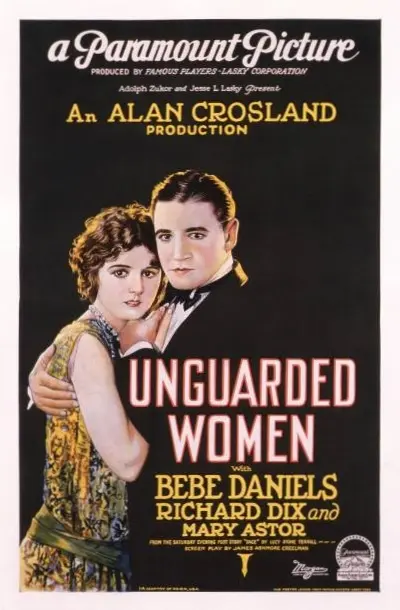
There is a peculiar, almost suffocating intimacy in the way 1920s cinema handled the concept of the 'broken soldier.' In Unguarded Women (1924), we aren't presented with the typical swashbuckling heroics often associated with Richard Dix. Instead, we witness the erosion of a man’s soul. Douglas Albright, portrayed with a brooding intensity by Dix, is a vessel for the collective trauma of a generation that survived the trenches only to find the peace of the home front utterly alien. This film, directed by Alan Crosland, navigates the murky waters of survivor's guilt with a dexterity that feels surprisingly modern, eschewing the simple flag-waving of its contemporaries for something far more lugubrious and profound.
The narrative doesn't shy away from the jagged edges of Albright’s conscience. His buddy’s death isn't just a plot point; it’s a character in itself, a silent, accusing presence that follows him from the mud of Europe to the high-stakes boardrooms of New York. When we compare this to the spiritual transformations found in Revelation, we see a shift from divine intervention to internal pathology. Albright isn't looking for God; he’s looking for a way to live with himself, a task that proves far more Herculean than any wartime feat.
The shift in setting to China serves as a brilliant visual metaphor for Albright’s displacement. In the silent era, the 'Orient' was often used as a shorthand for the exotic or the dangerous, but here, it functions as a purgatorial space. It is a land where Albright hopes to shed his American identity and the expectations of his social class. However, the arrival of Mary Astor as the friend’s widow shatters this illusion of escape. Astor, even in this early stage of her career, possesses a haunting fragility. She represents the living consequence of Albright’s perceived failure. Her presence is a mirror, reflecting his guilt back at him with a clarity he cannot endure.
Their interactions are fraught with a tension that transcends the written word. This isn't a romance; it’s a transaction of grief. Albright’s offer to marry her and abandon his fiancée, Helen (the luminous Bebe Daniels), is a staggering act of self-flagellation. He is willing to immolate his own future happiness on the altar of a dead man’s memory. This thematic weight reminds me of the heavy moral choices in Big Happiness, where identity and duty collide in ways that defy easy resolution. In Unguarded Women, the stakes feel even more visceral because they are rooted in the irreversible finality of death.
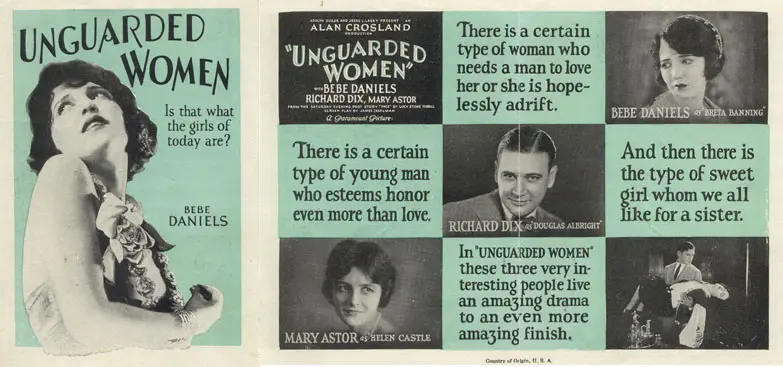
While Richard Dix provides the film's tortured center, Bebe Daniels offers its heartbeat. As Helen, she is tasked with portraying a woman whose love is being bartered away by a man she barely recognizes anymore. Daniels, often remembered for her more vivacious roles, brings a grounded, quiet strength to this performance. She isn't merely a passive victim of Albright’s whims; she is the anchor of reality in his sea of delusions. Her patience is not a sign of weakness, but a profound demonstration of emotional endurance.
Compare her role here to the more whimsical or tragic heroines in Miss Dulcie from Dixie or the heightened melodrama of Stolen Moments. Daniels manages to imbue Helen with a sense of agency that was often lacking in silent-era fiancées. She understands Albright’s trauma better than he does, and her willingness to wait—and eventually forgive—is the film’s true moral compass. The chemistry between Dix and Daniels is palpable, making the threat of their separation genuinely painful for the audience.
The visual storytelling in Unguarded Women is a masterclass in using light and shadow to convey internal states. James Ashmore Creelman’s writing, combined with Crosland’s direction, utilizes the 'unguarded' moments of the title—the flickers of doubt, the downward cast of eyes, the stiffening of a shoulder—to tell a story that title cards could never fully capture. The scenes in China are particularly striking, utilizing the architecture and the play of light through lattice-work to create a sense of entrapment. Albright is a prisoner of his own mind, and the sets reflect this claustrophobia beautifully.
There is a certain 'European' quality to the film’s gloom, reminiscent of the darker themes explored in Hilde Warren und der Tod. While American films of 1924 were beginning to lean into the 'Roaring Twenties' optimism, this production remains stubbornly, and effectively, somber. The suicide of the widow is handled with a stark, unsentimental gravity that was rare for Paramount at the time. It isn't played for cheap shock; it is presented as the only logical conclusion for a woman who refuses to be a living monument to another man’s guilt.
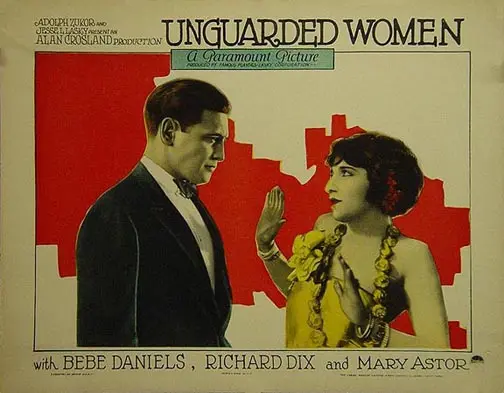
To understand the impact of this film, one must look at the supporting cast. Harry Mestayer and Donald Hall provide a social framework that highlights Albright’s isolation. They represent the world that expects him to 'just get over it,' a sentiment that remains depressingly relevant. The business aspects of the plot, which could have been dry, are used to show Albright’s attempt to find structure in a world that has lost its meaning. His failure to find peace in work leads him to the desperate conclusion that only a total sacrifice of his personal happiness can balance the scales of fate.
This narrative arc mirrors the complexities found in La faute d'Odette Maréchal, where the consequences of a single moment ripple out to destroy multiple lives. In Unguarded Women, the 'fault' isn't a moral lapse, but a perceived one. Albright is punishing himself for a crime he didn't commit, which makes his journey all the more tragic. The film asks us: how much do we owe the dead? And at what point does honor become a form of madness?
As the film reaches its conclusion, the resolution feels less like a 'happy ending' and more like a weary truce with life. Albright returns to Helen not as the man he was, but as a man who has finally looked into the abyss and survived the fall. The suicide of the widow, while tragic, is the catalyst for his liberation. It is a harsh, almost Darwinian resolution that strips away the pretenses of his guilt-driven fantasy and forces him back into the present.
Looking back at It Happened to Adele or the more rugged narratives of Colorado, we can see how Unguarded Women stands apart. It is a sophisticated, adult drama that treats its audience with respect, refusing to offer easy answers to the complexities of war trauma and romantic obligation. The performances of Dix, Daniels, and Astor are a testament to the power of silent acting—where a single look can convey a lifetime of regret.
In the grand tapestry of 1920s cinema, this film occupies a unique space. It is a bridge between the Victorian morality of the previous decade and the burgeoning psychological realism of the 1930s. It deals with the 'unguarded' parts of the human experience—the moments when our defenses fail, and we are left alone with our ghosts. For anyone interested in the evolution of the war drama or the history of silent film, Unguarded Women is an essential, albeit somber, experience. It reminds us that while the war may end on the battlefield, the struggle for the soul continues long after the guns have fallen silent. This is cinema at its most empathetic and its most unflinching.

IMDb 7.2
1931
Community
Log in to comment.