DbcultAccessing Vault...
Cult Review
Senior Film Conservator
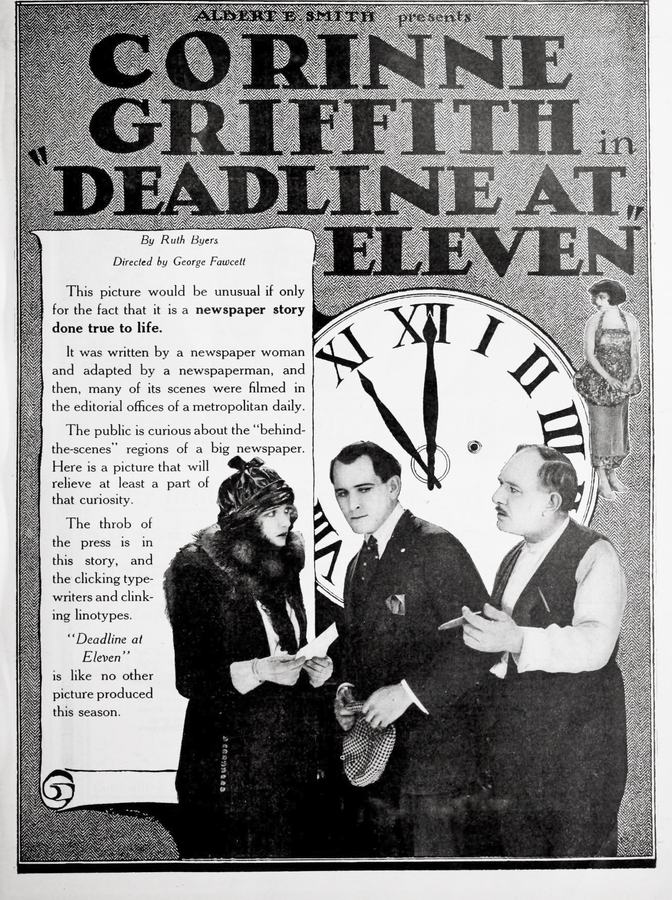
The year 1920 marked a seismic shift in the American consciousness, a temporal bridge between the Victorian vestiges of the previous century and the burgeoning audacity of the Jazz Age. Within this cultural crucible, Deadline at Eleven emerges not merely as a piece of ephemeral entertainment, but as a fascinating artifact of gender politics and journalistic mythology. Directed by the often-underappreciated Lucien Hubbard and penned by Ruth Byers, the film serves as a vehicle for Corinne Griffith—the 'Orchid of the Screen'—to pivot away from purely decorative roles into a character defined by agency, wit, and a sharp investigative instinct.
The premise of the 'slumming socialite' was a recurring trope in early silent cinema, yet here it is handled with a refreshing lack of sentimentality. When Helen Stevens (Griffith) walks into the cacophonous environment of the New York newspaper office, the atmosphere is thick with more than just tobacco smoke; it is heavy with the institutionalized misogyny of the era. Unlike the serialized heroines of Beatrice Fairfax, who navigated the perils of the city with a somewhat sanitized pluck, Stevens is subjected to a visceral derision that feels startlingly modern. The staff’s collective skepticism serves as the primary antagonist in the first act, a wall of masculine arrogance that she must dismantle through sheer competence.
Griffith’s performance is a masterclass in silent restraint. She eschews the frantic pantomime common to the period, opting instead for a subtle play of expressions that convey both her character's aristocratic poise and her burgeoning steeliness. It is a performance that anticipates the sophisticated career women of the 1930s screwball comedies, yet it remains anchored in the dramatic stakes of the silent drama.
Opposite Griffith is Webster Campbell as Jack Rawson, the quintessential 'broken' newsman. Rawson is a character study in the vulnerabilities of the era’s masculine ideal. His alcoholism is not treated as a mere comedic foil, but as a debilitating flaw that threatens to erase his humanity. The relationship between Stevens and Rawson is the emotional fulcrum of the film. It is a bond forged in the trenches of the city desk, transcending the typical romantic platitudes of the time. While films like One of Many explored the moral degradation of the urban environment, Deadline at Eleven focuses on the specific psychological toll of the journalistic life.
The sequence in which Rawson stumbles upon the murder scene while in a blackout-induced stupor is one of the most effectively staged moments in the film. The cinematography utilizes shadows and tight framing to evoke a sense of claustrophobia and confusion, mirroring Rawson’s fractured psyche. Here, the film flirts with the aesthetics of what would later become noir. The rain-slicked streets and the looming threat of the gallows for an innocent man create a tension that is palpable even a century later. The psychological weight of the accusation reminds one of the haunting guilt portrayed in The Bells, though the resolution here is found through external investigation rather than internal collapse.
The narrative brilliance of the screenplay lies in how it weaponizes the 'advice to the lovelorn' column—a position usually relegated to the 'pink pages' of the newspaper—as a tool for criminal investigation. Helen Stevens transforms a marginalized role into a hub of intelligence. The letters she receives from the desperate and the discarded become the breadcrumbs that lead her to the truth of the missing girl and the subsequent murder. This subversion of the 'woman’s page' is a powerful thematic statement on the value of domestic and emotional intelligence in the public sphere.
In comparison to the gritty realism found in Appearance of Evil, Hubbard’s direction in Deadline at Eleven maintains a certain polished elegance. The New York of the film is both a place of danger and a place of opportunity, a dualism that was central to the American mythos of the 1920s. The pacing is brisk, avoiding the sluggishness that often plagues silent features of this length. The transition from the newsroom banter to the high-stakes mystery is handled with a narrative dexterity that keeps the viewer engaged without sacrificing character development.
The supporting cast provides a rich tapestry of early 20th-century types. Alice Calhoun and Maurice Costello bring a gravitas to their roles, grounding the more sensational elements of the plot. James Bradbury Jr. and Dodson Mitchell round out the newsroom staff, creating a believable sense of camaraderie and conflict. The ensemble works with a synchronized energy that makes the newspaper office feel like a living, breathing entity—a character in its own right. This focus on the professional milieu as a community is a precursor to the workplace dramas that would eventually dominate television decades later.
We see echoes of the 'hero’s journey' in Rawson’s redemption, albeit a journey facilitated by the strength of a woman. Unlike the more traditional masculine heroics in The Hero of the Hour, Rawson’s salvation is a quiet, inward reformation. The final scene, where Helen brings him home to meet her mother (played by the formidable Emily Fitzroy), signifies more than just a romantic union; it represents a reintegration into the moral fabric of society. It is the ultimate 'deadline'—the point at which the chaos of the city must be reconciled with the stability of the home.
Technically, the film is a testament to the sophistication of the Vitagraph Company of America. The lighting in the night scenes is particularly noteworthy, utilizing low-key techniques to heighten the mystery. While it may not possess the experimental flair of Irrungen, it demonstrates a mastery of mainstream visual storytelling. The editing by Hubbard ensures that the parallel storylines—the search for the missing girl and Rawson’s legal peril—converge with maximum impact at the climax.
The use of intertitles in Deadline at Eleven is also worth mentioning. They are used sparingly and with a sharp, journalistic economy of language. This mirrors the setting of the film, where every word must count and the clock is always ticking. The tension of the 'deadline' is not just a plot point; it is the rhythmic pulse of the entire production.
Viewing this film in the 21st century requires an appreciation for the context of its creation. In 1920, the idea of a socialite working a 'real job' was still slightly scandalous, and the depiction of an advice columnist as a serious detective was revolutionary. The film sits comfortably alongside other contemporary dramas like Strictly Confidential or Glory, yet it distinguishes itself through its specific focus on the mechanics of the press. It captures a moment when the newspaper was the primary arbiter of truth and the most powerful tool for social change.
The film’s exploration of alcoholism and recovery also places it in conversation with works like Whom the Gods Destroy, where personal vice is treated with a mixture of melodrama and genuine concern. By allowing Jack Rawson to reform through the support of Helen Stevens, the film posits a hopeful view of human nature—one where even the most fallen can find a path back to the light through the intervention of a determined spirit.
Ultimately, Deadline at Eleven is a triumph of silent era storytelling. It manages to balance a complex plot, nuanced characterizations, and a sharp social commentary without ever feeling overstuffed. Corinne Griffith proves why she was one of the most luminous stars of her generation, providing a performance that is as intellectually engaging as it is visually captivating. The film is a reminder that the themes of truth, redemption, and the struggle for respect in the workplace are timeless.
Whether compared to the rugged adventures of The Girl Alaska or the high-stakes drama of Medicine Bend, Deadline at Eleven stands out for its urban sophistication and its proto-feminist heart. It is a vital piece of cinema history that deserves to be remembered for more than just its cast; it is a compelling, well-crafted narrative that still packs an emotional punch. As the final intertitle fades and the lights go up, one is left with the sense that Helen Stevens didn't just meet her deadline—she redefined it.
Final Rating: 8.5/10 - A Silent Masterpiece of Journalistic Intrigue
IMDb 5.8
1936
Community
Log in to comment.