DbcultAccessing Vault...
Cult Review
Senior Film Conservator
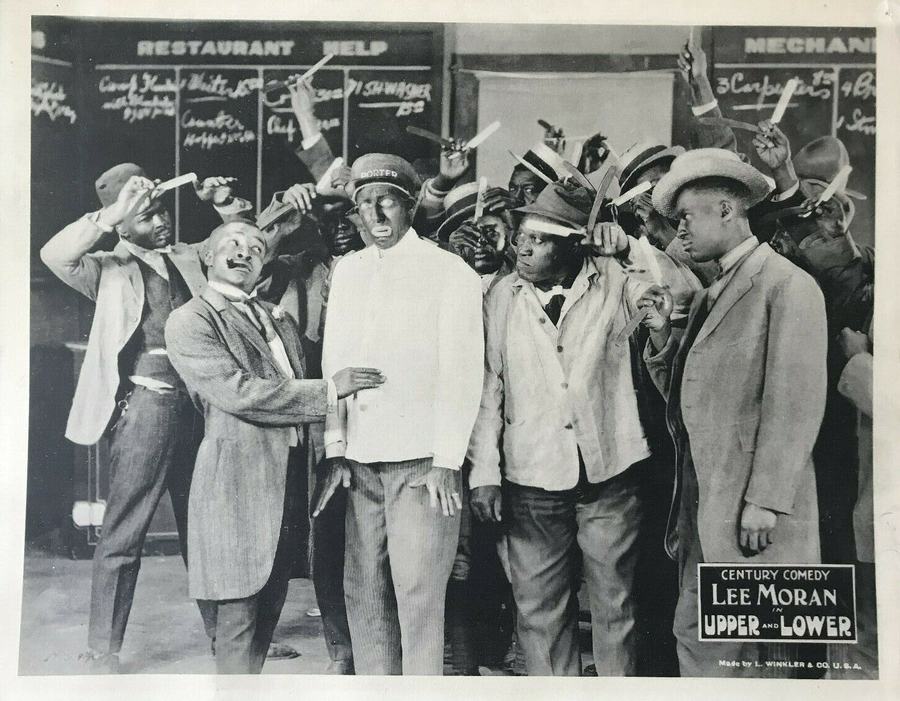
The silent era was a crucible of experimentation, a period where the boundaries between social commentary and broad slapstick were frequently blurred by the exigencies of early studio production. In Upper and Lower, directed by the prolific Alfred J. Goulding, we witness a fascinating, if occasionally jarring, intersection of fugitive anxiety and labor politics. This 1920 short film serves as a visceral document of its time, capturing the frantic energy of a world in transition, where the railway was the literal and metaphorical engine of American society.
Lee Moran, an actor whose physical vocabulary was as expansive as the landscapes he traversed, carries the weight of this narrative with a frenetic desperation. Unlike the more whimsical characters found in Sunnyside, Moran’s protagonist is driven by a primitive survival instinct. The premise—a man donning a racial disguise to evade the law—is undeniably problematic by contemporary standards, yet within the context of 1920s cinema, it represents a common, albeit reductive, trope of transformation and invisibility. This act of "blacking up" to join the Pullman Porters is not merely a gag; it is a narrative pivot that thrusts a white character into a marginalized labor class, creating a friction that the film explores with varying degrees of success.
The cinematic language employed by Goulding is one of constant motion. The camera, while largely static in the tradition of the time, captures a choreography of chaos. As Lee is funneled through the Pullman Porter Employment Agency, the film shifts its tone from a standard chase sequence into something more akin to the gritty urban realism found in A Romance of the Underworld. The agency itself is depicted as a labyrinth of bureaucracy and coercion, where the individual is stripped of agency and rebranded as a cog in the industrial machine.
The Pullman Strike context adds a layer of unexpected gravitas to the proceedings. While films like Fire Bugs leaned heavily into the pyrotechnics of comedy, Upper and Lower anchors its humor in the very real tensions of strikebreaking. Lee’s involuntary induction into the workforce as a "scab" is a masterstroke of situational irony. He is caught between the hammer of the law and the anvil of the striking workers, a position that requires a specific kind of comedic agility that Moran delivers with aplomb.
Alberta Vaughn and Betty May provide more than just the requisite romantic or decorative interest common to the era. Their presence suggests a world outside the immediate peril of the protagonist, offering a glimpse into the social strata that the film seeks to satirize. In many ways, the film mirrors the thematic concerns of What Would You Do?, posing a series of escalating moral and physical dilemmas that the protagonist must navigate through sheer improvisation.
Visual Analysis: The Steel and the Soot
The visual palette of the film, even in its surviving prints, evokes a sense of tactile grime. The Pullman cars are not just settings; they are characters in their own right. The narrow corridors and claustrophobic berths create a sense of entrapment that mirrors Lee’s legal predicament. This use of space is far more sophisticated than the open-air antics of The Man from Kangaroo. Here, the environment is a predatory force, a mechanical beast that demands constant attention and threatens to crush the unwary.
Alfred J. Goulding’s direction is characterized by a relentless pace. There is little room for the sentimental dallying found in David and Jonathan or the quiet introspection of The Price of Innocence. Instead, Goulding opts for a percussive editing style that emphasizes the impact of each gag and the proximity of the looming threat. The sequence on the train, where Lee must balance his duties with his concealment, is a masterclass in tension-building through repetition and variation.
One cannot discuss Upper and Lower without addressing the elephant in the screening room: the use of blackface. To the modern viewer, it is a jarring visual that complicates the enjoyment of the slapstick. However, as an art critic, one must analyze it as a tool of narrative convenience that reflects the racial hierarchies of the 1920s. Lee Moran’s character uses the disguise not for mockery in the traditional minstrel sense, but as a desperate cloak of invisibility. It highlights a paradoxical truth of the era: that a man would rather occupy the most disenfranchised position in society than face the legal consequences of his actions. This desperation is a recurring theme in Goulding’s work, often echoing the social disparities seen in Blue Blood and Bevo.
The film’s portrayal of the Pullman Porter Agency is also remarkably cynical. It depicts a system that is indifferent to the identity of its workers, so long as they can be used as fodder against the strike. This cynicism provides a sharp contrast to the more lighthearted explorations of class found in The Charming Deceiver or the Swedish sensibilities of Lika mot lika. Goulding’s America is a place of hard edges and cold steel, where the individual is constantly at risk of being ground down by the machinery of progress.
As the film reaches its crescendo, the slapstick becomes increasingly aerial and dangerous. The physical comedy here anticipates the thrill-seeking stunts that would later define the decade. Zip Monberg’s contributions to the ensemble should not be overlooked; the chemistry between the cast members creates a sense of a lived-in, albeit chaotic, world. The supporting players act as the stabilizers for Moran’s erratic energy, much like the ensemble in Niniche helps to ground the more farcical elements of that production.
Technically, the film demonstrates a keen understanding of the "short" format. Every frame is utilized to advance the plot or land a punchline. There is no wasted movement. This economy of storytelling is something that many contemporary filmmakers struggle to achieve. The way Goulding integrates the industrial landscape of the rail yards into the narrative flow is reminiscent of the logistical grandeur seen in Our Bridge of Ships, albeit on a more intimate, character-driven scale. The trains are not merely props; they are the very fabric of the film’s reality.
In comparison to Other Men's Shoes, which deals with identity through a more dramatic lens, Upper and Lower uses the "shoes" of the porter as a comedic engine. The physical discomfort of the role—the constant bowing, the heavy lifting, the navigating of the upper and lower berths—becomes a source of endless physical invention. Moran’s body becomes a site of resistance, flailing against the expectations of his assumed role while simultaneously trying to fulfill them to avoid detection.
The film also touches upon the isolation of the fugitive. Even in a crowded rail car, Lee is profoundly alone, separated from his peers by his secret and from the passengers by his disguise. This isolation is a common thread in the more melancholic silent comedies, such as A Nymph of the Foothills, though here it is played for high-stakes tension rather than pathos. The constant threat of exposure provides a rhythmic heartbeat to the film, a ticking clock that keeps the audience engaged throughout its duration.
The Verdict of History
Ultimately, Upper and Lower is a multifaceted artifact. It is a testament to the skill of Lee Moran and the directorial vision of Alfred J. Goulding. It is a snapshot of a time when the American labor movement was in a state of violent flux and when cinema was still finding its moral and aesthetic footing. While it lacks the refined elegance of Cowardice Court, it makes up for it with a raw, unbridled energy that is infectious. It is a film that demands to be seen not just as a comedy, but as a complex social document that utilizes the language of the grotesque to comment on the desperation of the human condition. For those interested in the evolution of the silent short, it remains an essential, if challenging, viewing experience that stands tall among its contemporaries.
IMDb —
1916
Community
Log in to comment.