DbcultAccessing Vault...
Cult Review
Senior Film Conservator
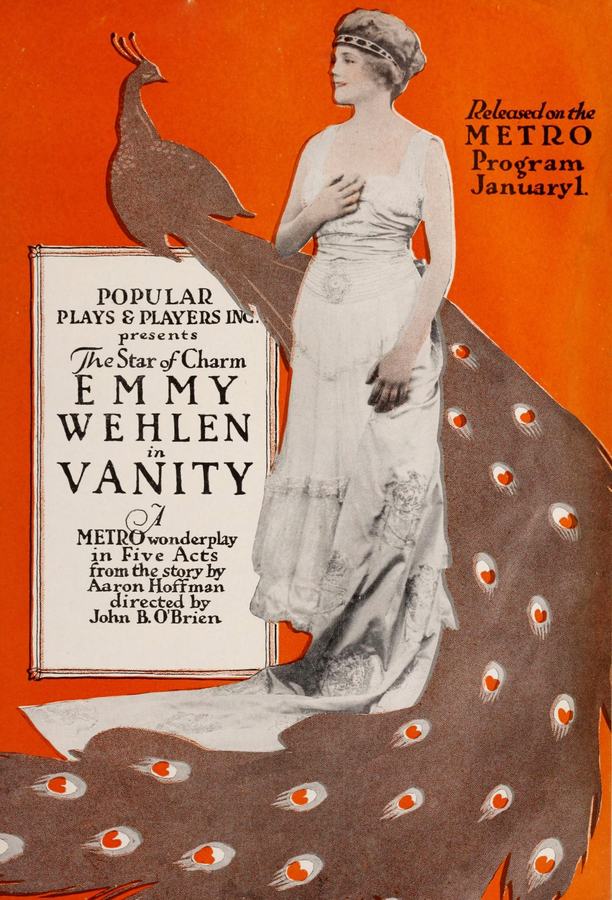
Films that survive only in cryptic 16-inch Eastman reels often feel like séances: shadows conjuring people who refused to stay properly buried. Vanity—a 1923 First National programmers’ special—arrives with that ectoplasmic aroma, yet once the projector clacks alive, its preoccupations feel eerily modern: cancel-culture extortion, performative femininity, the way memory can be Photoshopped by whoever owns the loudest megaphone. Director Donald Brantley (never canonised, always hustling) glides between gambling hells and couture salons with the same sinuous fatalism Fritz Lang would patent two years later in Destiny. The result is a moral whodunit dressed in beaded chiffon, smelling of cordite and cheap lilac.
Imagine a chessboard where every pawn has already betrayed the queen. Thirty years prior to our story, two drifters—Robert Armstrong, a cardsharp with a poet’s jawline, and Tom Mason, a miner who mistook mercy for weakness—share a saloon in some windswept nowhere. Cards fly; accusations flare; a revolver barks. When the smoke thins, only Armstrong’s monogrammed kerchief flutters above the cadaver, a planted heraldry that sentences him to fugitive life in absentia. Cut to Jazz-Age Manhattan: Armstrong now reclines on Empire furniture, but the past slips into his mail slot in the form of Mason’s letter—part reunion, part ransom note.
His only confidant is Dick, a son whose moral compass was forged in the same furnace of dread that forged Armstrong’s luck. They pass the letter like contraband, the camera dwelling on a trembling match-flame that seems to apologise for its own light. On the fateful night, Mason materialises, his face a topographical map of three decades’ resentment. The parlour lights extinguish—electricity itself complicit—and a solitary gunshot detonates. When illumination returns, Mason lies akimbo on an Aubusson rug, the bullet having exited the very history he tried to monetise. Dick, panicked yet eerily methodical, drags the corpse across manicured grass, fires Mason’s own pistol into the cooling flesh, and arranges a tableau of suicide. The camera, usually a mute observer, cranes upward as if embarrassed.
Parallel to this father-son tragedy slinks Phyllis Lord, a live-model for Martel’s boutique, whose days are spent impersonating affluence she will never taste. Brantley shoots her transformation sequences like a criminal heist: the pilfered gown sliding over corset bones, the illicit Crandell’s membership card palmed like a lockpick. Once inside the casino—an art-deco aquarium of tuxedos and predatory flappers—she gambles away her rent, then an extra fifty on the house’s credit. The moment she signs the marker, one senses shackles clicking shut. Enter Burke, ostensibly law incarnate, actually a puppeteer who smells leverage in her desperation.
Phyllis’s stint as undercover siren is staged with voyeuristic candour: the dictaphone hidden inside a chinoiserie vase, cigarette smoke curling toward a peephole. Dixie Marshall’s performance—equal parts porcelain and steel—lets us watch a conscience implode in real time. The film’s visual thesis crystallises here: women’s apparel functions both as armour and as evidence. Each silk hemline is a forged signature on the social contract; each stolen bracelet, a confession waiting to be played back at 78 rpm.
Burke believes he has engineered a perfect trap: Dick will confess to patricidal guilt, Phyllis will deliver the gramophone cylinder, and Armstrong Sr. will hang as a neat ribbon on the detective’s closed-case statistics. But Brantley has a sharper ace: Bessie Allen, a peripheral seamstress whose sickbed becomes the film’s moral fulcrum. Bessie’s posthumous letter—inked with the wobble of morphine and last rites—contains a marriage certificate proving Burke himself a bigamist. Phyllis storms into headquarters, waves the incriminating photograph like a battle standard, and barters Burke’s public decapitation for Armstrong’s signed confession. The standoff is swift, brutal, wordless: documents exchange palms, justice mutates into blackmail, the detective’s eyes glaze with the realisation that he too is expendable scenery.
The final shot—Phyllis collapsed into a chaise, arms outstretched toward a Dick who may never forgive her—echoes the Pietà while the camera retreats in an unblinking dolly, distancing us from salvation we once mistook as guaranteed.
Shot largely on soundstage interiors where shadows fall like ink into parchment, Vanity channels German Expressionism without its angular caricature. Instead, Brantley opts for a mood of velvet claustrophobia: doorways loom like guillotine arches, chandeliers drip molasses light. The tinting strategy—amber for parlour guilt, cyan for casino thrill—anticipals two-strip Technicolor affectations, yet remains monochromatic enough to feel like a fever dream.
Aaron Hoffman’s intertitles deserve a sidebar. Rather than functional placards, they read like pulp sonnets: “He gambled with tomorrow—and tomorrow collected its debt in blood.” Such baroque diction risks self-parody, yet within the film’s overheated atmosphere each card-flip aphorism lands like brimstone scripture.
Cinephiles may trace Vanity’s DNA through several strata: the gambling-parlour nihilism of Burning Daylight; the class-swap masquerades in The Gay Lord Waring; and the proto-noir fatalism later codified by A Fool There Was. Yet Brantley’s film predates them all in suggesting that American identity itself is forged debt—financial, moral, hereditary—and creditors always collect at compound interest.
Where Under the Gaslight fetishises peril to virginal lace, Vanity insists the lace was always complicit.
Archivists at MoMA resurrected a 35 mm nitrate print in 2017, funded by a Kickstarter that marketed the film as “the missing bridge between Victorian melodrama and hard-boiled crime.” A 2K scan now circulates via specialty Blu-ray labels and sporadic Kanopy rotations; streamers hunting for public-domain oddities occasionally host unrestored copies marred by water-spots, but even those scratches feel like scar tissue adding credibility.
Is Vanity a forgotten masterpiece? Not quite—its second act sags under expositive ballast, and the casino’s roulette wheel receives more visual worship than the human faces. Yet as a pre-code morality play it scalds, exposing how easily justice becomes barter, identity becomes costume, and innocence becomes collateral. It anticipates film noir by two decades, femme fatales by one, and post-MeToo reckonings by nearly a century. For that prescience alone, it deserves resurrection in any syllabus tracing American cinema’s long, exquisite affair with self-destruction.
Final tally: 8.1/10—a tarnished tiara, but still sharp enough to draw blood.
If this deep-dive thrilled you, consider supporting your regional film archive; every forgotten reel is a time-capsule waiting to rewrite the past we thought we knew.
IMDb —
1916
Community
Log in to comment.