DbcultAccessing Vault...
Cult Review
Senior Film Conservator
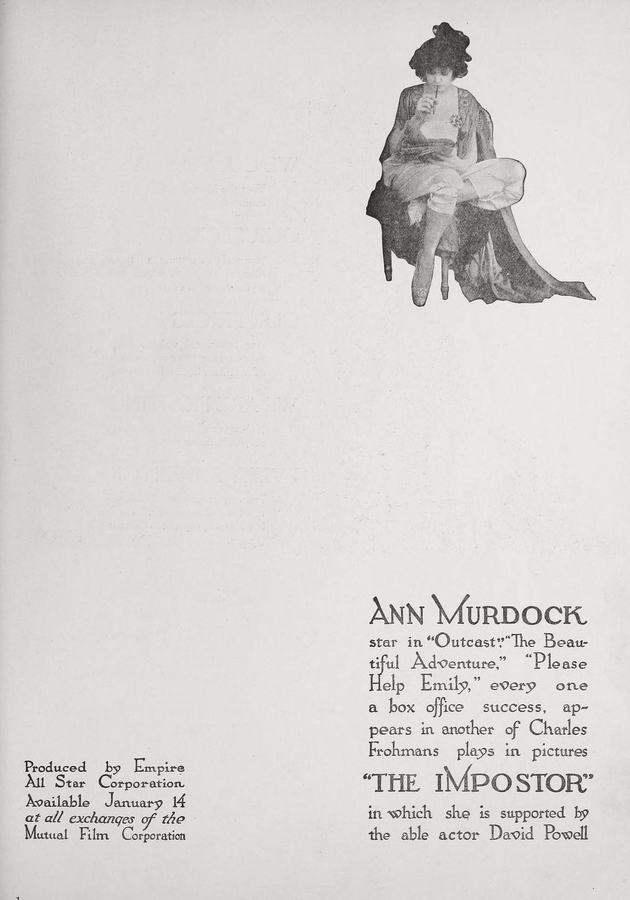
The year 1918, a tumultuous epoch marked by the waning shadows of a global conflict and the burgeoning dynamism of a new cinematic language, bore witness to the release of The Impostor. This silent drama, a poignant reflection of societal anxieties and individual aspirations, emerges from the rich tapestry of early American filmmaking as a compelling narrative of innocence lost and perhaps, against all odds, rediscovered. It's a film that, even a century later, speaks volumes about the enduring allure and inherent dangers of the urban dream, particularly for those venturing from the quietude of small-town life into the glittering, yet often deceptive, metropolis.
At its core, The Impostor is a morality play wrapped in the guise of social commentary, a story that navigates the treacherous waters of ambition and the seductive currents of deceit. Our protagonist, Mary Fenton, portrayed with a captivating blend of naiveté and burgeoning resilience by the remarkable Anna Murdock, is the quintessential small-town talent. Her voice, a beacon of purity in the local church choir, becomes her passport to what she believes is a brighter future. Murdock’s performance, a masterclass in silent film acting, conveys a spectrum of emotion – from wide-eyed optimism to crushing despair, and eventually, a quiet determination – all without uttering a single audible word. Her expressive eyes and subtle gestures are the very language of her journey, making her plight profoundly relatable.
The narrative thrust begins with the arrival of a slick, opportunistic impresario, whose honeyed words paint a vivid picture of fame and fortune awaiting Mary in New York. This figure, a common trope in stories of urban migration, represents the predatory underbelly of ambition, a stark contrast to the genuine artistic aspirations Mary holds. He promises a prestigious vocal academy, a six-month transformation into a star. It’s a classic setup, one that immediately puts the audience on edge, recognizing the inherent danger in such grand, unsupported claims. The city, then, is not merely a backdrop but a character itself – a siren call of opportunity that quickly morphs into a labyrinth of peril. This portrayal of New York as both a dream factory and a den of thieves resonates with other contemporary narratives exploring the harsh realities of urban life, much like the themes of struggle and survival found in films such as Nye dlya deneg radivshisya, which similarly grappled with the often-brutal intersection of aspirations and economic realities.
Mary’s arrival in New York is a swift descent into disillusionment. The promised school is a phantom, its doors shuttered, and her meager savings are cruelly snatched away. This sequence, devoid of dialogue, is rendered with a heartbreaking clarity through Murdock’s physical performance. Her slumped shoulders, her desperate glances, her solitary figure against the bustling backdrop of the indifferent city paint a vivid picture of utter desolation. It’s a powerful commentary on the vulnerability of the innocent in a world that often prioritizes profit over principle. Stranded and friendless on a park bench, Mary’s predicament attracts the attention of Charles Owen, portrayed by Charles Mussett. Mussett imbues Owen with a smooth, almost hypnotic charm, masking a deeply manipulative core. He offers Mary not just money and protection, but a temporary reprieve from her dire circumstances, pulling her into his orbit. This moment, while seemingly a salvation, is merely a different kind of trap, highlighting the precarious position of women in that era, often reliant on male benefactors for survival, a theme deftly explored in films like As Man Made Her, which scrutinized the societal constraints placed upon women.
Owen’s apartment, initially a sanctuary, quickly becomes the stage for a new form of deception. When his wife’s friend unexpectedly drops by, Owen, in a panicked improvisation, introduces Mary as his wealthy sister-in-law. This impulsive lie sets in motion a chain of events that catapults Mary into a world of sophisticated artifice she is ill-equipped to navigate. She is invited to the country home of the Walfords, a family embodying the genteel society Owen wishes to impress. This forced masquerade places Mary in an agonizing position, caught between the fear of exposure and the desperate need to maintain the illusion. The tension here is palpable, a silent ticking clock counting down to the inevitable revelation. The film expertly builds this suspense, allowing the audience to feel Mary’s increasing discomfort and the moral weight of her participation in the charade. The intricate web of lies and social maneuvering echoes the complex narratives of intrigue found in films like Woman Against Woman; or, Rescued in the Clouds, where hidden identities and social games drive the plot.
The inevitable unraveling occurs with the return of Owen’s unsuspecting wife. Confronted with the truth, Mary is forced to confess everything to the Walfords. This moment of truth, often the climax in such narratives, is handled with remarkable sensitivity. Instead of immediate condemnation, there’s a nuanced exploration of character and circumstance. The writers, Leonard Merrick, Anthony Paul Kelly, and Michael Morton, demonstrate a keen understanding of human nature, allowing for empathy even in the face of deceit. The Walfords, initially shocked, are portrayed not as caricatures of rigid morality, but as individuals capable of understanding the desperation that drove Mary’s actions. This nuanced portrayal elevates the film beyond a simple tale of right and wrong, delving into the complexities of moral compromise and societal pressures.
Crucially, it is young Blake Walford, played by Charles L. MacDonald, who emerges as Mary’s unlikely redeemer. MacDonald’s performance conveys a youthful idealism and genuine affection that cuts through the societal artifice. He has fallen in love not with the fabricated ‘wealthy sister-in-law,’ but with the genuine spirit of Mary Fenton, recognizing her inherent goodness despite the layers of deception. His forgiveness is not merely an act of romantic magnanimity but a profound statement on the power of empathy and the ability to look beyond superficial appearances. His proposal, therefore, is not just a happy ending, but a symbolic act of acceptance and a testament to the idea that true worth lies beyond material possessions or social standing. This journey from deception to redemption, and the ultimate reward of genuine love, offers a compelling counterpoint to the harsh realities Mary faced earlier, providing a sense of catharsis for the viewer.
The performances across the board are a testament to the artistry of silent film actors. Anna Murdock, as Mary, carries the emotional weight of the film with grace and conviction. Her transformation from an innocent, hopeful girl to a woman embroiled in deceit, and finally, to one who finds an unexpected path to happiness, is utterly convincing. Charles Mussett’s Charles Owen is suitably charismatic and duplicitous, a charming villain whose actions propel much of the plot. Charles L. MacDonald brings a refreshing sincerity to Blake Walford, making his eventual forgiveness and proposal feel earned and authentic. Supporting players like Charlotte Granville, Edyth Latimer, and Carew Grant, among others, contribute to the film’s rich ensemble, each adding texture to the social fabric within which Mary’s drama unfolds. The collaboration between writers Merrick, Kelly, and Morton, whose combined vision crafted this intricate narrative, is evident in the film's well-paced plot and character development, a skill essential in the era of visual storytelling. Their work here resonates with the moral quandaries explored in Beatrice Fairfax Episode 11: The Wages of Sin, which also delved into the consequences of one's actions and the path to expiation.
Visually, The Impostor, like many films of its era, relies on expressive cinematography and meticulous set design to convey mood and meaning. While specific directorial credits are not always emphasized in historical records for all silent films, the visual storytelling here is robust. The contrast between the stark, indifferent cityscapes and the lush, inviting country estate of the Walfords is a deliberate choice, emphasizing Mary’s journey from urban peril to pastoral peace. The use of close-ups to capture the nuances of emotion, and wider shots to establish the social context, are typical of the sophisticated cinematic language developing in the late 1910s. The film's ability to communicate complex emotional states and narrative twists without spoken dialogue is a testament to the power of visual storytelling, a skill that continues to captivate audiences even today. The careful staging of scenes, particularly during the moments of deception and confession, ensures that the audience remains fully engaged, understanding every unspoken word and implied feeling.
The thematic resonance of The Impostor extends far beyond its specific plot points. It’s a timeless examination of class distinctions, the corrupting influence of ambition, and the enduring human capacity for both deceit and forgiveness. Mary’s initial desire for fame, while understandable, makes her susceptible to manipulation. Owen’s actions highlight the moral vacuum that can exist within certain segments of society, where appearances trump honesty. Yet, the Walfords’ ultimate compassion reminds us that genuine goodness can pierce through even the most elaborate facades. This exploration of moral complexity and the consequences of one’s choices finds parallels in films like Paid in Full, which similarly scrutinizes the recompense for misdeeds, albeit with potentially harsher outcomes. The film also subtly questions the very nature of identity: is Mary the innocent choir singer, the wealthy sister-in-law, or something in between? The narrative suggests that true identity is revealed not through titles or possessions, but through character and actions under duress.
In an era where cinema was rapidly evolving, The Impostor stands as a compelling example of its narrative capabilities. It takes a relatively straightforward premise – a young woman caught in a lie – and elevates it through strong characterizations and a nuanced exploration of human morality. The film doesn’t shy away from depicting the harsh realities of its time, particularly for women venturing alone into unfamiliar territory. The robbery, the initial vulnerability, and the subsequent exploitation are all handled with a realism that grounds the more melodramatic elements of the plot. This blend of realism and dramatic tension is a hallmark of effective storytelling, allowing the audience to invest deeply in Mary’s fate. The struggle between societal expectations and individual desires, a common thread in many films of this period, is particularly well-articulated here.
Reflecting on The Impostor today, it’s clear that its themes remain remarkably relevant. The allure of quick fame, the dangers of online deception (a modern parallel to the phony impresario), and the perennial struggle to discern authenticity in a world of curated appearances are all echoes of Mary Fenton’s 1918 journey. The film serves as a valuable historical document, offering a glimpse into the social anxieties and moral compass of early 20th-century America. It's a reminder that human stories of ambition, deceit, and redemption are timeless, transcending technological advancements and societal shifts. For silent film enthusiasts and those new to the genre, The Impostor offers a rich, engaging experience, a testament to the enduring power of visual narrative. It’s a film that asks us to consider what truly defines a person, and whether a single act of deception, born of desperation, can ever truly erase one's inherent worth. The ultimate message of forgiveness and acceptance, offered by Blake Walford, provides a hopeful conclusion to a narrative fraught with tension, solidifying its place as a poignant and enduring piece of early cinematic art.
IMDb 4
1930
Community
Log in to comment.