DbcultAccessing Vault...
Cult Review
Senior Film Conservator
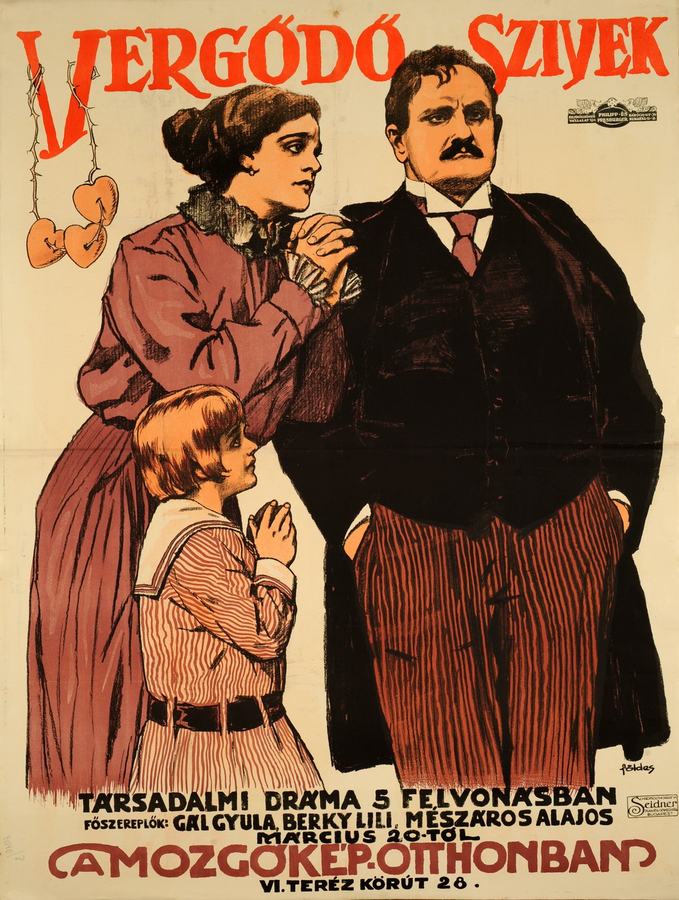
There are films that etch themselves into the collective consciousness not merely for their visual spectacle, but for the raw, unvarnished emotional truths they dare to confront. Vergödö szívek, a silent era gem whose very title, 'Throbbing Hearts,' hints at the tumultuous passions within, stands as a testament to cinema's early power to dissect the human condition. It's a narrative woven with threads of desperate choices, sacrificial love, and the insidious tendrils of power, all set against a backdrop that feels both universal and acutely personal. As an art critic, one approaches such a work not just to recount its plot, but to excavate its deeper meanings, to understand the currents of feeling that propelled its creation and continue to resonate with audiences, even across the chasm of time and technological advancement. This isn't just a story; it's a profound exploration of morality, agency, and the lengths to which individuals are pushed when their very survival, or the survival of those they cherish, hangs in the balance.
The narrative unfurls with a grim inevitability, introducing us to Keller, an accountant for the Garlathy works. He's not just an accountant; he's a man teetering on the precipice, his ledger less a record of financial transactions and more a chronicle of his own moral decay, exacerbated by a dependency on strong drink. His embezzlement, a desperate act perhaps born of weakness or necessity, becomes the fulcrum upon which the entire tragedy pivots. The discovery of his malfeasance by the ruthless director, Garlathy, sets in motion a chain of events that is both shocking and, in its own way, disturbingly plausible for the era. Garlathy, a figure of uncompromising authority and cold ambition, presents Keller with an ultimatum that is nothing short of barbaric: face the ignominy of prison, or surrender his daughter, Jolán, as Garlathy's wife. This is not a proposal; it is a declaration of ownership, a chilling assertion of power that treats human beings as commodities to be traded for personal gain or corporate solvency. The sheer audacity of this demand, the casual cruelty embedded within it, immediately establishes Garlathy as a formidable antagonist, a man whose moral compass is entirely self-serving. One might draw parallels to the predatory power dynamics seen in films like The Evil Thereof, where societal structures often enabled the powerful to exert undue influence over the vulnerable, though perhaps with less overt matrimonial coercion.
The true tragedy, however, lies not just in Keller's predicament, but in the heart of Jolán. Her spirit, as yet untainted by the machinations of the adult world, beats solely for Bánky, a promising young engineer whose honesty and idealism stand in stark contrast to Garlathy's calculating cynicism. Their love is portrayed as a beacon of hope amidst the encroaching shadows, a pure, unblemished connection that makes Garlathy's demand all the more horrifying. It is a love story threatened not by a rival suitor in the conventional sense, but by the cold, hard realities of economic desperation and moral compromise. Keller, trapped between a rock and a hard place, finds himself forced to confess his hopeless situation to Bánky. The scene, though silent, must have been pregnant with unspoken anguish. The father, broken by his own failings, appeals to Bánky not with a plea for help, but with a request for sacrifice. He persuades the young man to break off his engagement, to sever the tender bonds of affection that tie him to Jolán, all to spare Keller the shame and hardship of imprisonment. This moment is a masterclass in silent film emotional intensity, where the weight of a father's shame and a lover's devastating choice would have been conveyed through stark facial expressions and anguished body language. It echoes the profound, often impossible, sacrifices demanded of characters in classic literature, where personal happiness is often subjugated to family honor or survival.
Bánky's subsequent decision to abandon Jolán, to tear himself away from the woman he loves, is an act of profound, agonizing selflessness. He carries the burden of a secret that, for a time, must appear to Jolán as a cruel, inexplicable betrayal. Her heartbreak, uncomprehending and raw, fuels the ensuing tragedy. She enters into an unhappy marriage with Garlathy, a union devoid of affection, a mere transaction designed to preserve her father's freedom. This forced marriage, a common trope in melodramas of the era, takes on a particularly bitter hue here, as it's not merely for social standing or wealth, but a direct consequence of blackmail and moral decay. Jolán's life with Garlathy is depicted as a gilded cage, her spirit slowly suffocating under the weight of her husband's oppressive presence and the absence of true love. The film, in its silent eloquence, would have meticulously crafted scenes illustrating her quiet despair, her longing for a life that was stolen from her. This theme of a woman trapped in an unhappy marriage, often for reasons beyond her control, resonates with other films of the period, such as The Thousand-Dollar Husband, though the motivations and specific circumstances differ significantly. In Vergödö szívek, the emotional toll is arguably heavier due to the direct, blackmail-driven nature of the union.
The narrative, like a tightly wound spring, awaits its release, which comes with the death of Keller. It is only then that the true reason for Bánky's heartbreaking breakup is revealed, shattering Jolán's long-held misconceptions and replacing her resentment with a profound understanding of the sacrifices made for her. This revelation is a pivotal moment, a turning point where the emotional landscape of the film shifts dramatically. The audience, having witnessed Jolán's suffering and Bánky's enigmatic departure, finally gains full insight into the tragic circumstances that separated them. This plot device, the delayed revelation, is a powerful tool in storytelling, allowing for sustained dramatic tension and a cathartic release of information. However, Garlathy, ever the villain, is not content to let bygones be bygones. With Keller gone and the truth beginning to surface, he sees an opportunity to eliminate his rival once and for all. He concocts trumped-up charges, aiming to send Bánky to prison, thereby permanently removing the threat to his forced marriage and his fragile hold over Jolán. This final act of vindictiveness sets the stage for a dramatic climax, a confrontation between truth and lies, love and malice.
It is in this moment of ultimate crisis that Jolán, who has long been a victim of circumstance, transforms into a figure of strength and agency. Her confession, a courageous act of defiance against Garlathy's tyranny, becomes the linchpin that saves Bánky. She reveals the full extent of Garlathy's blackmail, exposing his cruelty and liberating Bánky from the false accusations. This is her moment of triumph, a reclamation of her own narrative, a powerful assertion of truth over deceit. The film, through this act, champions the enduring power of love and honesty, suggesting that even in the darkest corners of human experience, integrity can prevail. The performances, particularly that of Flóra Fáy as Jolán, must have been particularly nuanced, conveying the journey from naive love to profound despair, and finally to resolute strength. Gyula Nagy, as the tormented Keller, would have needed to embody the crushing weight of guilt and desperation, while Sándor Farkas's Bánky would have conveyed noble sacrifice through stoic silence. Garlathy, likely portrayed by Márton Garas, would have been a terrifying presence of cold, calculating villainy.
The genius of silent film, particularly in a drama like Vergödö szívek, lies in its ability to communicate complex emotions without the crutch of dialogue. The reliance on visual storytelling—facial expressions, gestures, mise-en-scène—demands a heightened sense of theatricality and an exceptional understanding of human psychology from both the actors and the director. Soma Guthi and Jenö Janovics, the writers, crafted a narrative that is inherently dramatic, ripe with opportunities for powerful visual metaphors. Imagine the contrast between the opulent, yet sterile, environment of Garlathy's home and the more natural, perhaps simpler, settings where Jolán and Bánky's love blossomed. The use of shadow and light would have been paramount in conveying the moral ambiguity of characters like Keller and the stark villainy of Garlathy. The film, in its essence, is a moral fable, examining the corrosive effects of greed and the redemptive power of truth and self-sacrifice. It stands as a powerful example of how early cinema, often dismissed as primitive, was capable of profound artistic expression and deep psychological insight, rivaling the dramatic intensity of contemporaries like Jane Eyre in its exploration of societal constraints and personal integrity.
Delving deeper into the thematic resonance, Vergödö szívek is not merely a tale of individual woe but a subtle commentary on the societal structures of its time. The power wielded by Garlathy, a factory director, over his accountant speaks volumes about the hierarchical nature of early industrial society. The vulnerability of individuals like Keller, and by extension, his family, to the whims of the powerful, highlights a pervasive lack of social safety nets or legal protections. Jolán's forced marriage isn't just a personal tragedy; it's a symptom of a system where women, particularly, had limited agency and were often treated as pawns in patriarchal games. Her ultimate act of defiance, therefore, transcends personal salvation; it becomes a quiet rebellion against the oppressive forces that sought to control her destiny. This aspect connects the film to broader social commentaries found in other works of the period, perhaps even subtly echoing the fight for women's suffrage as seen in a film like Your Girl and Mine: A Woman Suffrage Play, albeit through a more personal, dramatic lens rather than overt political messaging. The film’s exploration of corruption within a corporate environment also offers a timeless critique, suggesting that the pursuit of profit can often lead to ethical compromises and human suffering, a theme explored in various forms across cinematic history, including later, more explicit crime dramas.
The character arcs are particularly compelling. Keller's journey from flawed individual to desperate father, then to a man whose death ignites the truth, is fraught with internal conflict. His actions, while reprehensible, are ultimately driven by a twisted form of paternal love. Bánky embodies the ideal of romantic heroism, a man willing to sacrifice his own happiness for the woman he loves and her family's honor. His silent suffering and eventual vindication provide a powerful counterpoint to Garlathy's villainy. But it is Jolán who truly undergoes the most profound transformation. Initially a passive object of exchange, she evolves into an active agent of her own destiny. Her journey from naive lover to heartbroken bride, and finally to courageous truth-teller, is the emotional backbone of the film. This arc speaks to the enduring strength of the human spirit, its capacity for resilience, and the power of love to inspire acts of profound courage. The choice of actors for these roles would have been critical in conveying these intricate emotional landscapes. Imagine Lili Berky or Piroska Szabados, both prominent actresses of the era, bringing such depth to Jolán's plight. Their silent performances, relying on gesture and expression, would have been pivotal in communicating the nuanced internal struggles of their characters.
The film's pacing, typical of silent melodramas, would have allowed for lingering shots on faces, emphasizing emotional states, and building suspense through visual cues rather than rapid-fire dialogue. The use of intertitles would have been crucial, not just to convey dialogue but to provide exposition and internal monologues, guiding the audience through the intricate plot. The visual aesthetic would likely have been rich in symbolism, perhaps using recurring motifs to underscore themes. For instance, the Garlathy works themselves could be depicted as a monolithic, oppressive structure, contrasting with softer, more naturalistic settings associated with Jolán and Bánky's love. The grim reality of the industrial setting, a place where livelihoods are earned but souls can be lost, provides a potent backdrop. One might compare the sense of urban anomie or the dangers lurking within a city's underbelly, as hinted in films like Storstadsfaror (City Dangers), though Vergödö szívek focuses more on the internal corruption within the corporate structure itself rather than general urban peril.
Beyond the immediate plot, Vergödö szívek taps into universal themes that ensure its timeless appeal. The conflict between love and duty, the corrupting influence of power, the agony of self-sacrifice, and the eventual triumph of truth are all elements that transcend specific historical contexts. It's a reminder that human nature, with its capacity for both profound good and abyssal evil, remains remarkably consistent across generations. The film’s ability to evoke such strong emotional responses without spoken words is a testament to the pure artistry of early cinema. It speaks a universal language of sighs, tears, and defiant gazes. The legacy of such films is not just in their preservation but in our continued engagement with their narratives, allowing them to spark reflection on our own moral landscapes and the choices we face. The intricate web of deceit and devotion woven by writers Soma Guthi and Jenö Janovics, brought to life by a talented ensemble cast including Gyula Gál, Andor Szakács, and Mihály Fekete, creates a cinematic experience that, even a century later, retains its profound emotional grip. It’s a film that demands empathy, challenges assumptions, and ultimately celebrates the resilience of the human heart in the face of overwhelming adversity. The 'throbbing hearts' of the title are not just those of the characters, but the very pulse of human experience captured on celluloid, resonating with a timeless beat.
The final act, with Jolán's courageous confession, is particularly poignant. It's a moment of reckoning, not just for Garlathy, whose schemes unravel, but for Jolán herself, who reclaims her dignity and agency. This act of speaking truth to power, even at great personal risk, is a theme that resonates deeply and elevates the film beyond a simple melodrama. It transforms Jolán from a passive victim into an active heroine, a woman who, having been subjected to an unthinkable ordeal, finds the inner strength to fight for justice and protect the man she loves. This climactic moment serves as a powerful resolution, offering a sense of catharsis for the audience who has witnessed the characters' trials and tribulations. The intricate plotting, where Keller's death serves as the catalyst for truth, demonstrates a sophisticated understanding of narrative structure, ensuring that every piece of the puzzle falls into place with dramatic impact. The film, therefore, is not just a historical artifact but a vibrant piece of storytelling that continues to speak to the enduring power of human connection and the fight for integrity in a world often fraught with compromise. It’s a reminder of cinema’s capacity to illuminate the darkest corners of the human heart and celebrate its capacity for light.
IMDb 5.4
1926
Community
Log in to comment.