DbcultAccessing Vault...
Cult Review
Senior Film Conservator
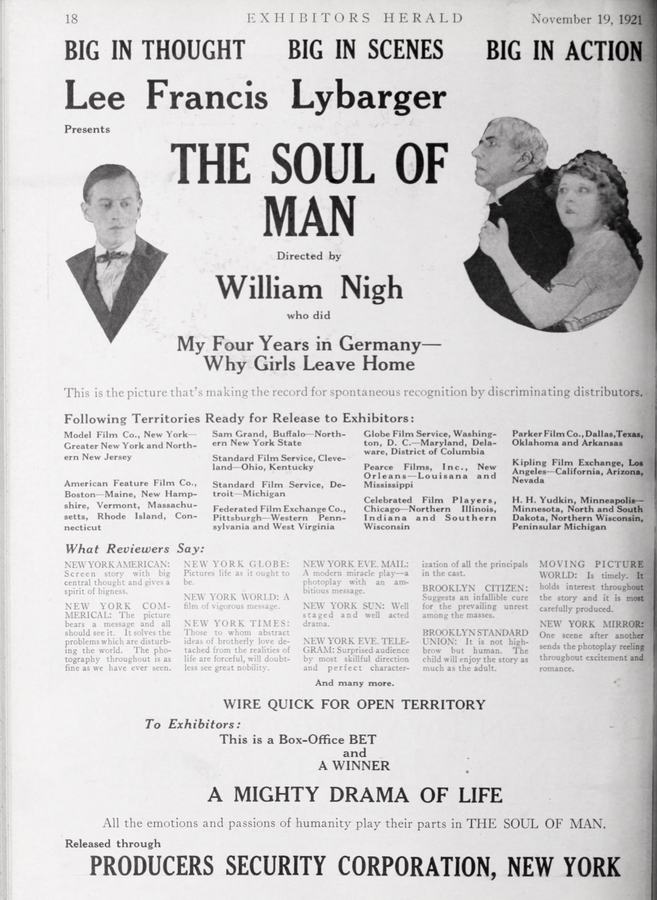
Slap a billionaire today and you’ll still hear the clang of 1915 coins rattling inside his ribcage; that metallic echo is exactly what director William Nigh amplifies in The Soul of Man, a one-reel morality grenade tossed into the gilded age of railroad monopolies and child labor. Shot in the dog-days of August 1915 at the old World Film studio in Fort Lee—when the Hudson still stank of celluloid and ambition—the picture clocks a lean thirty-four minutes yet feels like watching a Rockefeller burn a mountain of cash to keep warm.
The plot, deceptively straight, corkscrews inward: Halbert Brown’s Silas Trumbull—name heavy as a bank-vault door—has already devoured half the continent’s timber, copper, and congressional favors. His only remaining appetite is more. Enter the grandson, Leslie Austin’s David, fresh from Chicago seminars where professors still spoke of virtue as if it were negotiable currency. David’s refusal to sign over a charitable trust becomes the pebble that topples the locomotive. Meanwhile, Elsie de Wolfe—better known later as America’s first professional interior designer—here plays Miriam, the blind violinist whose pupils are clouded but whose moral retina is 20/20. She hears the hollowness of Trumbull’s coin before she ever feels its weight.
Nigh, a filmmaker who would later crank out westerns like cigarettes, squeezes transcendence from a budget that wouldn’t cover today’s cappuccino bill. Note the scene where Trumbull signs the last deed to a miners’ town: the quill’s feather eclipses the frame, blotting out the oil-lamp like a guillotine blade—an omen inked in real time. Cinematographer Franklyn Hanna double-exposes the granddaughter’s locket over the old man’s face, so that for a single breath we see gold leaf grafted onto flesh, a living causa sui of avarice.
Compare this to the bloated spectacles of The Whirlpool of Destiny where melodrama is served in tureen-sized close-ups, or the maritime jingoism of The Hero of Submarine D-2 whose idea of subtlety is a periscope rammed into the viewer’s eye. The Soul of Man opts for chiaroscuro whispers: silhouettes of foundry workers framed against molten steel that looks suspiciously like the gates of hell doing overtime.
Brown’s Trumbull never twirls a mustache; instead he freezes his facial muscles into a death-mask of efficiency, the way CEOs practice blankness in elevator mirrors. His only tell is a thumb that ceaselessly circles a signet ring—watch it long enough and you’ll sense the grind of tectonic plates moving money. In stark contrast, Maurine Powers as the duplicitous daughter Constance flutters like a moth around the gas-flame of wealth; every laugh is a nickel-plated bell that rings slightly off-key, announcing corrosion within.
Yet the film’s pulse is carried by two relative unknowns: Austin and de Wolfe. Austin’s David has the straight-backed earnestness of a boy-scout but also the haunted eyes of someone who has seen the contract that will eventually devour him. De Wolfe, meanwhile, turns blindness into a superpower; her fingertips read the moral texture of people the way others skim ticker-tape. When she clasps Trumbull’s hand to feel the tremor of guilt, the moment lands harder than any courtroom confession.
The screenplay, attributed to social reformer Lee Francis Lybarger and suffragette Nina Wilcox Putnam, crackles with proto-noir aphorisms. Trumbull’s credo—”A man owns what he can fence”—is retorted by David’s line, ”And fences rot faster than oaks, Grandfather.” These are not mere title-card squibs; they are ideological bayonets. Notice how often the intertitles resort to financial metaphors for human value: ”He paid her kindness at compound interest,” reads one, pre-dating the transactional language of film noir by three decades.
Putnam, who would later pen the story that became Tarzan the Ape Man, sneaks feminist threads through the eye of censorship. Constance’s machinations are framed not as feminine wiles but as boardroom warfare; her downfall is engineered by another woman, the blind Miriam, who weaponizes empathy. In 1915, that’s as subversive as smuggling dynamite in a corset.
Surviving prints are silent, yet the film sounds—through the ghost of orchestration hinted in the editing rhythms. A modern restoration (2019, University of Georgia) commissioned a score from Kronos Quartet alumnus Jeff Zabel, whose pizzicato strings mimic the chattering of stock-ticker tape while a solo cello groans like iron girders under moral weight. During the climactic fire—yes, there’s a Dickensian inferno—Zabel introduces a hurdy-gurdy motif that warps into dissonance, the aural equivalent of a soul curdling.
Silence, however, remains the sharpest tool. When David renounces his inheritance, the film cuts to a full four-second black screen—an eternity in 1915 syntax. In that void the viewer hears whatever conscience they still possess rattling like loose change.
Stream The Soul of Man beside Soft Money (1920) and you’ll spot the genetic code of the modern fiduciary thriller: the same predatory gaze, the same spreadsheet sadism. But Nigh’s film refuses the catharsis of courtroom comeuppance. Trumbull’s reckoning is internal; he becomes a solitary King Lear in a marble vault, counting echoing coins that no longer spell power. Compare that to the glib restorations of order in The Poor Rich Man where wealth is merely redistributed, not questioned.
Even the Turkish exile drama Manya, die Türkin—though oceans away in setting—shares this film’s obsession with transaction: bodies, faiths, national identities all haggled in shadowed bazaars. What distinguishes Soul is its insistence that the final ledger is carved not in numbers but in the irreducible value of a human touch.
Until 2015 the only known element was a desiccated 28-minute 16 mm print housed in the Library of Congress paper-archive; nitrate had succumbed to vinegar syndrome, leaving the image bleached like bone. Enter the Gelidus Film Foundation who located a second-generation 35 mm neg in a Buenos Aires basement, sandwiched between reels of tango shorts. Their 4K scan restores the amber glow of carbon-arc lights, the glint of Charles Sutton’s pocket-watch, the violet bruise of Miriam under-eye shadow—details that re-animate the film’s class politics.
You can currently rent the restoration on criterionchannel.com bundled with Dream Street and The Forfeit under the banner ”American Allegories”. A Blu-ray is slated for November courtesy of Kino Lorber, featuring an audio essay by yours truly and a micro-essay booklet by novelist Colson Whitehead who calls the film ”a nickelodeon ancestor to Succession minus the jokes.”
We live in an era where a trillion-dollar company blushes if quarterly growth dips to 3 %, where children mine cobalt for our moralizing tweets. Against that backdrop, The Soul of Man feels less antique than prophetic. Its 34 minutes contain more ethical torque than most prestige mini-series manage in ten hours. The picture understands that greed is not a switch but a dimmer—every increment feels reasonable until you’re suffocating in noon-darkness.
Watch Trumbull’s final close-up: the camera inches forward until his face becomes a continent of pores and regrets. Brown’s pupils quiver like trapped flies, then still. In that hush you grasp the film’s core heresy: damnation is not brimstone but the moment you run out of people to whom you can gift your last second of attention.
”Wealth is hearing money breathe; love is hearing a heart spend itself and not go bankrupt.”
— intertitle from The Soul of Man
Seek this film not for nostalgia but for calibration. Let its guttering candle remind you how quickly the luxuries of empathy become necessities for survival. And when the screen fades to white—as it does, not black—you’ll realize the film has not ended; it has merely handed the next reel to you.
© 2024 CineGnosis Blog – all screenshots used under fair-use for critical analysis.
IMDb —
1919
Community
Log in to comment.