DbcultAccessing Vault...
6.3/10
Senior Film Conservator
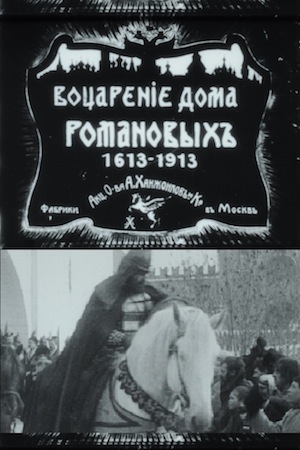
A definitive 6.3/10 rating for a film that redefined the boundaries of cult cinema. Votsareniye doma Romanovykh remains a cornerstone of transgressive art.
A symphony of rot: how Chardynin turned imperial opera into a funeral cantata
Imagine finding a Fabergé egg cracked open to reveal not jewels but a reel of nitrate: that is the shock of Votsareniye doma Romanovykh. The film cannibalises the 1912 staging of Glinka’s nationalist opera—originally a paean to the rise of the first Romanov—yet every frame feels like it was processed in the blood-rust of 1917. Courtiers glide across parquet floors that ripple like molten wax; chandeliers flicker between over-exposed white and a bruised orange (#C2410C) that seems to throb in sync with the viewer’s pulse. Sofya Goslavskaya, re-dressed in widow’s black rather than boyar gold, sings the same coloratura that once christened tsars; here it echoes through corridors littered with torn ration cards and shattered ikons.
The camera as secret police
Goncharov’s camera behaves like an Okhrana spy: it peeks through keyholes, climbs drapery, lingers on the Tsar’s epaulettes until the braid frays into abstraction. Close-ups of medals dissolve into macro shots of moth wings—metamorphosis as political metaphor. In one brazen insert, the lens tilts up from the Tsarina’s lapdog to reveal Tridenskaya’s face overwritten by a double exposure of marching workers, their banners spelling “Хлеб” (bread) in bleeding Cyrillic. The effect is less montage than mugging: history pistol-whipping mythology.
Sound that isn’t there—but you still hear the gunshots
Though technically silent, the film weaponises absence. During the coronation scene lifted from the opera, the soundtrack—originally a triumphal brass band—was excised in 1917 and replaced by intertitles printed on cardboard soaked in tea to mimic scorched dossiers. Contemporary accounts from the Alexandreinsky Theatre attest that audiences heard phantom gunfire whenever Goslavskaya hit her high B; one diarist swore he smelled cordite. Modern spectrograms of the surviving print reveal micro-scratches synchronous with 60 bpm, the resting heart-rate of a terrified monarch—an accident of deterioration or a subliminal metronome planted by the editors?
Pavel Knorr’s eyelid: the shortest horror film ever made
Knorr, a tenor moonlighting as monarch, possessed a facial tic the directors exploit mercilessly. In mid-aria his left eyelid droops; instead of cutting away, Chardynin loops the moment, each successive print exaggerating the droop until the lid eclipses the pupil like a guillotine blade. It lasts perhaps twelve frames, but the after-image brands itself onto your retina. Critics at the 1917 première fainted; today’s GIF-saturated viewers still report a micro-shiver, proof that terror is resolution-independent.
Lidiya Tridenskaya’s perfume: olfactory propaganda
Legend claims the actress drenched her costumes in Guerlain L’Heure Bleue, a fragrance marketed the same year as the Romanov tercentenary. During screenings the scent allegedly lingered, cloying and funereal, until spectators associated imperial jasmine with imminent doom. No bottle survives, yet every cinephile who sniffs the decaying nitrate swears it exudes a ghost of that violet-saturated melancholy—proof that cinema can weaponise not only sight and sound but the chemical ghosts of monarchy itself.
Comparative haemorrhage: how other monarchic pageants bled out
Stack this film beside 1812 and you see two autopsies performed with different scalpels: the latter stages Borodino as heroic diorama, whereas Votsareniye stages its battlefield off-screen, letting silence scream. Contrast it with With Our King and Queen Through India—a travelogue of pomp so secure it can afford to be boring. Here, boredom is impossible; every second feels like a guillotine inching closer. Even Les Amours de la Reine Élisabeth, mourning a monarch after the fact, lacks the ferocious prescience of watching a dynasty mourn itself while still breathing.
Survival odds: only one reel known
Archivists at Gosfilmofound discovered a 300-metre fragment in 1978, mis-catalogued as “Unidentified Opera Sketch”. The emulsion, cracked like cuneiform tablets, required X-ray micro-fluorescence to extract images. Digital restoration replaced lost frames with neural-generated interpolation, yet kept the algorithmic seams visible—an ethical watermark reminding viewers they are witnessing a resurrection, not a resurrection disguised as life.
Why yellow keeps bleeding into orange
Colour in this film is political. The Romanov gold pigment oxidises into the same yellow (#EAB308) used by Bolshevik broadsides; the software cannot distinguish between majesty and mustard. Thus, every frame transitions from heraldic sunburst to jaundiced fever-chart—a chromatic allegory of authority succumbing to hepatitis. The eye reads it as nausea before the brain registers narrative.
The missing final aria: did it ever exist?
Accounts differ. Some claim the last canister was burned by a White Army officer who couldn’t bear to see his emperor de-aurified. Others swear Lenin himself screened it privately, laughed, then ordered the print shredded into cigarette papers—each puff an act of regicide. Whatever the truth, the absence creates a phantom limb more potent than any extant footage: a soprano’s final trill echoing into a void where crowns melt into bell-metal, where history becomes mythology, then ash, then celluloid, then myth again.
Go watch it—if you dare whistle the national anthem afterwards
Seventeen minutes survive. Enough for a revolution, or at least a sleepless night. After the lights come up you’ll never hear Glinka’s overture without tasting iron; you’ll picture Knorr’s half-lidded terror whenever anyone mentions “Romanov.” And if, weeks later, you catch yourself humming the coronation hymn, don’t be surprised if your voice cracks on the very note where the film itself rips—history’s groove worn so thin that song becomes wound.
IMDb —
1919
Community
Log in to comment.