DbcultAccessing Vault...
Cult Review
Senior Film Conservator
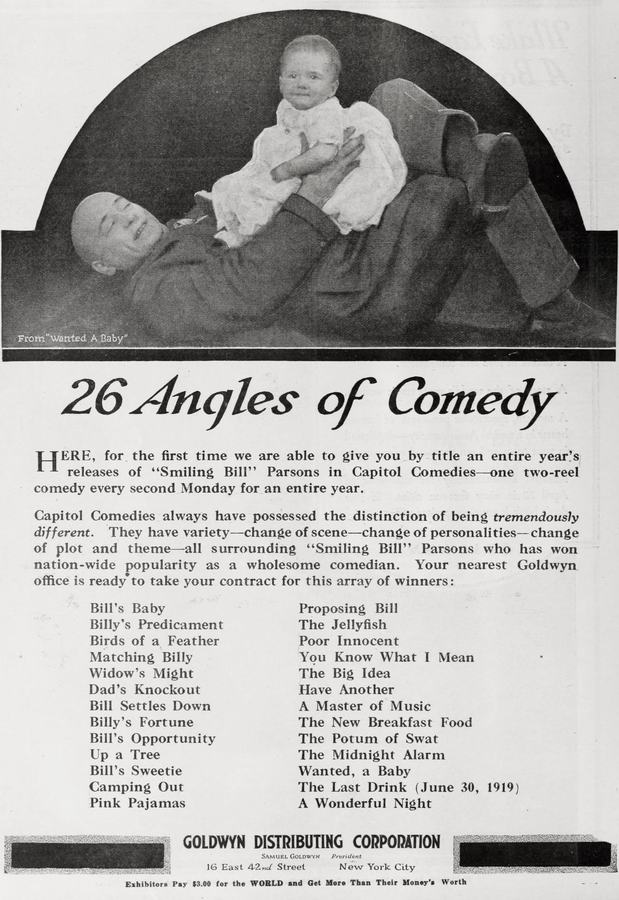
The year 1919 served as a pivotal threshold in the evolution of American cinema, a time when the industry was shedding its primitive skin to embrace more sophisticated, character-driven narratives. Amidst this transition, Wanted: A Baby emerged as a fascinating artifact of the 'Smiling Bill' Parsons series. Parsons, an actor whose screen presence was defined by a jovial, almost aggressive optimism, found in this short a perfect vehicle for his brand of kinetic comedy. The film operates on a premise that is both timeless and deeply rooted in the gender anxieties of the early 20th century: the domestic wager.
At the heart of the film is Bill, a character who embodies the 'merry bachelor' trope—a figure of untethered masculinity that was increasingly under scrutiny as the Victorian era’s rigid structures gave way to the Roaring Twenties. The wager itself is the narrative's primary engine, a catalyst that forces Bill out of his comfortable, masculine enclave and into the traditionally feminine sphere of the nursery. This thematic movement is not unlike the desperate financial gambles seen in The Lottery Man, though here the currency is not just cash, but the very definition of paternal aptitude.
Bill’s confidence is his greatest foil. Parsons plays the character with a delightful lack of self-awareness, his broad smiles and exaggerated gestures suggesting a man who believes he can conquer the intricacies of childcare through sheer force of personality. The comedy arises from the friction between Bill’s theoretical competence and the practical, messy reality of an infant. Unlike the more sentimental depictions of childhood found in Poor Little Peppina, the baby in this film is a chaotic force of nature, a tiny disruptor of the patriarchal order.
Director and writer Tom Bret utilizes the limited space of the 1919 interior set to create a sense of claustrophobic hilarity. The camera, largely static as per the conventions of the time, becomes an impartial witness to Bill’s unraveling. There is a specific rhythm to the slapstick here—a cadence of trial, error, and eventual catastrophe. Whether it is the struggle to secure a diaper or the Herculean task of preparing a bottle, Bret ensures that every action is imbued with a sense of high-stakes urgency. The film’s editing, though rudimentary by modern standards, effectively punctuates Bill’s growing desperation, contrasting his initial bravado with the disheveled reality of his new life.
The technical execution of Wanted: A Baby reflects a period where filmmakers were beginning to understand the power of the close-up to convey internal states. When Bill gazes at the infant, we see a complex mix of terror, frustration, and a burgeoning, unexpected tenderness. This nuance elevates the film beyond mere farce, touching upon the universal human experience of being overwhelmed by responsibility. It shares a certain thematic DNA with The Virtuous Model, which also explored the performance of social roles, albeit in a much more dramatic and somber context.
To view Wanted: A Baby today is to peer into a cultural moment where the roles of men and women were being radically renegotiated. The post-war landscape saw women entering the workforce in unprecedented numbers, and the domestic sphere, once an unchallenged female domain, was becoming a site of negotiation. Bill’s wager is a comedic manifestation of this tension. By attempting to prove he can 'rear an infant as well as one of the opposite sex,' he is inadvertently challenging the biological essentialism that governed early 20th-century family life.
While the film ultimately plays these tensions for laughs, there is an underlying subtext of social anxiety. The bachelor’s attempt at domesticity is presented as an aberration, a source of ridicule that reinforces the status quo even as it mocks it. This is a common thread in comedies of this era, which often flirted with transgressive ideas only to retreat into the safety of tradition by the final reel. In this sense, the film serves as a lighter counterpart to the more serious explorations of social duty found in The Immortal Flame or the rigid moral frameworks of Magda.
William Parsons remains one of the more curious figures of the silent era. His 'Smiling Bill' persona was a brand of its own—a precursor to the later, more refined screen personalities of the 1920s. In Wanted: A Baby, Parsons demonstrates his physical range. His comedy is not merely about falling down; it is about the effort to remain upright. He uses his entire body to convey the exhaustion of childcare, his once-crisp suit becoming increasingly wrinkled and stained, a visual metaphor for the erosion of his bachelor identity.
The chemistry—or lack thereof—between Parsons and the infant performer is the film’s secret weapon. The baby’s genuine reactions to Parsons’ antics provide a level of authenticity that scripted comedy often lacks. There is a spontaneity in these scenes that feels modern, a departure from the more staged performances found in rural comedies like Our Friends the Hayseeds. Parsons’ ability to react to the unpredictable nature of a child is a testament to his skill as a performer and his willingness to share the spotlight with a co-star who cannot follow a script.
When placed alongside other films of the late 1910s, Wanted: A Baby holds its own as a work of focused, high-energy entertainment. While it lacks the grand, sweeping vistas of Eastward Ho! or the exotic allure of Golfo di Napoli, its strength lies in its intimacy. It is a 'chamber comedy,' finding humor in the mundane and the domestic. This focus on the internal dynamics of a household can also be seen in Christa Hartungen, though Bret’s film eschews European melodrama for American slapstick.
Furthermore, the film’s preoccupation with the 'cost' of a wager reflects a broader cinematic fascination with chance and consequence. We see this in Sold at Auction, where the stakes are life-altering, and in the Danish production Gengældelsens ret, which deals with the darker side of human debts. Wanted: A Baby keeps the stakes light, yet the underlying message remains: every bet has a price, and for Bill, that price is his pride and his peace of mind.
The cinematography in Wanted: A Baby, while adhering to the standard medium shots of the time, occasionally breaks away to highlight the absurdity of Bill's environment. The way the nursery is framed—overflowing with laundry, toys, and the general detritus of infancy—creates a visual representation of Bill’s internal state. It is a world that has spiraled out of his control. This use of mise-en-scène to reflect character psyche is a subtle but effective technique that would become more prominent in the coming decade.
Contrast this with the whimsical, almost fairytale-like aesthetics of Das rosa Pantöffelchen or the atmospheric tension of The Corner. Bret’s film is grounded in a gritty, albeit comedic, reality. There are no dream sequences or stylized flourishes here; the humor is derived from the tangible, the physical, and the immediate. Even the title cards are used with a certain economy, allowing the physical performances to carry the weight of the narrative—a hallmark of superior silent filmmaking.
Ultimately, Wanted: A Baby is more than just a relic of a bygone era; it is a testament to the enduring power of character-driven comedy. William Parsons delivers a performance that is both of its time and strangely prophetic of the 'bumbling dad' archetype that would dominate sitcoms for decades to come. The film’s exploration of gender roles, while played for laughs, offers a valuable glimpse into the shifting social currents of 1919.
In the broader landscape of silent film, it stands as a meritorious example of the short-form comedy. It doesn't need the epic scale of a feature to make its point. Instead, it relies on the universal relatability of its premise and the undeniable charm of its lead actor. For those interested in the roots of American screen comedy, or for those who simply enjoy watching a confident man be humbled by a small child, this film remains an essential watch. It captures a moment of innocence and upheaval, much like the characters in Wild Waves and Women, navigating the unpredictable tides of a world in flux. Wanted: A Baby is a joyous, frenetic, and ultimately human look at the challenges of caregiving, proving that some wagers are worth losing for the lessons they teach.
IMDb 6.4
1935
Community
Log in to comment.