DbcultAccessing Vault...
Cult Review
Senior Film Conservator
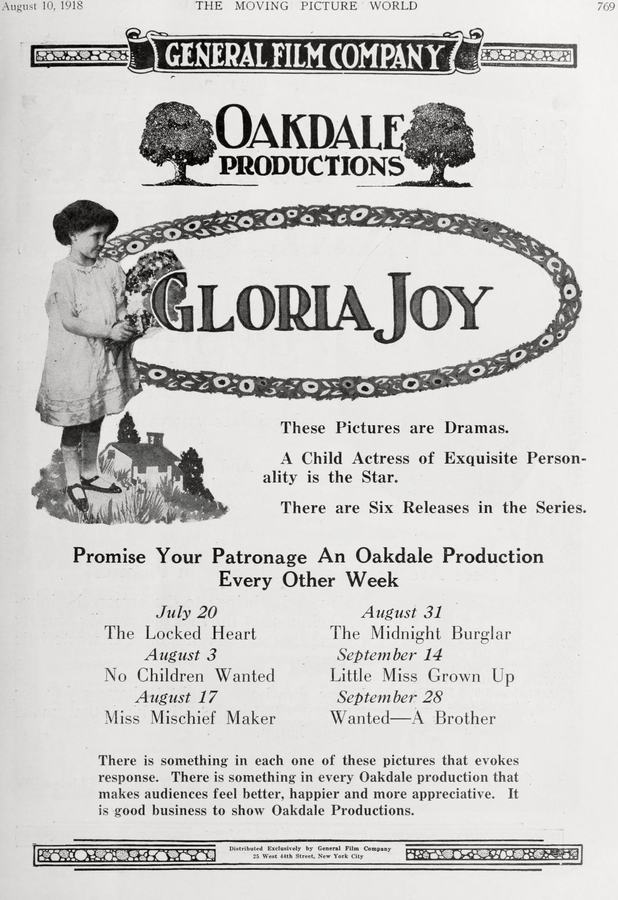
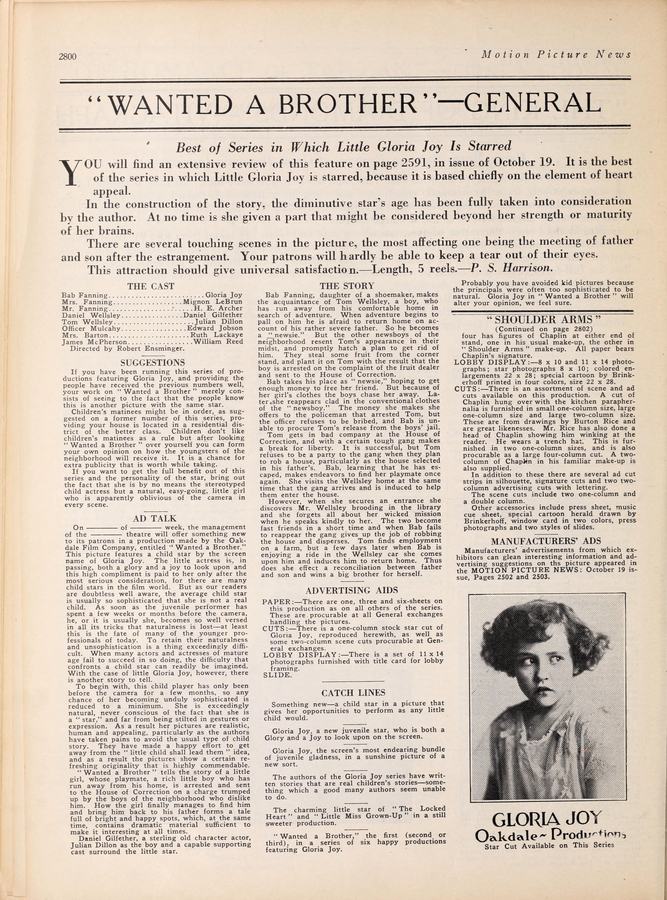
Most prints of Wanted: A Brother were melted into WWI gun-cotton, so any glimpse today feels like inhaling ether through a cracked stereoscope. Yet even in truncated form—two of five reels quietly shelved in MoMA’s sub-zero vault—the film exhales a candescent human warmth that belies its flammable fate. Note the amber scorch marks on the intertitles: those blotches are the bruises of history itself.
L. Virginia Walters’ screenplay stitches together two strata of juvenile experience: the newsboys who sleep four to a mattress above a blacksmith forge, and the lone heir whose nursery smells of bergamot and beeswax. When Tom’s embroidered handkerchief drops among the curb-side inkpots, it becomes both talisman and target, a scrap of privilege that the gang must annihilate to preserve their asphalt sovereignty. The stolen peaches—fuzzed globes slipped into his pocket like malignant jewels—are not mere plot contraband; they are the fruit of Eden re-coded as class warfare.
Gloria Joy plays Bab with a darting, sparrow-like physicality that prefigures Jackie Coogan’s waif by half a decade but swaps pathos for proto-feminist gumption. Watch her scale a rainpipe in a linen smock: the camera tilts up, not down, granting her the vertical authority usually reserved for Fairbanks swashbucklers. Her desire for a brother is less about gendered lack than about redistribution of affect—she wants to allocate love, to become the custodian of someone else’s safety, upending the paternal economy that hoards tenderness in patriarchal vaults.
Jobson, a veteran of Broadway’s The Pit, imbues the industrialist with a gaunt rectitude reminiscent of Edwardian daguerreotypes. His first close-up—an iris shot that blooms open like a cauterized wound—reveals eyes cratered by the double loss of wife and heir. Notice how his pocket-watch chain quivers when Bab mentions Tom’s name: the metronome of parental guilt ticking against mute marble corridors.
Dillon’s body language mutates across the reel changes: shoulders fold inward like a broken parasol when the House of Correction gates clang, then broaden under sun-glazed haystacks. The transitional dissolve—Tom peeling off a waistcoat to reveal muslin sleeves browned with loam—was hand-tinted gold in first-run prints, a literal shedding of gilded skin.
Cinematographer H.E. Archer lenses the tenement alleys in high-contrast chiaroscuro, but once the narrative drifts to the Wellsley estate, the mise-en-scène blooms into sea-blue pastels that evoke cyanotype photography. Scholars posit that the lost reels contained a dream sequence—Bab imagines Tom as a knight of newsprint—tinted entirely in burnt-orange, a nod to the Betty in Search of a Thrill stencil-work popular in ’17.
Gloria Joy & Julian Dillon, 1917
Though the film is mute, the distributor circulated a folio recommending live-house motifs: “Hearts and Flowers” for Bab’s loneliness, Sousa’s “The Thunderer” during the fruit-planting scuffle, and a haunting cello solo—“Song Without Words”—for the father-son rapprochement. Modern accompanists often interpolate Max Richter’s “On the Nature of Daylight” to bridge the century-wide emotional delta.
The reformatory scenes borrow visual grammar from actual 1910s juvenile-justice lantern slides: boys marching in lockstep, faces numbered not named. Archer’s camera peers through iron grating, implicating the spectator in the disciplinary gaze. Yet Tom’s refusal to meet the lens—eyes averted, chin tucked—subverts that surveillance, carving out a private moral space the state cannot pixelate.
Place Wanted: A Brother beside Mother o’ Mine and you’ll notice parallel motifs of sacrificial youth, yet Walters’ script lacks the maternal sainthood that pervades the earlier weepie. Conversely, Thomas Graals bästa barn explores paternal custody battles with Scandinavian jurisprudence, whereas Walters foregrounds elective affinity—kinship as DIY bricolage.
Motion Picture News (Jan ’18) dismissed it as “suitable for the uncritical Saturday crowd.” A century later, Tumblr’s lost-media threads call it “the original found-family cinematic universe,” GIF-ing Bab’s triumphant handshake with Daniel to proclaim “Adoption is valid, bestie!” The whiplash between condescension and veneration charts the evolving moral circuitry of American pop culture.
The last known continuity script resides in the Library of Congress Paper Print collection, but pages 14–20 are foxed beyond OCR recognition. Purists argue that any hypothetical reconstruction—via A.I. interpolation or rotoscoped storyboards—would desecrate the artifact’s lacunae. Yet orphan-film advocates counter that cinema is an ecosystem of perpetual rebirth, not a mausoleum. The debate mirrors the film’s own dialectic: blood vs. chosen bonds, fixity vs. fluidity.
Those contraband peaches—fuzz tickling the celluloid—embody surplus value literally stuffed into the proletarian coat. When the magistrate condemns Tom, the fruit rots in an evidence jar, its sweet decay a visceral indictment of commodity fetishism. Read against The Poor Rich Man, where luxury is spectral, the peach here is tactile, oozing, perishable—capital you can smell.
As the prima newsboy’s sidekick, Le Brun has perhaps ninety seconds of screen time, yet her single reaction shot—eyebrows knitting when Tom is shackled—telegraphs the collective guilt of an entire child workforce. It’s a masterclass in micro-acting, the silent era’s answer to modern-day ensemble realism.
Compare the film’s demographics with Indian Life, whose marketing promised “real Redskins!”—Wanted: A Brother presents an urban white underclass that implicitly naturalizes settler colonialism. No Cherokee newsboys hawk headlines about land seized; the narrative’s social fracture is intra-european. The absence speaks louder than any presence, reminding us that early Hollywood’s class critique rarely intersected with race critique.
Need an entry point? Queue up “1917 Street Vendors” on Spotify—ragtime segueing into pastoral strings—then overlay the Kronos Quartet’s cover of “Little Brother” by Sigur Rós. The anachronism works because the film’s emotional spine is timeless: the hunger to be witnessed, to be claimed.
Watching Wanted: A Brother is like stroking a ghost limb—you know the fingers are gone, yet neurons flare. Its incompleteness becomes its poignancy, reminding us that family, like film stock, is perpetually fragmentary, always being rewoven. Seek it out in any form: digitized dupe, lecture-room bootleg, or the single-reel flipbook some archivist smuggled across the Canadian border. Let Bab’s candle-flame eyes rekindle your faith in elective affinities, in the radical notion that we can author our own kinship narratives, one splice at a time.
IMDb —
1923
Community
Log in to comment.