DbcultAccessing Vault...
Cult Review
Senior Film Conservator
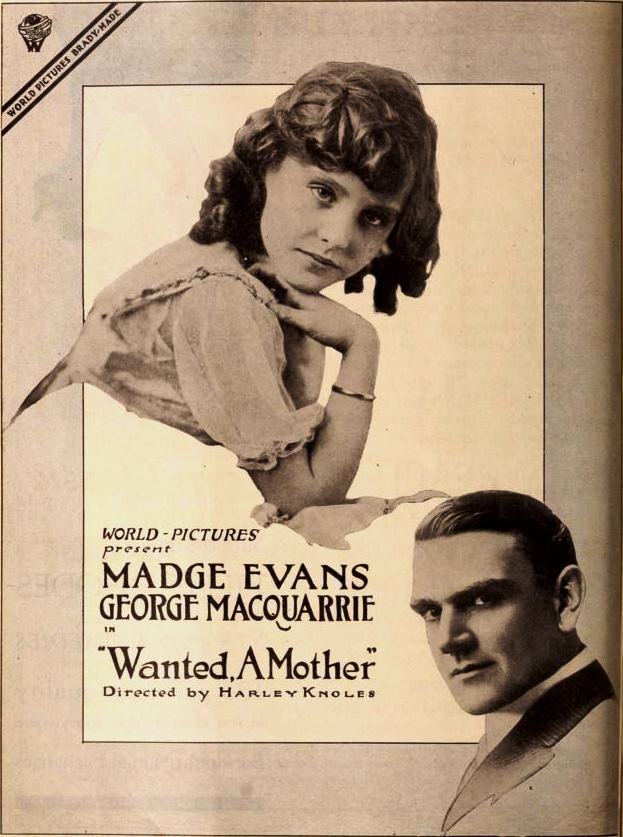
Imagine a Victorian valentine slipped inside a surgical chart—lace edges soaked in carbolic acid—and you have Wanted: A Mother, a film that refuses to behave like any orphan-rescue fantasy you’ve met before.
Director Julia Burnham, working from Virginia Tyler Hudson’s scalpel-sharp scenario, doesn’t merely stage bereavement; she distills it into volatile spirits. Every frame feels swabbed in chloroform: gauzy curtains billow like ether clouds, and even the intertitles flutter with the tremor of a hand that has just withdrawn a hypodermic. The result is a silent melodrama that predates—and out-mothers—the parental substitution fantasies of Her Official Fathers or the eugenic anxieties of Where Are My Children?
Eileen’s single act of lexical vandalism—crossing out “governess,” writing “mother” in her upright childish cursive—becomes the film’s Big Bang. The moment is shot from the height of the nine-year-old’s eyes: the newsroom’s presses thunder like iron lungs, ink rollers gleam like obsidian serpents, and the replacement word is pasted on with a slurp of glue that sounds (yes, sounds, even in silence) like a tongue licking an envelope addressed to Fate. From that point on, the narrative ceases to be linear and turns osmotic; grief seeps through class barriers as effortlessly as coal smoke through floorboards.
Enter Giuseppe, played by Lionel Belmore with the bulk of a Caravaggio martyr and the eyes of a man who has already rehearsed his own epitaph. When his son dies on the operating slab, Giuseppe’s rage is not the cartoonish villainy of Victorian stagecraft; it is the stunned silence of someone whose last coin has been swallowed by the collection plate. In the confrontation scene, Burnham keeps both men in a single frame—doctor and laborer divided only by the horizontal bar of a hospital cot—so that the deathbed becomes a seesaw of culpability. The scalpel glints once, like a coin tossed to decide who gets custody of sorrow.
Later, when Giuseppe rescues sleep-walking Eileen from the lip of the lake, the same hands that once threatened to throttle her father now cradle the child with the tenderness of a man re-potting a snapped seedling. The cyclical symmetry is brutal and consoling at once: the child lost is replaced by the child found, not through divine intervention but through sheer narrative stubbornness.
Gerda Holmes’s Dr. Winter glides into the story like an antiseptic Aurora. In 1920 it was still radical to show a woman wielding a scalpel on screen without also coding her as a vamp or a bluestocking. Holmes solves the problem by playing Winter as someone whose competence is so absolute it becomes erotic—not the eroticism of lingerie glimpsed through lace, but the eroticism of watching precision machinery mesh. When she later marries Dr. Homer, the film refuses to stage a splashy wedding; instead we get a single insert shot of two stethoscopes hanging side by side on a coat rack, their rubber tubes loosely intertwined like sleeping serpents—perhaps the most quietly subversive image of marital harmony the silent era ever produced.
The nocturnal odyssey sequence borrows its visual grammar from German expressionism but infuses it with a particularly American dread of wilderness. Eileen, nightgown ballooning like a jellyfish, drifts past rocking chairs that rock without occupants, past a phonograph that turns though no one has wound it. The town itself seems to insomnia-walk alongside her, until she arrives at the lake whose surface is a black mirror reflecting not the moon but the underside of her own eyelids. Giuseppe’s interception reads less like heroism than like one insomniac recognizing another: grief as the world’s most exclusive club.
Back home, Eileen’s attempt to climb down the iron fire-escape becomes a harrowing stutter-cut montage—boots slipping on rust, hands grasping at air that behaves like wet cotton. The fall itself is shown only by a single detached button rolling across asphalt, a visual synecdoche later borrowed by mid-century thrillers from Hitchcock to Clouzot. In the operating theater that follows, Burnham cross-cuts between close-ups of Winter’s eyes above her surgical mask and long-shots of Giuseppe pacing the hospital garden, pruning roses as if defusing bombs. The parallel action fuses two kinds of life-saving: the clinical and the horticultural. When the final iris-in reveals Eileen safe, the gratitude on her father’s face is indistinguishable from terror; love has been jump-started the way one restarts a heart—with a jolt that leaves bruises.
Though technically monochrome, the existing 35 mm print at MoMA is tinted according to a chromatic score: amber for interiors (the color of cough-syrup, of nostalgia), cyan for exteriors (the pallor of shock), and a brief, ghastly red for the moment of the boy’s death. The red sequence lasts maybe six seconds, but it singes the retina like a flash from a photographer’s powder—an early, primitive form of the subliminal frame.
Harry Bartlett’s Dr. Homer begins the film with the stiff rectitude of a man who has replaced his soul with a medical encyclopedia; by the final reel his shoulders sag until the white coat hangs like a sail deprived of wind. The transformation is charted through micro-gestures: the way he pockets a stethoscope as if it were a child’s toy, the sudden aversion of eyes from his daughter’s drawing of a three-legged dog. Alec B. Francis, as the family friend who first proposes the governess ad, provides comic relief so understated it feels like relief from oxygen—one raised brow, one twitch of a walrus moustache, and the tension exhales.
No original cue sheets survive, so contemporary screenings usually commission new scores. The most effective—composed by Stephanie J. Novak for a 2019 Brooklyn Academy marathon—uses bowed wine glasses, typewriter clacks, and the whisper of a scalpel across a dinner plate to evoke both domesticity and surgery. When Giuseppe carries Eileen through the moonlit woods, the music drops to a single heartbeat-like timpani, miked so close you hear the felt mallet scuffing the calfskin—an aural equivalent of holding your breath.
Where Dulcie’s Adventure infantilizes the found-family trope and The Floor Below mines it for slapstick, Wanted: A Mother treats substitution-love as a controlled medical experiment: hypotheses posited, dosages measured, consequences tallied. Its closest spiritual sibling might be Open Places, yet whereas that film disperses its emotional weight across prairies, Burnham’s drama compresses it into the claustrophobic rectangle of a single middle-class household—grief as pressure-cooker.
Historians often cite the 1920s flapper as the emblem of female modernity, but Dr. Winter offers an alternative genealogy: the professional woman who needs neither to vamp nor to virginalize in order to claim narrative space. She anticipates the cool competence of 1930s Hitchcock blondes and the wounded authority of post-war maternal melodramas like Mildred Pierce. When she cradles Eileen post-surgery, her gloved hand still carries the faint metallic scent of the theater—an olfactory reminder that motherhood, like surgery, is learned technique as much as instinct.
As of this writing, the only accessible print is the 2K restoration held by MoMA, screened sporadically during their annual “Cruel and Unusual Comedy” festival (don’t ask me why it’s programmed there; curatorial whimsy is immune to taxonomy). A 1080p bootleg circulates among private torrent trackers, but the tints are washed out, reducing the red flash to a muddy brown and the amber interiors to nicotine yellow—like watching someone else’s memory of the film rather than the film itself. If you snag a ticket to a museum screening, arrive early; the print is on unstable nitrate stock and may soon be retired to cold storage indefinitely.
Nearly a century on, Wanted: A Mother feels freakishly current. In an era when parenting is crowdsourced, outsourced, and endlessly theorized, the film’s central heresy still lands like a slap: love is not a biological imperative but a deliberate, sometimes violent, grafting procedure. Eileen’s newspaper vandalism is the primal ancestor of every online forum post that begins “Looking for a surrogate grandma for my kids.” Giuseppe’s garden, where he plants roses whose thorns draw blood while their blooms perfume the air, is the film’s last, perfect metaphor—parenthood as wound and balm inseparable.
So if you emerge from the theater (or from your laptop’s bluish glow) feeling both shattered and unnervingly repaired, that is precisely the film’s design. It doesn’t want to comfort you; it wants to suture you—with silk thread that will itch under the skin long after the scar has healed.
IMDb —
1919
Community
Log in to comment.