DbcultAccessing Vault...
5.7/10
Senior Film Conservator
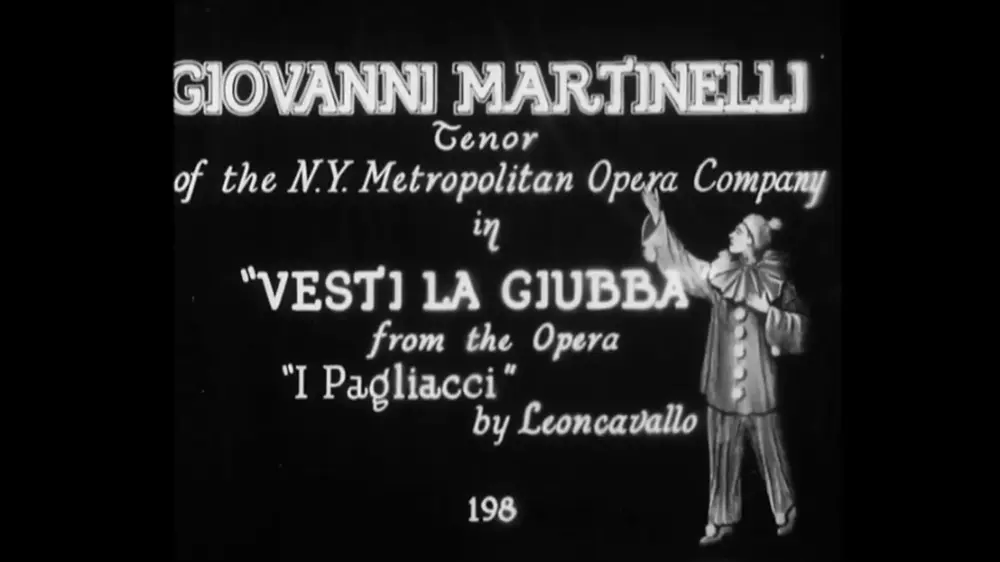
A definitive 5.7/10 rating for a film that redefined the boundaries of cult cinema. Vesti la giubba remains a cornerstone of transgressive art.
Should you spend four minutes watching a grainy, black-and-white recording of an opera singer from nearly a century ago? Short answer: Yes, but only if you want to witness the exact moment the silent era began to die. This film is essential for historians and opera lovers, but it will likely baffle or bore those looking for modern pacing or narrative complexity.
This film works because it captures the unadulterated power of one of history's greatest tenors at the peak of his vocal prowess. There are no edits to hide behind, no post-production pitch correction, and no second takes; it is a raw, athletic feat of vocal endurance. This film fails because the static nature of early Vitaphone recording strips away the cinematic language we have come to expect, leaving us with what is essentially a filmed stage play. You should watch it if you are fascinated by the transition from silent to sound film or if you want to see how much emotional weight a single human face can carry without the aid of a musical score or dialogue.
For the modern viewer, Vesti la giubba is a curiosity rather than a piece of entertainment. It is a museum piece that demands respect for its technical bravery. In 1926, hearing a voice come from a screen was nothing short of miraculous. Today, we take that for granted. However, if you strip away the technological novelty, you are left with Giovanni Martinelli's face. His performance of the tragic clown Canio is terrifyingly committed. He doesn't just sing; he weeps through his vocal cords. It is an experience that transcends the medium, even if that medium is currently hissing with age.
The film opens with Martinelli already in character. The costume is iconic—the oversized buttons, the ruffled collar, the white face paint. But it is the eyes that hold the viewer. Unlike the exaggerated gestures found in silent films like Confessions of a Queen, Martinelli’s movements here are dictated by the breath required for the aria. There is a specific moment, just as he begins the famous 'Ridi, Pagliaccio,' where his chest heaves and his eyes well up. It is a level of realism that was largely absent from the stylized acting of the mid-20s.
Comparing this to other films of the era, such as the energetic Roaring Lions on the Midnight Express, the atmosphere here is suffocatingly heavy. There is no movement, no chase, and no slapstick. It is just a man and his grief. The sound quality, while improved in modern restorations, still carries that distinct Vitaphone 'hum.' This hum acts as a third character, a constant reminder of the machinery that made this recording possible. It creates a sense of haunting distance, as if we are eavesdropping on a ghost.
The Vitaphone process involved recording sound onto a large wax disc that was then synchronized with the projector. This meant the camera could not move. If the camera moved, the noise of the motor would be picked up by the sensitive microphones. Consequently, Vesti la giubba is a single, unbroken medium shot. This lack of editing creates a peculiar tension. In a film like The Man from Glengarry, the narrative is pushed forward by cuts and transitions. Here, the narrative is pushed forward by the sheer force of Martinelli’s lungs.
The lighting is harsh, typical of the era, casting deep shadows that accentuate the tragedy of the clown's makeup. It feels claustrophobic, much like the thematic trapping seen in You're Pinched. Martinelli is trapped by his costume, trapped by his duty to perform, and trapped by the literal frame of the camera. This technical limitation actually serves the story of I Pagliacci perfectly. Canio is a man with no exit, and the static 1926 camera ensures the audience feels that same lack of escape.
To understand why this short was made, one must look at the cultural landscape of Prohibition era America. Warner Bros. wasn't just trying to make movies; they were trying to bring high culture to the masses. By filming a Met star like Martinelli, they were legitimizing the 'talkie' as a serious art form. This wasn't the low-brow comedy of Lost: A Bridegroom or the simple moralizing of Charity. This was Opera. This was serious. This was 'Solid Ivory' talent, much like the themes explored in Solid Ivory.
The film also stands in stark contrast to the international cinema of the time. While La banda del automóvil o la dama enlutada was exploring crime and movement in Mexico, Hollywood was experimenting with the internal world of the performer. Martinelli represents the 'Three X Gordon' star power of his day—a name that could sell tickets on both coasts. Three X Gordon relied on charisma, and Martinelli has it in spades, even through the crackle of a century-old recording.
Pros:
- Preserves a legendary vocal performance that would otherwise be lost to time.
- Provides a literal 'time machine' look at 1920s theatrical makeup and costume design.
- The emotional honesty of the performance is undeniable and piercing.
- Short runtime makes it an easy 'educational' watch.
Cons:
- The visual quality is heavily degraded in most available copies.
- The 'hiss' of the Vitaphone disc can be distracting for modern ears.
- Zero cinematic 'language'—no close-ups, no wide shots, no movement.
There is a surreal quality to Vesti la giubba that reminds me of An Elephant's Nightmare. The white-faced clown singing into a void feels like a fever dream. It lacks the epic scale of Spartak or the exotic allure of Harem Scarem, but it possesses an intimate intensity that those films lack. It is a film about the soul, stripped of all artifice except for the costume. It touches on themes of identity and performance that are also present in Yehuda Hameshukhreret, though in a much more localized, European operatic context.
Ultimately, the film functions like a high-end version of The Cabaret. It is a performance piece designed to showcase talent. But while a cabaret is often fleeting and light, Martinelli’s performance is heavy with the weight of tradition. He isn't just singing for the camera; he is singing for the ages. He knew this was a permanent record. You can see it in the way he holds his final pose. He is waiting for the disc to stop spinning. He is waiting for history to judge him.
Vesti la giubba is not a movie in the modern sense. It is a captured moment. It is flawed, static, and noisy. But it is also magnificent. Giovanni Martinelli’s voice cuts through the decades like a knife. It is a brutal reminder that before we had CGI and complex editing, we had the human voice and the human face. That was enough then. If you have the patience, it is enough now. It works. But it’s flawed. Watch it to see the clown cry, then stay to realize that his tears, captured in 1926, are just as real as yours today.
IMDb 7
1931
Community
Log in to comment.