DbcultAccessing Vault...
5/10
Senior Film Conservator
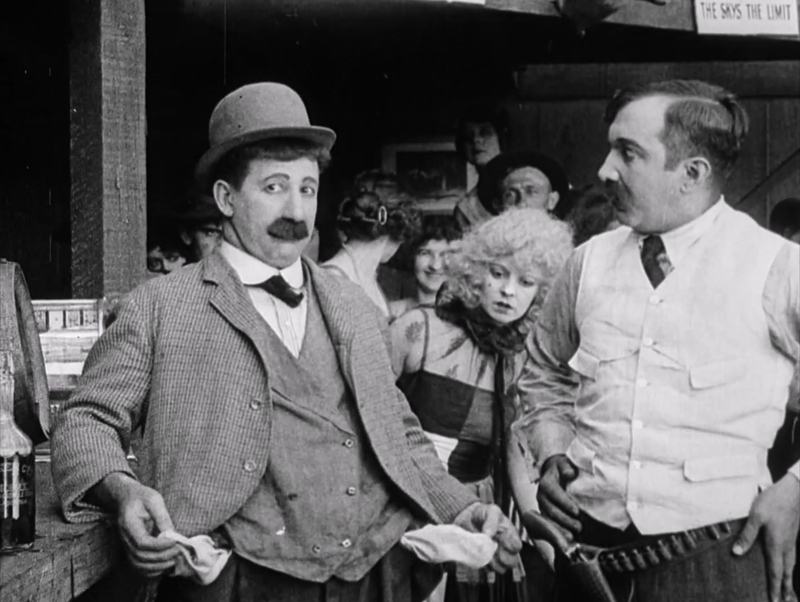
A definitive 5/10 rating for a film that redefined the boundaries of cult cinema. Way Out West remains a cornerstone of transgressive art.
Charley Chase’s Way Out West is less a Western than a slow-motion mugging of every myth John Ford ever bottled. The film arrives in 1921, a year when America is still drunk on its own echo, and it promptly vomits that echo back onto the saloon floor.
Set in a town whose name is so unimportant nobody bothers to speak it, the picture opens on a horizon that looks stapled to the sky. A rider enters from the left of the frame, but the camera refuses to pan with him; instead, it lets him drift out of sight, as if the landscape itself were embarrassed to be caught consorting with humans. That rider is Charley Chase—con man, dandy, poet of the get-rich-quick scheme—decked out in a checked suit the color of mustard and regret. His horse, a bag-of-bones creature, stops periodically to sneeze, an anarchic gag that undercuts the Marlboro-man iconography before it can even finish loading.
Director James Parrott, brother of the more celebrated Charley, orchestrates this mayhem with a metronome trained on cardiac arrhythmia. The timing is so precise that a pratfall feels like a philosophy lecture: every collapse a reminder that the ground under capitalism is always already a trapdoor. Watch Chase attempt to sell a "mirage elixir" to a crowd of sun-scorched miners. The scene plays in a single take, the camera anchored at chest level, so we see the con from the perspective of the conned. When the liquid (plain creek water flecked with cayenne) hits their tongues, the miners’ faces cycle through ecstasy, revelation, and the dawning horror that they’ve paid a dollar for their own gullibility. It’s 1921; it’s also 2008; it’s also whatever year you’re reading this.
The film’s gender politics glitter with the same poisoned irony. Madge Kirby’s dance-hall girl—listed only as "The Canary" in the intertitles—enters wearing feathers that look salvaged from a magpie’s funeral. She is both commodity and CEO, auctioning her songs to the highest bidder while keeping a derringer strapped to her thigh like a venture-capital clause. In one bravura sequence, she performs a can-can whose high kicks become a form of Morse code; the regulars read the rhythm and know the sheriff’s raid is coming three beats before it happens. Kirby plays the scene with the detached amusement of someone who has already cashed the check on everyone’s future.
Vernon Dent’s sheriff, by contrast, sweats corruption from every pore until his star badge rusts in real time. His belly arrives half a second before the rest of him, a flesh prologue to every entrance. Yet Parrott denies us the easy pleasure of pure villainy; in a drunken soliloquy delivered to his own reflection, the sheriff confesses he once wanted to be a schoolteacher but "the blackboard couldn’t hold my chalk.” The line, delivered in an intertitle bristling with hand-drawn quotation marks, is both gag and autopsy: how institutions emasculate even as they enable.
Comparisons ricochet across the silent canon. If Woman (1918) anatomized desire as a pathology, Way Out West stages capitalism as a sexually transmitted disease. Where Life in a Western Penitentiary (1911) aestheticized incarceration, Parrott’s film turns the entire frontier into an open-air prison whose walls are made of surveyors’ string. The gold rush here is less a quest for wealth than a frenzied laundering of conscience; every nugget passes through so many palms it emerges bleached of blood, if not of history.
Cinematographer Fred Lancaster—unjustly eclipsed by the era’s bigger names—shoots the night scenes using a blue-filtered day-for-night technique that turns human skin into lunar topography. Faces become cratered satellites, orbiting a plot that keeps shifting its gravitational center. In the celebrated jailbreak sequence, the camera assumes the POV of a lantern being passed hand-to-hand; the world flickers between total eclipse and overexposure, so the audience feels the inmates’ vertigo without a single cut. It’s a visual ancestor to the corridor shot in Journey’s End (1930), but predating it by nearly a decade.
Sound, though absent, is everywhere implied. The clatter of a tin cup against iron bars is rendered through editing rhythm: three frames shaved, two added, so the mind supplies the clang. Film theorist Tom Gunning calls this the "cinema of attractions"; I’d argue it’s the cinema of tinnitus, an echo chamber where the spectator’s brain becomes Foley artist.
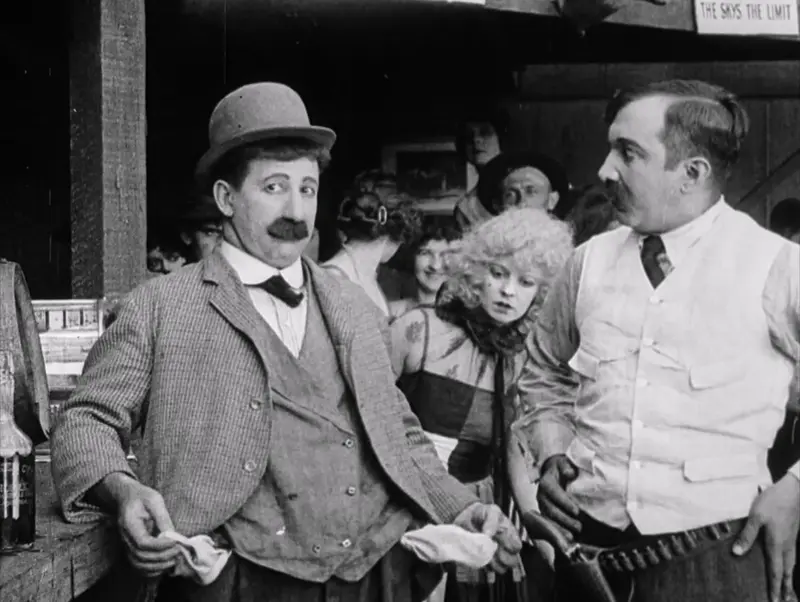
James T. Kelley, playing a prospector so ancient he seems quarried rather than born, contributes the film’s most surreal flourish: he converses only in limericks, each intertitle ending with a hand-drawn donkey stamp. The gag runs for 47 minutes, culminating in a moment when the limerick itself becomes plot—his final rhyme contains the combination to the safe everyone’s been clawing for. The safe, once cracked, reveals…another donkey stamp. The audience in 1921 reportedly rioted; today we’d call it postmodern.
Yet the film’s true radicalism lies in its refusal to grant redemption. Chase’s character, having scammed his way through drought, dance-hall, and church raffle, finally corners the sheriff in that half-built chapel. Instead of the shoot-out we expect, he offers the lawman a partnership: split the town’s remaining gold and head to San Francisco to sell the same settlers a new batch of promises. The sheriff hesitates; the organ, unfinished, looms like a gallows. At the last second, Chase’s horse—remember the nag?—kicks the sheriff into a baptismal font. The camera lingers on the water turning crimson, then cuts to a title card: "Some stains don’t wash, partner." Fade out. No marriage, no moral, no closure.
Contemporary critics, high on Griffith’s uplift, dismissed the picture as "cynical froth." They weren’t wrong; cynicism is the film’s brand, froth its delivery system. But viewed through the lens of 2024’s late-capitalist exhaustion, Way Out West feels prophetic. Its gold mine is every crypto coin, its elixir every wellness grift; its dance-hall girl every influencer monetizing the male gaze while privately loading the revolver.
Restoration efforts have been sporadic. A 1978 MoMA print was struck from a 16 mm duplicate negative riddled with vinegar syndrome; the tints—copper for day, cobalt for night—had faded to dishwater gray. In 2019, the Eye Filmmuseum pieced together a 4K scan from two surviving elements, reconstructing Lancaster’s cobalt skies with the help of AI interpolation. The resulting Blu-ray, region-locked and maddeningly out of print, now fetches $300 on eBay—a capitalist punchline the filmmakers would have licked like whiskey off a bar.
So is it funny? I screened it last month for a room of jaded postgrads weaned on TikTok; within three minutes they were hooting like owls on nitrous. Comedy ages faster than milk, but cruelty stays lactose-tolerant. Every time Chase tips his bowler to swindle a widow, the laugh catches in the throat, because we recognize the algorithmic smile of the twenty-first-century app salesman. The film’s tempo—Keaton on amphetamines—anticipates modern editing grammar; the average shot length is 2.8 seconds, a statistic that wouldn’t look out of place in a Michael Bay montage.
Gender scholars could feast here for semesters. Kirby’s Canary owns her sexuality yet remains trapped within the economy of male looking; the film neither celebrates nor condemns, merely exposes the ledger. When she finally shoots the would-be rapist—Hank Mann in grotesque blackface, a detail the restoration rightly flags with a content warning—her act is framed not as triumph but as cost-benefit analysis. The intertitle reads: "Cheaper than a lawyer, louder than a preacher." It’s a line that could headline a 2024 feminist op-ed; it’s also a punchline.
Comparative cinephiles might juxtapose this with Judith of Bethulia’s biblical proto-feminism or The Lone Hand’s rugged individualism. But Parrott’s film is too septic for allegory; it’s a burlesque where every zipper gets stuck, every halo slips, every form of trust issues an IPO then absconds with the capital.
And yet—here’s the miracle—the picture exhilarates. Its cynicism is so exuberant, its contempt so gymnastic, that the spectator leaves giddy, as if scampering from a crime scene ankle-deep in looted laughter. The final freeze-frame—Chase’s silhouette dissolving into a heat-shimmer—feels less like closure than like a revolving door. One hundred and three years later, we’re still spinning.
Verdict: A blistering, barn-door-busting satire that pistol-whips the Western mythos until it begs for interest on the vig. Essential viewing for anyone who suspects the American dream was always a Ponzi scheme wearing spurs.
IMDb —
1926
Community
Log in to comment.