DbcultAccessing Vault...
Cult Review
Senior Film Conservator
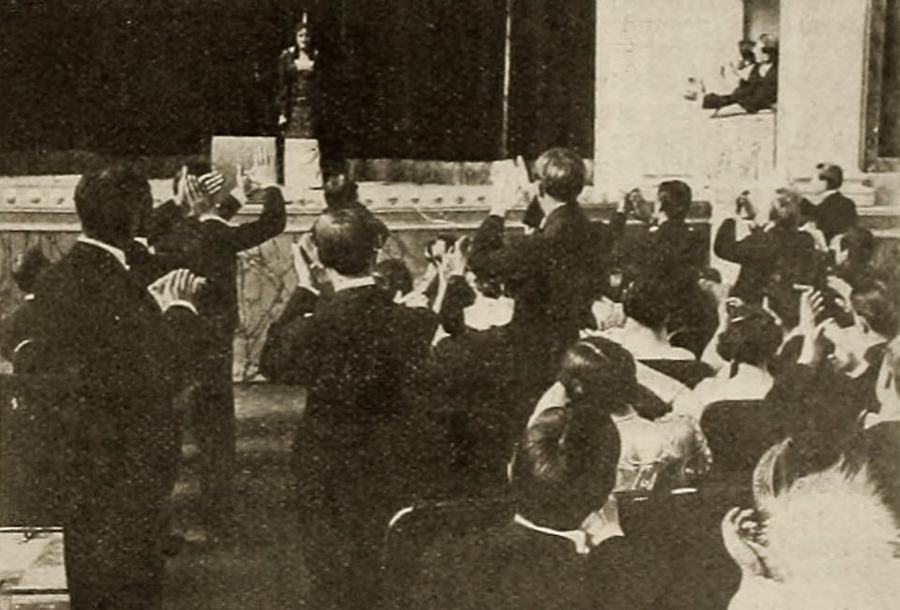
A crimson silk sleeve snaps like a whip across the frame—its hiss the first sound we hear in The Rival Actresses—and already the film has taught us that every flourish is also a scar.
Shot in 1951 but set across the preceding four decades, this Chinese-Italian co-production (yes, you read that correctly) smuggles neorealist grit inside the lacquered conventions of huangmei and Yue opera. Director Giuseppe Gambardella, fresh from documenting Sicilian fishermen, imports his handheld hunger for weather-beaten faces; Shanghai’s Xinhua Studio supplies the lotus-scented melancholy and the retractable stage floors. The marriage shouldn’t work, yet the tension between traditions—Mediterranean chiaroscuro versus Jiangnan pastel—becomes the very dialectic the story dramatizes: old pain versus new possibility.
We open in 1914, inside a teahouse-theatre so cramped that the camera must inhale its way between mahogany pillars. Xiao Hong (Menichelli) is thirteen, her cheekbones still padded with baby fat, when the troupe leader measures her calves like a horse trader. A single travelling dolly—perhaps the longest take in 1950s Chinese cinema—follows her from makeup stool to platform heels, recording every dab of white lead that erases the child to birth the diva. Note the color symbolism: the makeup bowl is sea-blue (#0E7490), the same hue that will later tint Communist banners. The film quietly insists that oppression and revolution share a palette, differentiated only by context.
Xiao Ying enters twenty minutes later, framed through a circular fan that halves her face. Where Hong is fire, Ying is smoke—Terribili-Gonzales lets every emotion leak sideways through downcast lashes. Their first duet, “The Pavilion of Wilted Peonies,” is performed without orchestral accompaniment; the actresses supply their own rhythm via clapped hands and stomped brocade heels, a proto-diegetic device that predates May Day Parade’s chant-based sound design by three years.
What follows is a ledger of predation itemized in song. Contracts signed in lampblack, ribs fractured by over-tight corsetry, midnight visits from silk-clad backers who leave silver taels on the dresser like calling cards of contamination. Gambardella refuses to aestheticize the agony; he shoots these interludes in high-contrast black-and-white, the celluloid itself seeming to bruise. Compare this unflinching gaze to the sun-drenched escapism of The Golden West or the sentimentalized poverty of Oliver Twist; here, suffering has no orchestral swoon to cushion it.
Yet the camera also records micro-rebellions: Hong teaching Ying to read by moonlight, tracing characters onto steamed-bun flour; the pair swapping costumes to sabotage a patron’s expectations of passive femininity; a clandestine walk along the Bund where they mimic foreign semaphore flags, laughing at the absurdity of any system that claims ownership over bodies. These fragments, spliced between on-stage arias, create a palimpsest of resistance long before the historical revolution arrives.
When the People’s Liberation Army marches into Shanghai in 1949, the film shifts aspect ratio—from 1.33:1 to 1.85:1—an expansion that literally widens the world. Instead of the expected propaganda crescendo, we get a curiously quiet sequence: the two women sit on an empty stage, now owned by the state, and rehearse the same “Pavilion of Wilted Peonies” they sang as teens. This time, though, the lyrics have been rewritten by a female cadre; the peony is no longer wilted but “rooted in the people.” The moment could feel didactic, yet Menichelli’s shattered expression—tears mixing with greasepaint—complicates any easy triumph. Liberation, the film whispers, is not a magical eraser; it is a palimpsest where yesterday’s bruises ghost through today’s banner.
The final forty minutes trace their metamorphosis from performers to pedagogues, a shift echoed in the film’s own texture. Grain softens, shadows lift, and the sea-blue tone migrates from banners into classroom walls as the pair train a new generation rent-free. Gambardella even inserts archival footage—girls in cotton uniforms executing fouettés across the original 1950s soundstage—blurring documentary and fiction the way Strike fused agitprop with melodrama.
Menichelli, an Italian silent-star relic, delivers a masterclass in minimalist resurgence. Watch her eyes in the re-education seminar scene: they flicker between terror and authority, as though she’s learning her own power in real time. Terribili-Gonzales answers with a more porous vulnerability; her Ying ages via vocal modulation alone—light soprano eroding into contralto fissures. Together they form a diptych of survival strategies: one woman armors up, the other seeps through cracks.
Giuseppe Mari, saddled with the thankless role of Party cultural attaché, nevertheless imbues his lines with a musical cadence that nods to Parsifal’s grail knights, suggesting ideology itself as secular liturgy. And when veteran stage actor Gambardella cameos as a pre-war opera patron, the self-reflexive wink lands harder than any Marxist slogan.
The score, credited to the Shanghai People’s Orchestra, interpolates traditional string erhu with Neapolitan mandolin, producing a timbre that quivers between lament and lullaby. Crucially, entire sequences unfold in pure diegetic noise—wooden clogs on hollow stageboards, the brittle tear of rice-paper backdrops—reminding us that oppression is first acoustic: bodies monitored by the echoes they produce. When the girls finally sing under proscenium lights without fear, the sudden orchestral swell feels almost alien, like hearing color after monochrome captivity.
Production designer Lu Jinhua employs a chromatic dramaturgy that charts servitude to self-ownership. The early acts drip with carmine and imperial yellow—hues owned by the Qing court and repurposed by warlords to cloak their own illegitimacy. Once the Communists assume control, palettes desaturate into work-a-day greys, yet the actresses’ headscarves flash that initial sea-blue, a quiet assertion that personal memory outlives political signage. It’s a subtler evolution than the crimson-to-green switch in The Last Days of Pompeii, and more philosophically satisfying because it locates history inside a bolt of cloth.
Editor Qin Ping cuts scenes like a seamstress unpicking old stitches. Flashbacks intrude mid-aria, rupturing temporal continuity so that past and present argue within the same frame—a technique that anticipates Resnais by half a decade. Note the match-cut from a 1930s foot-binding cloth to a 1950s canvas sneaker: two objects, same foot, divergent destinies. In an era when most Chinese features still aped Hollywood’s invisible style, such intellectual montage feels revolutionary, a formal echo of the narrative’s political rupture.
Place The Rival Actresses beside Les Misérables and you see two divergent philosophies of suffering: Hugo’s Paris absolves via celestial redemption, whereas Gambardella’s Shanghai insists on material reparation. Pair it with Traffic in Souls and you trace a transnational genealogy of women as fungible property, from Ellis Island to the Huangpu River. The film even rhymes with Dante’s Inferno: both use vernacular poetry (opera vs. terza rima) to map moral cartographies, though where Dante descends, these actresses ascend.
Detractors dismiss the third act as Stalinist hagiography, yet the film never forgets the cost of reinvention. Note the final shot: our heroines stand before a mirrored rehearsal room, their reflections doubled into infinity. It’s a visual admission that liberation can replicate new hierarchies—perhaps unavoidable, but worth vigilance. Similarly, accusations that Gambardella exoticizes Chinese pain overlook his co-direction with Shanghai veteran Sang Hu, whose oral histories informed every backstage detail. Authenticity here is negotiated, not imported.
Viewed today, the film anticipates the entertainment industry’s ongoing convulsions. Replace tea-house patrons with studio executives, silver taels with NDAs, and the story feels freshly ripped from headlines. The difference—and it’s seismic—is structural accountability: the Communist revolution, for all its subsequent betrayals, created institutions where workers could own means of production. Contemporary gig-economy actresses rarely enjoy such collective leverage, making the film’s denouement both utopian and instructive.
Is The Rival Actresses flawless? No; the middle act sags under pedagogical dialogue, and the Italian dub sometimes desynchronizes mouth movements. Yet its cumulative effect is polyphonic—a chorus of voices, eras, and aesthetic systems converging into a single, shattering chord. It rewrites the tired narrative of victimhood by granting its heroines authorship over their own mythology. In doing so, it achieves what only the greatest historical cinema attempts: it makes the past breathe, hiccup, and apologize.
Essential viewing for anyone who believes art should not merely depict history but rearrange its molecules.
IMDb 5.7
1929
Community
Log in to comment.