DbcultAccessing Vault...
Cult Review
Senior Film Conservator
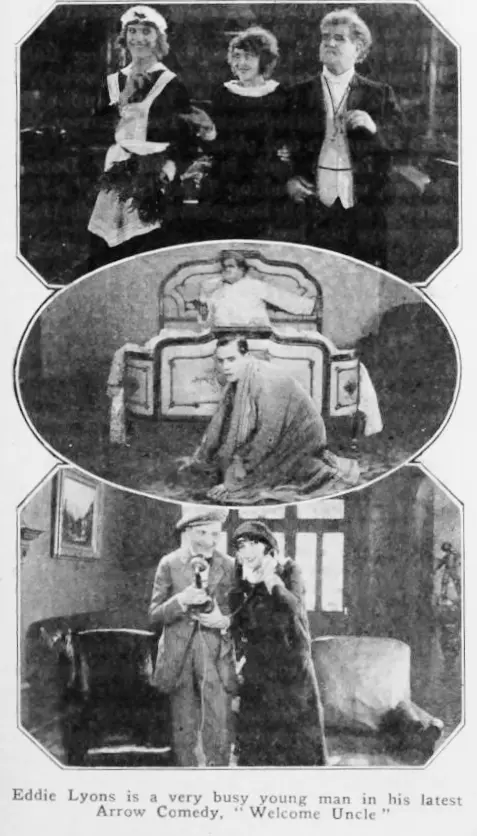
To witness Welcome, Uncle! is to step back into a specific temporal pocket of 1923 where the grammar of cinema was still being written in the ink of sweat and silver nitrate. This film, directed and written with a burgeoning sense of rhythm by Edward Ludwig, stands as a fascinating artifact of the silent era's obsession with the 'unexpected visitor' trope. While many contemporary works of the period, such as The Sin of Martha Queed, delved into the moralistic depths of human failing, Ludwig opts for a lighter, albeit no less intricate, exploration of the human condition through the lens of frantic deception.
Eddie Lyons, a performer whose name should arguably be etched alongside the pantheon of silent greats, carries the weight of the film with a kinetic grace that borders on the balletic. His performance is not merely one of pratfalls and exaggerated grimaces; it is a nuanced study of a man drowning in his own social ambitions. The plot, while ostensibly simple, functions as a clockwork mechanism where every gear is a lie and every spring is a desperate hope for inheritance. In an era where films like Paradise Lost were exploring grander, more philosophical themes, Lyons and Ludwig found a peculiar kind of magic in the mundane terror of family expectations.
Edward Ludwig’s direction in this 1923 piece offers a glimpse into the formative years of a filmmaker who would later navigate the transitions of Hollywood with varying degrees of success. Here, his camera is inquisitive, often lingering on the secondary reactions of the ensemble to punctuate the absurdity of Lyons’ central performance. There is a palpable sense of space within the domestic setting—a claustrophobia that mirrors the protagonist's internal state. Unlike the sprawling, exotic vistas found in Sands of the Desert, the geography of 'Welcome, Uncle!' is internal and domestic, making the stakes feel oddly intimate yet universally relatable.
The pacing of the film is a testament to the editorial intelligence of the early twenties. Each scene is constructed to build upon the previous lie, creating a cumulative effect that mirrors the snowballing chaos of a nightmare. One cannot help but compare the structural integrity of this comedy to the more dramatic pacing of The Man Who Played God. While the latter utilizes silence to build gravitas, 'Welcome, Uncle!' utilizes it to heighten the impact of the visual punchline. The silence is not a void; it is a canvas upon which Lyons paints a portrait of a man on the edge of a nervous breakdown.
Lyons’ screen presence is uniquely suited for this brand of 'polite' anarchy. He possesses a face that is simultaneously capable of expressing deep anxiety and a forced, manic cheerfulness. This duality is the engine of the film. When the titular uncle arrives, Lyons’ transition from the master of his domain to a subservient, terrified nephew is handled with a subtlety that was often lost in the broader burlesques of the time. His work here feels more grounded than the stylized performances in Lulù, providing a bridge between the vaudevillian roots of early film and the more naturalistic approach that would eventually take hold.
The supporting cast, though perhaps less historically significant than Lyons, provides a sturdy framework. They represent the various facets of social pressure—the demanding spouse, the judgmental peer, the oblivious catalyst. Their interactions are choreographed with a precision that suggests a high level of rehearsal, a necessity in an age where film stock was precious and retakes were a luxury. This precision gives the film a theatrical quality, yet Ludwig’s use of close-ups ensures that the cinematic medium is never forgotten. It avoids the 'filmed play' trap that snared so many other early features.
Visually, the film is a masterclass in the use of high-contrast lighting to define social space. The interiors are bathed in a soft, diffused light that suggests a warmth and stability that the characters simply do not possess. This visual irony is a hallmark of Ludwig’s early style. When we look at the documentary-like realism of La montagne infidèle, we see a different application of the camera's power. In 'Welcome, Uncle!', the camera is a co-conspirator in the lie, framing shots to hide the very things the characters are trying to conceal from their benefactor.
The set design deserves its own mention. The middle-class home is rendered with an attention to detail that speaks volumes about the era’s aesthetic. From the heavy drapery to the ornate furniture, the environment is a character in itself—a physical manifestation of the status Lyons is so desperate to maintain. It is a far cry from the whimsical, almost surreal environments of Toonerville's Fire Brigade, opting instead for a groundedness that makes the eventual descent into slapstick all the more jarring and effective.
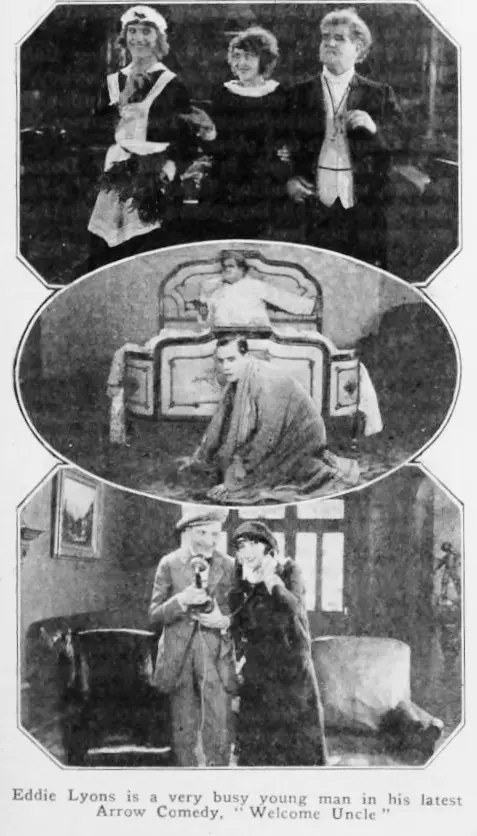
To truly appreciate the niche 'Welcome, Uncle!' occupies, one must look at its contemporaries. Where Lucille Love: The Girl of Mystery relied on serialized intrigue and high-stakes adventure, this film finds its tension in the mundane. It is the tension of a dinner party gone wrong, the horror of a secret revealed over tea. This domestic focus aligns it more closely with the emotional registers of Egyenlöség, though Ludwig replaces the latter’s somber social commentary with a more palatable, yet equally sharp, comedic edge.
Furthermore, the film’s treatment of romantic subplots is surprisingly mature. It doesn't rely on the saccharine sentimentality found in The Bashful Lover. Instead, the relationships in 'Welcome, Uncle!' are transactional, complicated by the very financial pressures that drive the plot. This cynicism is a refreshing departure from the era’s standard romantic tropes, suggesting that Ludwig and Lyons had a more sophisticated understanding of their audience’s own lived experiences.
The comedic set-pieces in 'Welcome, Uncle!' are built on a foundation of escalating stakes. There is a sequence involving a misplaced telegram that rivals the best work of the era for its sheer timing. It’s not just about the physical comedy; it’s about the psychological toll the situation takes on the characters. We see this same commitment to character-driven humor in Back from the Front, but Lyons brings a certain 'everyman' vulnerability that makes his failures feel more poignant. He is not a clown; he is a man trying to survive his own bad decisions.
The film also benefits from a lack of the overt moralizing that plagued many silent features. While The Devil's Garden might take a heavy-handed approach to the consequences of sin, 'Welcome, Uncle!' allows its characters to be flawed, greedy, and deceptive without demanding their total destruction. It is a more humanistic approach to comedy, recognizing that the struggle for social standing is a universal, if often ridiculous, pursuit.
Beneath the surface of the laughs lies a poignant reflection of the post-war American psyche. The 1920s were a time of unprecedented economic flux, and 'Welcome, Uncle!' captures that anxiety perfectly. The 'Uncle' is not just a relative; he is a symbol of the old wealth, the gatekeeper to a future that the protagonist feels he must trick his way into. This theme of 'faking it until you make it' resonates even today, making the film feel surprisingly modern despite its century-old vintage. It lacks the pastoral nostalgia of Lena Rivers, choosing instead to engage with the urban, upwardly mobile reality of its time.
Even the inclusion of sports and leisure as a status symbol, which we might see reflected in the celebrity-driven Play Ball with Babe Ruth, is handled here with a satirical touch. In Lyons' world, leisure is a performance, a stressful act designed to impress others rather than a source of genuine enjoyment. This subversion of the 'American Dream' is what elevates the film from a standard comedy to a work of genuine artistic merit.
In the final analysis, Welcome, Uncle! is a triumph of silent storytelling. It demonstrates that you don't need a massive budget or a cast of thousands to create a compelling, hilarious, and deeply insightful film. You need a director who understands the rhythm of human desperation and an actor who can embody it with every fiber of his being. Eddie Lyons and Edward Ludwig were a formidable team, and this film remains a testament to their combined brilliance.
While history may have favored the more dramatic epics or the more overtly slapstick icons, there is a quiet, enduring power in the domestic comedy of 'Welcome, Uncle!'. It reminds us that our smallest lies are often our funniest, and that the masks we wear for our families are often the most difficult to remove. For those willing to look past the grain and the flicker of the 1923 print, there is a vibrant, living piece of art waiting to be rediscovered. It stands as a beacon of comedic timing, much like The Twinkler, but with a sharper edge and a deeper heart. Welcome him in; he has much to teach us about ourselves.
IMDb —
1917
Community
Log in to comment.