DbcultAccessing Vault...
Cult Review
Senior Film Conservator
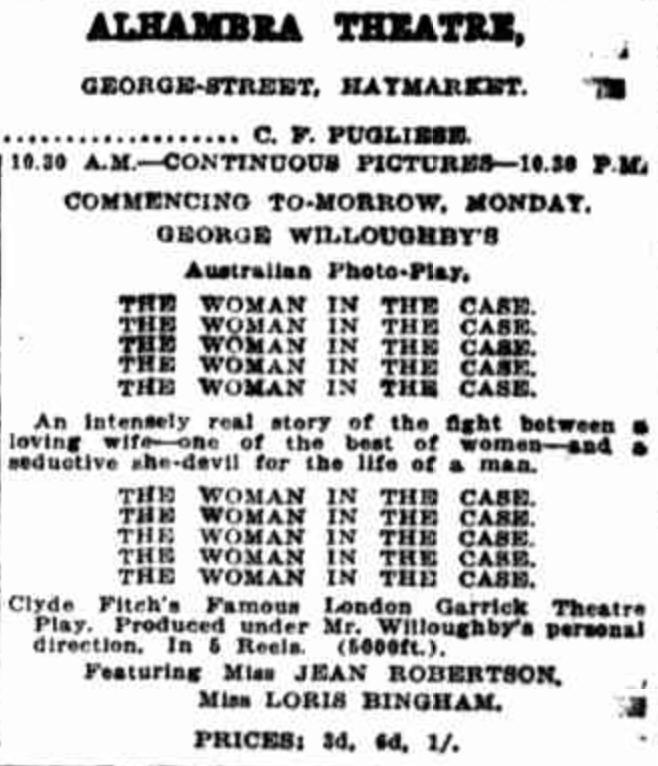
In the burgeoning landscape of 1916 cinema, a year that birthed such diverse works as The Yellow Passport and the epic gravitas of King Lear, there emerged a production that challenged the simplistic dichotomies of the Victorian stage. The Woman in the Case, adapted from the pen of the prolific Clyde Fitch, stands as a monolith of early psychological suspense. It is a film that demands we look beyond the flickering sepia and recognize the sophisticated narrative machinery at work—a machinery that predates the hard-boiled tropes of the 1940s by nearly three decades.
The narrative nucleus revolves around Julian Rolfe (Austin Milroy), a man whose social standing is abruptly liquidated by an accusation of cold-blooded murder. The victim is his friend, Philip Long (David Edelsten), whose demise is shrouded in the toxic influence of Claire Forster (Jean Robertson). Robertson, in a dualistic masterclass, portrays the catalyst of this ruin with a predatory grace. However, the true heart of the film beats within Margaret Rolfe. To save her husband from the gallows, she must perform a radical act of self-erasure, shedding her identity as a dutiful wife to inhabit the skin of a 'woman of the world.' This thematic preoccupation with masks and masquerades echoes the moral complexity found in The Soul's Cycle, yet it grounds its stakes in a far more immediate, legalistic peril.
Visually, the film utilizes the limited technical palette of its era to create a stark contrast between the domestic sphere and the urban underbelly. The cinematography, though static by modern standards, employs a deliberate framing that emphasizes the isolation of its characters. When Margaret enters the lair of Claire Forster, the lighting shifts—at least metaphorically—into a more chiaroscuro-adjacent style. We see the influence of theatrical staging, yet there is a burgeoning understanding of the close-up as a window into the soul. Unlike the more whimsical visual textures of Rübezahls Hochzeit, this film maintains a grounded, almost grimy realism that enhances its stakes.
The pacing is a slow-burn revelation. Much like the tension built in The Closing Net, the film understands that the audience’s anxiety stems from the potential of Margaret’s exposure. Every drink shared with Claire, every flirtatious glance exchanged with the peripheral men of the demi-monde, is a high-wire act. Jean Robertson’s performance as Claire is particularly noteworthy; she embodies a proto-femme fatale who is not merely evil, but driven by a scorched-earth resentment. Her interactions with Margaret—who is essentially playing a character within a character—create a fascinating meta-commentary on the roles women were forced to play in the early 20th century.
When we contextualize The Woman in the Case against its contemporaries, its unique grit becomes even more apparent. While The Little Gypsy leans into a more pastoral, romanticized melodrama, Fitch’s story is obsessed with the mechanics of the legal system and the fragility of reputation. It shares a certain DNA with The Fight, particularly in its depiction of individuals pushed to the brink by systemic corruption or personal vendettas. However, where The Failure might focus on the internal collapse of its protagonist, The Woman in the Case focuses on the external reconstruction of a persona as a weapon of justice.
The film also offers an interesting counterpoint to The House Built Upon Sand. Both films deal with the instability of the domestic unit, but here, the instability is caused by an external predator rather than internal moral rot. The legal drama elements, though rudimentary, provide a framework that would later be perfected in films like Officer 666, albeit with a much more somber tone. There is no comedic relief here; the stakes are life and death, and the film treats them with a somber, almost religious intensity.
One cannot discuss this film without acknowledging the transgressive nature of Margaret’s journey. In 1916, for a 'virtuous' woman to mimic the behaviors of a 'fallen' woman—drinking, smoking, and engaging in ribald conversation—was a shocking narrative choice. It suggests that virtue is not an inherent trait, but a costume that can be donned or discarded. This subversion of the 'Siren' archetype, often seen in works like The Siren's Song, is what gives the film its lasting power. Margaret isn't just fighting for her husband; she is demonstrating a terrifying competence in a world that would rather see her as a helpless victim.
The supporting cast, including Winter Hall and Clive Farnham, provide a solid foundation, but the film truly belongs to the two women at its center. Their psychological duel is far more engaging than the actual 'murder mystery' elements. As we see in The Call of the Dance, the social pressures on women to conform to specific archetypes were immense, and The Woman in the Case exploits those pressures to create genuine suspense. The 'case' of the title isn't just the murder trial; it is the case of womanhood itself, examined under the harsh light of survival.
From a technical standpoint, the film exhibits the burgeoning sophistication of the mid-1910s. While it lacks the sheer atmospheric dread of Det gamle fyrtaarn, it compensates with a tight, screenplay-driven structure. The use of intertitles is judicious, allowing the physical performances to carry the emotional weight. Austin Milroy’s Julian is portrayed with a frantic, desperate energy that serves as the perfect foil to the cool, calculated movements of the women. The film also touches upon the themes of 'tainted' influences, much like Tainted Money, exploring how the lure of easy living and moral laxity can lead to irrevocable tragedy.
Even the more rugged elements, reminiscent of The Iron Strain, are present in the film's refusal to sugarcoat the consequences of Claire's actions. There is a sense of inevitability to the proceedings, a tragic momentum that keeps the viewer engaged despite the lack of modern editing techniques. The film’s climax, a masterfully staged confrontation, is as satisfying today as it must have been a century ago. It is a testament to Fitch's writing that the dialogue—even when translated into silent titles—retains its razor-sharp edge.
In conclusion, The Woman in the Case is far more than a historical curiosity. It is a vital piece of the cinematic puzzle, a bridge between the stage-bound melodramas of the past and the character-driven noir of the future. It treats its audience with respect, offering a complex moral landscape where the lines between hero and villain are blurred by necessity. Jean Robertson delivers a performance for the ages, capturing the dual nature of her role with a nuance that is often missing from silent cinema.
For those interested in the evolution of the thriller, this film is essential viewing. It demonstrates that even in 1916, filmmakers were grappling with the complexities of human psychology and the societal constraints that force us to become people we never intended to be. It stands tall alongside its contemporaries, providing a darker, more cynical alternative to the standard fare of the time. If you can find a print of this elusive gem, do not hesitate; it is a haunting reminder that the ghosts of the past still have much to tell us about the present. The shadows it casts are long, reaching forward to influence generations of storytellers who would follow in Margaret Rolfe's perilous footsteps.
Note: This review reflects on the 1916 version of the film. While other adaptations exist, the raw intensity of this silent iteration remains the definitive cinematic translation of Clyde Fitch's vision.
IMDb —
1928
Community
Log in to comment.