DbcultAccessing Vault...
Cult Review
Senior Film Conservator
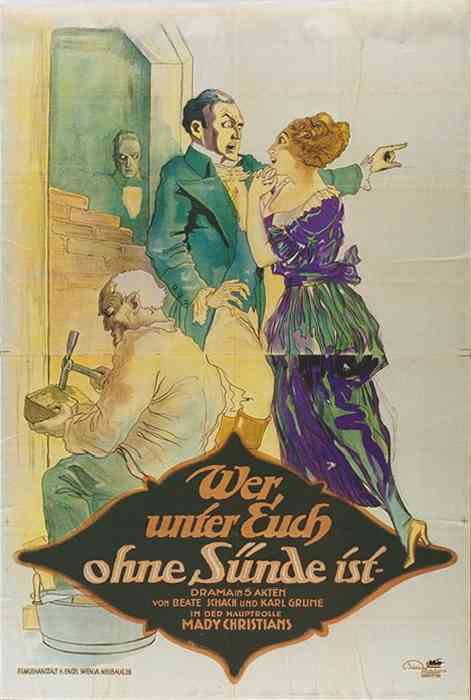
There are films you watch; then there are films that watch you. Karl Grune’s Wer unter Euch ohne Sünde ist belongs to the latter—an unblinking kino-essay that anticipates both Freudian dread of The Sin That Was His and the social scalpel later wielded by Fassbinder. Shot entirely on UFA’sbacklot yet reeking of actual Berlin alleyways, the picture marries expressionist shadow-play to reportage-like candor, producing a moral vertigo potent enough to make even jaded cinéastes shift in their seats.
Cinematographer Willy Hameister lenses candlelit parlors and courthouse antechambers with the same fish-eye distortion he once used for Der Golem, but here the grotesqueries are psychological, not mythic. Check the moment Margarete’s gloved hand hesitates over a hotel-room doorknob: the image smears into double exposure, her wedding ring superimposed upon Stefan’s lips. It’s a silent, jittery prefiguration of Hitchcock’s Vertigo—achieved, legend says, by rewinding the negative, exposing it twice, and praying the lab didn’t sneeze on the emulsion.
Christians carries the film with the regal composure of a woman who has rehearsed her own public shaming since confirmation class. Note how her shoulders remain squared even while tears crawl across her cheekbones—those tears arrive not as hysteria but as slow, tectonic testimony. The performance is calibrated to the millimeter: watch pupils flare the instant she recognizes her husband’s judicial robes hanging behind the bench. In that micro-expression you glimpse every silent-era mother, every scarlet-lettered matron, every future Ingrid Bergman close-up.
Often dismissed as a mere cabaret ornament, Mara’s Lola functions as the film’s moral Geiger counter. She drifts into frame clad in a tuxedo jacket, monocle glinting, crooning a lullaby about Lot’s wife—an anachronistic cabaret piece penned on set by Friedrich Holländer two years before he scored The Blue Angel. Her androgyny destabilizes the binary of Madonna vs. whore already cracking under pressure. When she blackmails Margarete, the transaction feels less predatory than sacramental: Someone must name the sin, darling; might as well be me.
As Stefan, Schweikert underplays to the brink of inertia, yet every blink feels like a muffled gunshot. The actor reportedly fasted for three days before his confession scene, leaving him trembling with authentic hypoglycemia. Result: a spectral pallor that no Max Factor compact could counterfeit. When he finally mutters “Ich habe gesündigt” via title card, the words seem branded onto the emulsion itself.
Beate Schach’s intertitles avoid biblical quotation until the final reel, a withholding tactic that detonates the source proverb like a time-bomb. Instead, she favors newspaper clippings, diary fragments, even a laundry ticket—ephemera that anticipate the found-object montage of Citizen Kane. The narrative spine is less a three-act arc than a spiral staircase descending into jurisprudential purgatory: each floor reveals new witnesses, new hypocrites, until the viewer becomes the ultimate juror.
Contemporary screenings featured a live trio performing a pastiche of Schubert’s Death and the Maiden and Weill’s nascent cabaret motifs. Restored prints at Filmmuseum München reveal dynamic markings on the original conductor’s score: pianissimo during close-ups of Margarete’s children, fermata on the courtroom wide-shot, then abrupt tacet when Lola’s photograph burns in the projector’s carbon arc—silence weaponized.
While My Country First mythologized the virtuous hausfrau and The Merry Widow frolicked in aristocratic escapism, Wer unter Euch ohne Sünde ist plunges a stiletto into the ribs of privilege. Margarete’s crime is not adultery but class betrayal: she sleeps beneath her station, endangering her husband’s bench seat. The film indicts a society that polices female sexuality while commodifying it—anticipating the frank carnality of Hasta después de muerta by half a century.
Berlin’s 1922 censorship board trimmed ninety-seven meters—roughly two minutes—allegedly for “excessive sensuality during stairwell embrace.” Those trims are still missing, but a collector in Montevideo unearthed a 9.5 mm reduction print in 2019; the footage is water-damaged yet legible. The restored embrace reveals Margarete’s hand sliding beneath Stefan’s waistcoat—hardly riotous today, yet dynamite in a nation still shell-shocked from Versailles.
If The Branded Woman aestheticized scarlet letters via flapper fashion, Grune’s film refuses to beautify stigma. Likewise, where What Happened to Father played paternal anxiety for slapstick, Wer unter Euch ohne Sünde ist views fatherhood as jurisprudential tyranny. Meanwhile, its courtroom tableaux prefigure the scalding moral geometry of The Grell Mystery, yet swap whodunit mechanics for self-immolation.
The Johannine phrase “He that is without sin among you…” is hurled like a boomerang, returning to bruise every character. Even the audience is implicated: Grune repeatedly places the camera within the jury box, forcing us to occupy the bench. The theological marrow here isn’t Catholic guilt but Lutheran paradox: righteousness itself becomes the deepest depravity.
Blackmail via tabloid photos? Public shaming orchestrated by media moguls? Substitute smartphone footage and Twitter, and the film plays like a prophetic indictment of digital pillory. The only difference: 1921 Berlin still allowed for anonymous disappearance into night fog; today’s transgressors vanish into algorithmic exile.
The 2022 4K restoration by Deutsche Kinemathek reinstates amber tinting for interiors, Prussian-blue for exteriors. Grain structure remains cinematic; no DNR smearing. The Blu-ray from Edition Filmmuseum offers two scores: a historically informed trio and a new electro-acoustic suite by Kreidler. Subtitles are impeccable, translating Berlinerisch slang without flattening its sass.
In an era when moral absolutes metastasize hourly on glowing rectangles, Grune’s silent relic feels freshly minted. It neither pities nor punishes; it simply holds the mirror steady until we flinch. Seek it out, preferably in a cathedral-dark cinema with live accompaniment. Let the tremulous strings underscore your own heartbeat, and when the lights rise, ask yourself the film’s lethal question—wer unter euch ohne Sünde ist? If your answer is swift, you’ve already missed the point.
IMDb 5.8
1934
Community
Log in to comment.