DbcultAccessing Vault...
Cult Review
Senior Film Conservator
Can a century-old short film about a wagon train still elicit a genuine laugh in the age of high-concept digital comedy? Short answer: Yes, but only if you have an appetite for the specific, rhythmic language of silent slapstick and can overlook a script that is essentially a series of loosely connected pratfalls.
Westward Bo is specifically for the cinema historian or the silent film completionist who finds joy in the physical nuances of the 1920s. It is absolutely not for anyone seeking a coherent narrative or a modern sense of pacing. This is a film that thrives on the friction between its rugged setting and its cartoonish inhabitants.
Before we dive into the dusty details of this 1926 production, let's establish the baseline for its existence in the modern streaming landscape.
Westward Bo arrives at a curious time in film history. By 1926, the Western was already a well-established myth-making machine, but the industry was also beginning to realize that the tropes of the frontier were ripe for parody. While films like Way of the West took the ruggedness of the trail seriously, Westward Bo treats the entire endeavor as a comedy of errors.
The film opens with a chaotic assembly of the wagon train. There is no sense of the majestic 'Manifest Destiny' here. Instead, we see a collection of characters who look like they would struggle to navigate a city block, let alone a mountain pass. The directing choices emphasize the claustrophobia of the group rather than the openness of the landscape. It’s a smart choice. By keeping the camera tight on the actors, the film forces the humor to come from their reactions rather than the scenery.
Take, for example, the sequence involving the packing of the main wagon. Billy Bletcher’s character attempts to balance a ridiculous amount of domestic furniture onto a vehicle clearly designed for basic supplies. The way he maneuvers a grandfather clock—a symbol of the 'old world'—into a space meant for flour and water is a silent critique of the absurdity of the pioneers themselves. It’s a punchy, visual metaphor that works without a single title card.
The real heart of Westward Bo lies in its cast. Billy Bletcher, who would later become famous as the booming voice of Disney’s Pete, is here a creature of pure movement. He is small, energetic, and seemingly made of rubber. His performance is a stark contrast to the more grounded, emotive style of Bessie Love. Love, who had already proven her dramatic chops in earlier features, brings a much-needed sense of stakes to the proceedings.
While Bletcher is falling over barrels, Love is the one providing the 'straight' performance that makes the comedy land. There is a specific scene where Love has to react to the loss of their supplies. While a lesser actress might have played it for broad laughs, she plays it with a flicker of genuine anxiety. This grounding makes the subsequent slapstick recovery feel earned rather than arbitrary. It’s a dynamic we see in other 1926 comedies like Behind the Front (1926), where the humor is built on the backs of recognizable human frustration.
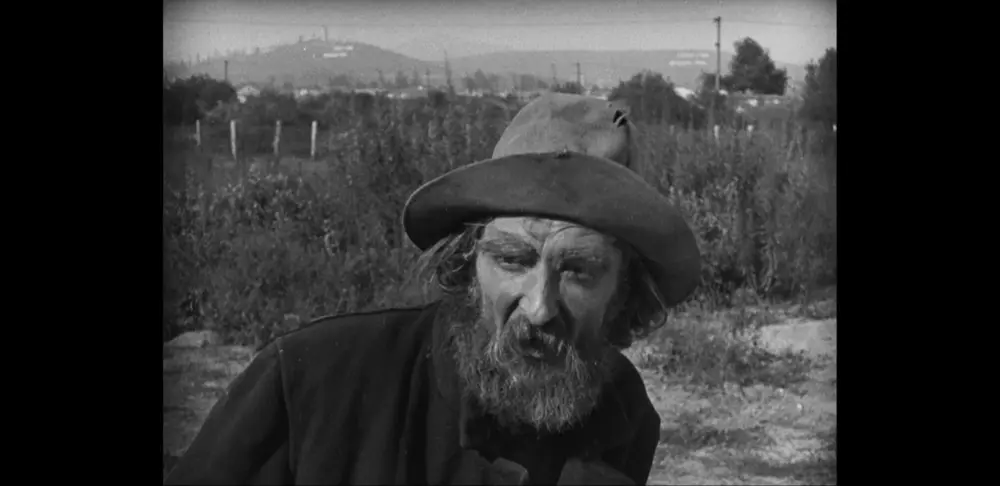
However, the supporting cast, including Mark Hamilton and Tex Young, often feels like window dressing. They fill the frame but rarely contribute to the comedic momentum. The film is at its best when it focuses solely on the friction between Bletcher’s incompetence and Love’s exasperation. The horse, quite frankly, shows more comedic timing than most of the secondary humans.
From a technical standpoint, Westward Bo is a fascinating look at the limitations of location shooting in the mid-20s. The cinematography is functional but lacks the artistry found in bigger-budget contemporaries like A Boy of Flanders. The lighting is harsh, likely the result of shooting in high noon desert sun without adequate diffusion. This gives the film a gritty, almost documentary-like texture that sits at odds with its silly tone.
The pacing is where the film truly shows its age. In the 1920s, audiences were accustomed to a slower build-up for gags. Today, the three-minute setup for a ten-second payoff feels agonizing. There is a sequence involving a river crossing that seems to go on for an eternity. We see the wagon enter the water. We see the water splash. We see the characters argue. We see the wagon get stuck. By the time the actual 'punchline'—the wagon floating away while the characters are still arguing on the bank—happens, the modern viewer has already checked their phone twice.
Yet, there is an undeniable charm in the practical effects. There is no CGI here. When a wagon overturns, it is a real wagon overturning in real dirt. The physical danger, however slight, adds a layer of tension that modern green-screen comedies lack. It feels tangible. It feels heavy. It works. But it’s flawed.
Short answer: Only if you are a dedicated student of silent cinema or a fan of Billy Bletcher’s unique physicality. For the average viewer, the repetitive gags and lack of a strong narrative arc make it a difficult sit.
If you are looking for a masterpiece of the era, this isn't it. If you are looking for a 20-minute window into how the 1920s parodied its own myths, then it is absolutely worth your time. It serves as a perfect companion piece to other short-form comedies of the time, such as Andy's Hat in the Ring, showcasing the breadth of slapstick styles available to audiences before the transition to sound.
Pros:
- Bessie Love provides a grounded, professional performance that anchors the chaos.
- Genuine practical stunts that carry a weight modern films often lack.
- A fascinating historical look at the transition of Westerns into the comedy sphere.
- Short runtime makes it an easy 'educational' watch.
Cons:
- The humor is often predictable and dated.
- Poor lighting in several outdoor sequences makes some action hard to follow.
- The supporting characters are entirely forgettable.
- Lack of a cohesive ending feels like the film just ran out of reel.
Westward Bo is a minor footnote in the careers of Bessie Love and Billy Bletcher, but it is a footnote worth reading for those who care about the roots of American comedy. It lacks the sophisticated wit of a Keaton or the emotional depth of a Chaplin, but it possesses a raw, unpretentious energy. It’s a film about people failing at being heroes, and in 1926, that must have felt quite refreshing. Today, it feels like a dusty artifact—charming, slightly broken, but still capable of a faint glimmer of light if you look at it from the right angle. It isn't a essential viewing, but for the right person, it's a delightful curiosity.
IMDb 5.3
1929
Community
Log in to comment.