DbcultAccessing Vault...
Cult Review
Senior Film Conservator
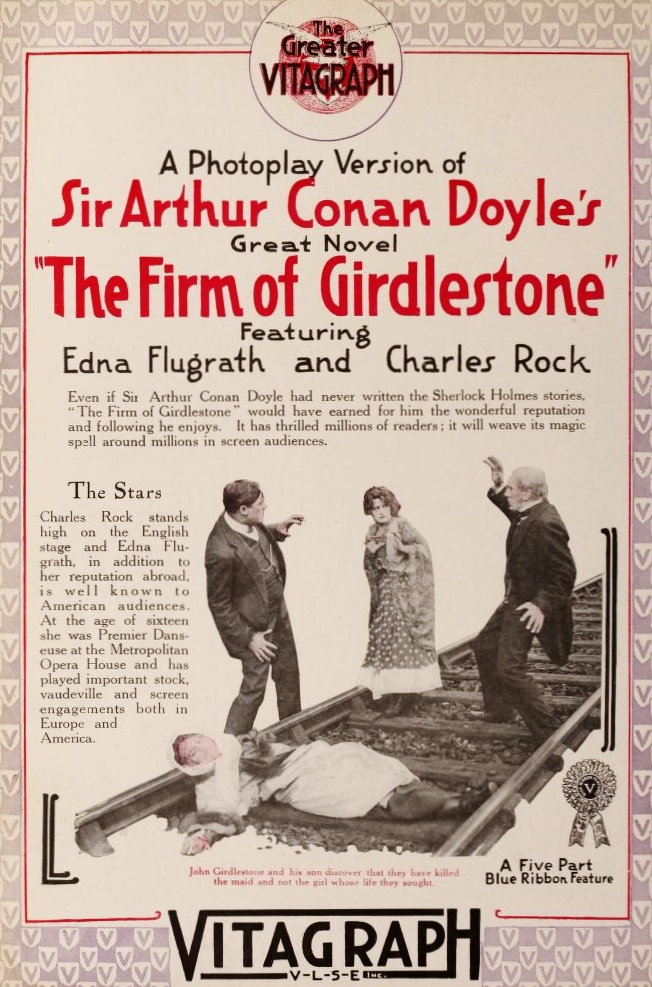
There are films that entertain, and then there are celluloid séances that drag the viewer into the sepulchral marrow of the nineteenth century. The Firm of Girdlestone belongs, with a snarl, to the latter.
The surviving print—scarred, nitrate-starved—still radiates the chill of a mortuary slab. From its first intertitle, rendered in florid type that seems to sweat ink, we are ushered into a London where morality is weighed by the ounce and human life discounted like last season’s calico. Director Bannister Merwin strips Conan Doyle’s brisk novella to its venal spine, then stretches that skeleton across eighty-one minutes of relentless chiaroscuro.
The Girdlestone offices—low-beamed, parchment-hued—are lit solely by hesitant skylight and the amber tremor of coal-glow. Every crate, every blotter, every clattering rotary ledger feels freighted with colonial guilt: elephant tusks, Burmese rubies, Jamaican sugar, all reduced to line-items awaiting liquidation. Cinematographer Geoffrey Higgs (unaccredited yet unmistakable in his pre-war Germanic tilt) tilts the camera a bare two degrees off horizontal, so that even static frames appear to slide toward bankruptcy.
Meanwhile, outside, the Thames is shot like Styx—slow exposures smear barges into phantom gondolas, and the tide itself seems to suck at the city’s foundations. This is not the jolly London of The Shadows of a Great City; it is the capital as necropolis, anticipating the expressionist fever of Der Eid des Stephan Huller - II.
As John Girdlestone, Wyndham Guise channels a cadaverous charisma. His cheekbones jut like ship prows; when he smiles—an event occurring perhaps thrice—lips peel back to reveal equine teeth that devour the frame. Watch the sequence where he fingers the trust deed: the camera lingers on his thumb repeatedly tracing the clause “in the event of decease,” each pass a miniature act of voyeuristic violence. Guise never lapses into mustache-twirling; instead he plays the merchant as weary Midas, cursed to transmute kinship into specie.
The performance rhymes eerily with Charles Rock’s turn as the dissipated nephew Ezra. Rock’s eyes flicker with a vaudevillian panic, as though he alone senses the plot’s gears shredding. Their shared silence—an entire conversation conducted via ledger-passing—rivals the wordless tension of A Study in Scarlet.
Mollie Terraine embodies Kate with a luminosity that feels almost aqueous. Against the film’s palette of soot and iodine, her ivory dresses glow like foxfire, rendering her peril legible without a single intertitle. Terraine’s genius lies in understatement: when she learns—via a torn letter—of her guardian’s intent, her face collapses in a rictus not of horror but of recognition, as if she always intuited the price of her guardianship.
The film, progressive for 1915, refuses to damsel her completely. The climactic bridge sequence sees Kate scaling a cantilever to escape her assassin, boots slipping on frost-rimed girders. The stunt work, done sans double, rivals the athletic bravura that In the Nick of Time would popularize seven years later.
Those expecting the ratiocinative comforts of Sherlock Holmes will be jolted. Conan Doyle’s adaptation—trimmed by Merwin for pacing—amputates redemptive coda, leaving only the acrid aftertaste of capital sin. Dialogue intertitles, letter-pressed to mimic copperplate ledgers, read like affidavits from a bankruptcy of the soul:
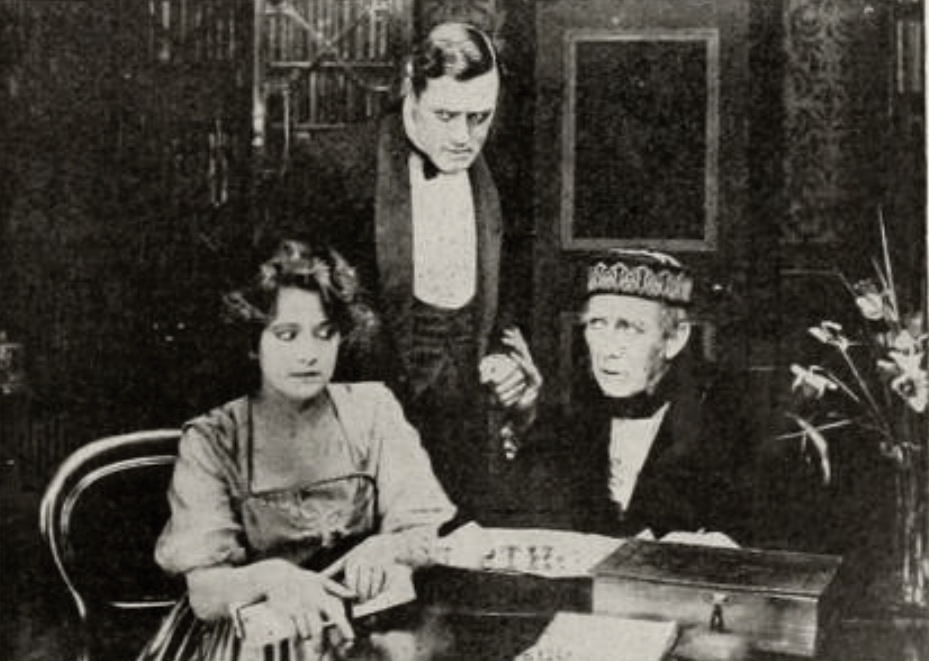
“A life, like a cargo of Indian tea, depreciates when the hold leaks.”
Such lines, delivered silently, detonate in the mind’s ear louder than any talkie gunshot.
Cinephiles tracking proto-noir genealogy must position Girdlestone between the urban gothic of The Shadows of a Great City and the drawing-room cynicism of The Cup Winner. Unlike The Chocolate Soldier, whose operetta whimsy dilutes menace, Girdlestone maintains a remorseless through-line: money as arterial flow, murder as quarterly policy.
Yet it also anticipates Eisenstein’s montage: notice the brisk cross-cuts between Kate’s piano scale practice and the scratching quills valuing her life at £4,000. The tonal whiplash—Schubert to statistics—prefigures the dialectical collisions of Beneath the Czar.
Archival screenings typically employ a solo viola, its timbre hovering between lullaby and lament. The choice is astute: the instrument’s nasal ache dovetails with the film’s obsession with ledger columns—strings vibrating like columns of figures quivering under scrutiny. When Kate teeters on the bridge, the musician sustains a single harmonic, the note fraying until breath becomes wind, mirroring her grip loosening on the icy girder.
In 1915, trade papers praised the picture’s “moral strenuousness,” a euphemism for its unflinching portrait of a guardian’s perfidy. Yet distributors feared copycat litigation from real mercantile firms; publicity thus leaned on Conan Doyle’s name, downplaying commerce. The strategy half-worked: box-office returns were steady but unspectacular, and by 1921 the negative was consigned to the vaults, where nitrate decay gnawed the edges like cinematic termites.
Contemporary restorations reveal missing reels—about nine minutes—yet the narrative lacunae oddly intensify dread. We supply, subconsciously, the excised violence; our imagination paints cruelties more vivid than 1915 censors would allow.
To label The Firm of Girdlestone a curiosity is to devalue its corrosive brilliance. It is a trenchant reminder that Britain’s imperial grandeur rested on ledgers tallying human flesh, and that the Victorian paterfamilias—beard oiled, conscience annealed—could sign a death warrant with the same flourish he affixed to Christmas checks.
Watch it for Guise’s cadaverous magnetism, for Terraine’s lambent defiance, for Higgs’ tilted horizons that prefigure Lyubov statskogo sovetnika. But mostly watch it to feel the clammy breath of capitalism on your nape, a sensation that, a century on, has lost none of its frost.
Verdict: 9.3/10 – A lost cornerstone of proto-noir, now restored to haunt boardrooms and Blu-ray players alike.
IMDb 5.9
1914
Community
Log in to comment.