DbcultAccessing Vault...
Cult Review
Senior Film Conservator
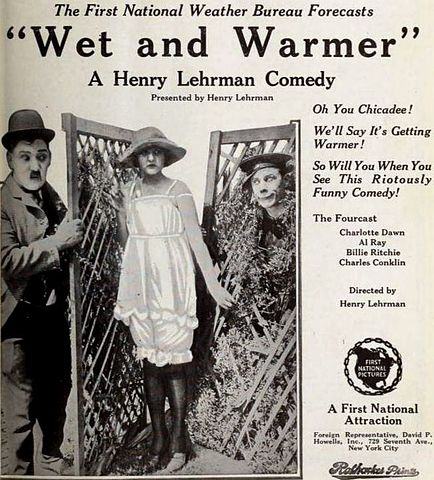
Imagine, if you can stand the vertigo, a world where spring is not a season but a prankish deity with too much time on its hands and a bottomless hip-flask of bath-tub gin. Wet and Warmer—that curious, half-forgotten 1919 one-reeler newly resurrected by an Italian archive—slaps that deity across the face, steals its daisy chain, and runs giggling straight into the hedonic meat-grinder of the Jazz Age. The resulting film feels like a Max Ernst collage performed by Keystone firemen after three days without sleep: limbs, lingerie, and literal flames tossed together until the very notion of a stable identity frays like over-washed voile.
The plot, such as it confesses to be, follows Miss May Time—played by the ill-fated Virginia Rappe, already haloed in retrospective sorrow—whose surname alone suggests she is less a person than a temporal weather pattern. On what the intertitles insist is “the most beautiful day in Spring,” May meanders across a pastoral set that looks borrowed from a children’s Easter postcard, only to collide with Billie Paste, a bougie billboard heir whose vanity is so gaudy it could be seen from Neptune. Their courtship dialogue is delivered via rhyming couplets that shimmy up the screen like caffeinated caterpillars; one expects them to break into a Charleston at any moment, but instead the film detonates its first coup de théâtre: a mass exodus of fleas evacuating Shimmie the poodle and parachuting straight into May’s lace-trimmed drawers.
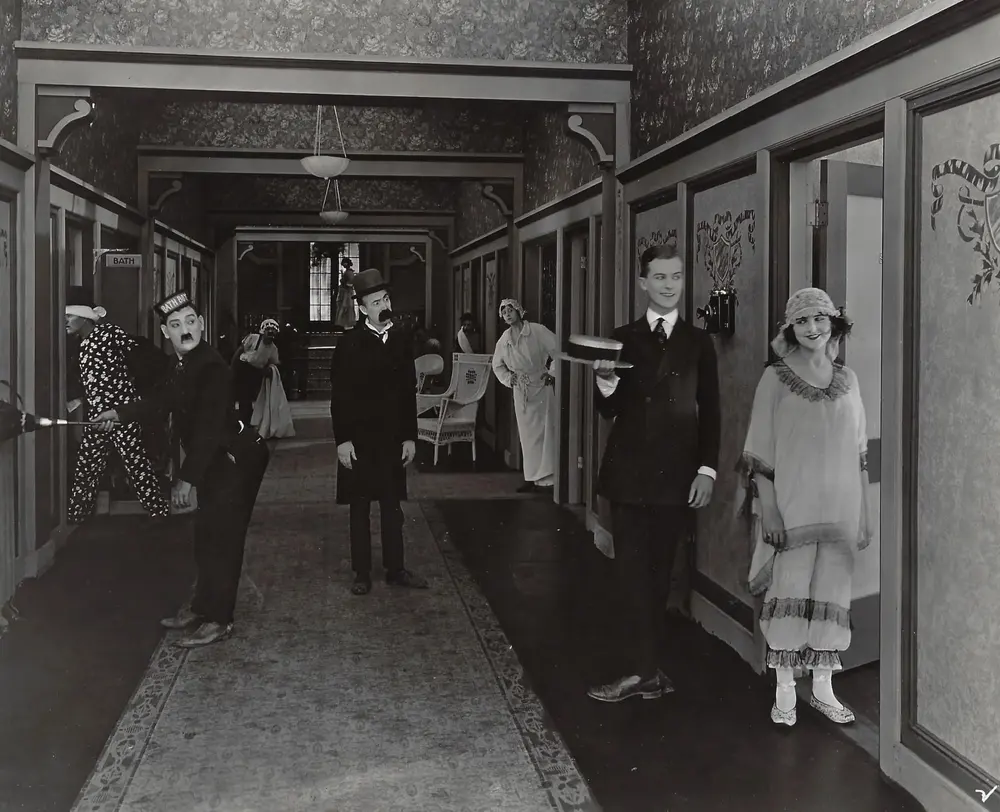
What follows is the silent era’s most eccentric striptease. May dives behind a topiary griffin, frantically shucks every stitch, and re-emerges wearing a three-piece suit that seems tailor-made for a dandy of ambiguous morals. The gender switch is not played for coy “oh-la-la” titillation; rather, it becomes a passport into a shadow carnival where social etiquette is written on rice paper and promptly torn to confetti. Enter the Mysterious Stranger—Albert Ray under a smear of greasepaint and menace—who treats May’s masculine drag as an invitation to hurl custard pies of existential dread her way. He pickpockets her confidence, replaces it with hot bother, and leads her through a gauntlet of public humiliations that climax at a lake where an obliging swan—yes, an actual swan, neck like a question mark—yanks the Stranger into the drink. The moment is both rescue and rebirth, baptism and exorcism, and it happens so fast you half believe the bird was unionized.
Meanwhile, back in the land of literal posters, May’s poodle has been shellacked behind a billboard houri named La Belle Fatima. Every time the poor beast wriggles, the dancer’s cardboard hips gyrate with scandalous elasticity, turning the town square into an impromptu peep-show. The gag is primitive on paper—man pastes dog, dog becomes burlesque puppet—but on screen it vibrates with a proto-surrealist charge that anticipates Buñuel’s eye-slit shenanigans by a full decade. The populace, prim in cloche hats and boaters, respond with synchronized pearl-clutching, as though the very pavement has been scandalized.
Then, because dreams are contractually obligated to cheat, May wakes. The Stranger dissolves into Montague Moon, her flesh-and-blood fiancé; Billie Paste mutates into the household’s bootlegging hall-boy, a whippersnapper who keeps the gentry tipsy with a hose full of hootch. The revelation should feel like a narrative rug-pull, yet the film stages it with such nonchalant sleight-of-hand that the emotional whiplash lands closer to melancholy than relief. All that gender-bent panic, all that public disrobing, was merely the subconscious burping after too much illegal gin. The bath-tub upstairs, monopolized by a female guest who has turned it into a private lagoon, forces May to commission a makeshift Russian bath on the top floor—an architectural afterthought that becomes the stage for the film’s incendiary finale.
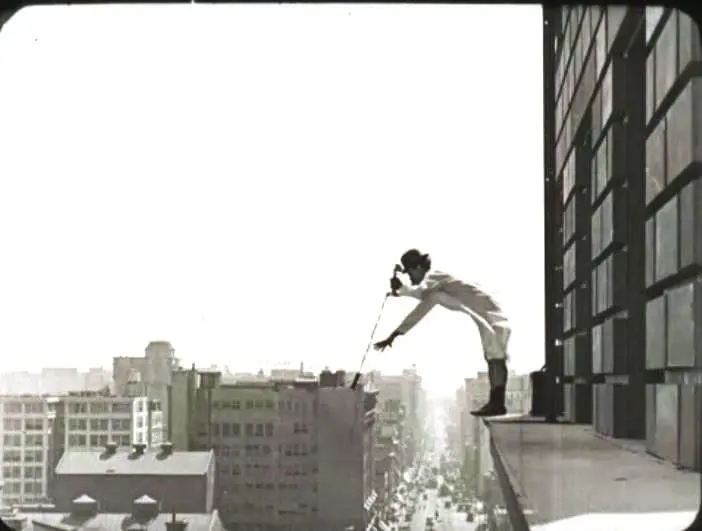
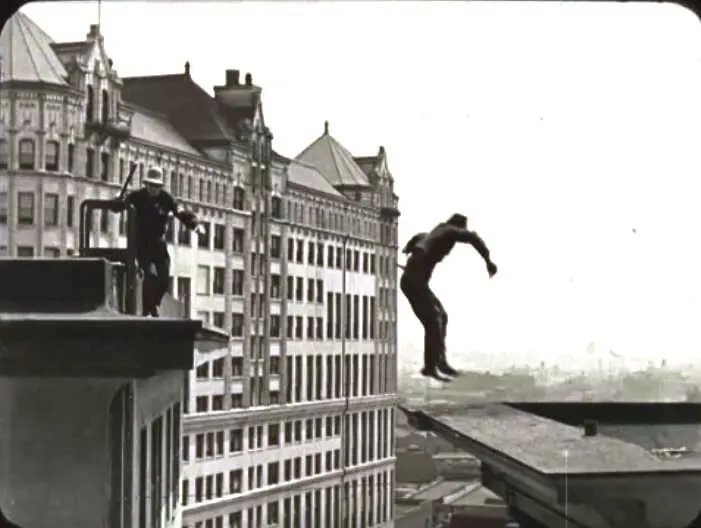
Here Henry Lehrman—the credited writer and, one suspects, chief anarchist—unleashes a Rube Goldberg contraption of catastrophe. The hall-boy and the reincarnated Stranger slink upstairs for a stealthy plunge, only to discover the bathwater has been replaced by a pane of glass—an icy metaphor for the impenetrability of desire. While they puzzle over their bruised knees, a fire ignites in the mattress, because apparently mattresses in 1919 are soaked in kerosene and resentment. Fire extinguishers, filled with the same flammable hootch that fuels the party, transform into Roman candles. Cue a stampede up to the roof, where a fire hose, pressurized by chaos, becomes a bucking bronco that catapults the hall-boy toward the gutter. The Stranger, balanced on a ladder that teeters like a metronome on meth, peers into the chasm of the street below while the building roars with orange delight.
Watching this unfold in a 4K scan—yes, the nitrate was found in a Sicilian lemon-crate—one is struck by how modern the comedy feels. The editing rhythms anticipate the smash-cuts of Edgar Wright; the slapstick is laced with nihilism worthy of Fireman, Save My Gal! yet fleeter, more caffeinated. Consider the tinting: scenes of pastoral flirtation bathe in rose-madder, while the inferno sequence is hand-painted sickly chartreuse, a hue that does not exist in nature but absolutely should. The intertitles, meanwhile, are proto-Beat, all internal rhyme and amphetamine alliteration: “Beware the bloom that boomerangs back!”
Performances oscillate between pantomime broadness and something eerily intimate. Virginia Rappe, doomed to be remembered for a scandal that happened off-screen, here commands the lens with a combustible blend of vulnerability and mischief. When she strides across the garden in borrowed brogues, monocle glinting, she is both conqueror and fugitive, a woman testing how much oxygen audacity requires. Albert Ray’s Stranger channels a young Erich von Stroheim minus the monocled menace, plus a spring-heeled grace that makes every threat feel like an invitation to tango. And Billie Ritchie’s hall-boy—half guttersnipe, half Puck—deserves a doctoral thesis on the art of the conspiratorial eyebrow raise.
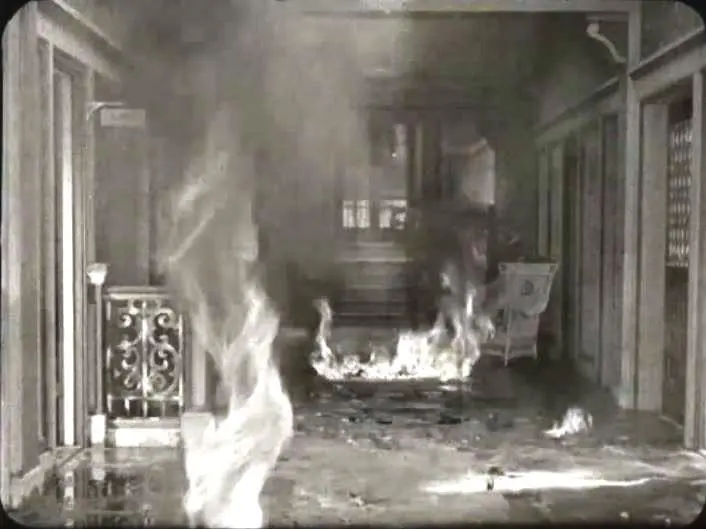
Contextually, the picture slots into 1919’s uneasy interregnum between Victorian gentility and hard-partying Modernism. Prohibition is months away; Spanish flu still rattles in the civic lungs; women have just barely won the vote. Wet and Warmer metabolizes all that social vertigo and exhales it as farce. The gender-swap subplot isn’t mere titillation—it’s a test drive for new freedoms, a dare posed to patriarchal tailoring. The bootleg liquor sloshing through every corridor whispers that the coming dry years will be anything but, while the rooftop conflagration feels like a dress-rehearsal for the decade’s coming implosions (Fatty Arbuckle scandal, Rappe’s own death, the death of silent comedy itself).
Comparative glances prove illuminating. The dream-to-reality rug-pull predates La gitana blanca’s romantic fatalism by two years, while the pyrotechnic finale rhymes with the burning warehouse climax of Paid in Full, though Lehrman’s film is lighter on moralizing and heavier on hallucination. Meanwhile, the gender-bending anticipates Hypocrites’ allegorical nudity, but Wet and Warmer keeps its subversions zipped inside tweed and twill.
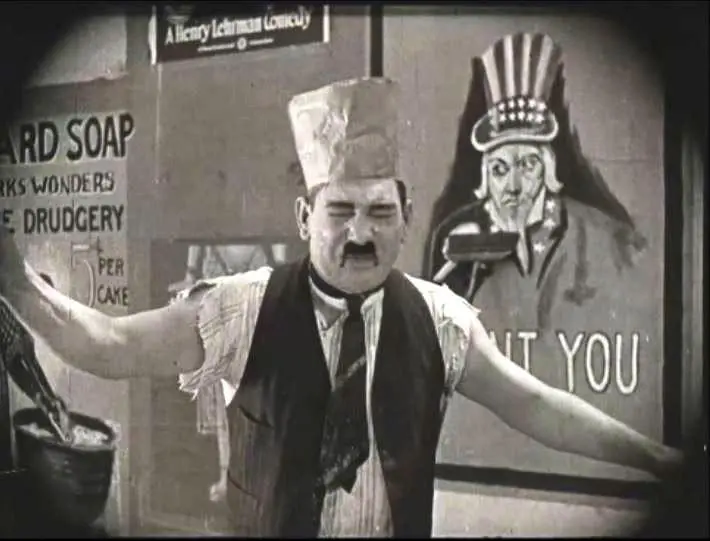
Caveats? Certainly. The oriental-dancer billboard gag hasn’t aged with grace; modern viewers will wince at the minstrelsy-adjacent caricature. And the film’s pacing—originally stretched to 24 minutes—can feel breathless to the point of aneurysm. Yet these flaws feel less like moral failings than archaeological scars, reminders that comedy has always walked a tightrope between subversion and sour taste.
So is Wet and Warmer a lost masterpiece? Let us not hyperventilate. It is, rather, a cracked kaleidoscope: when rotated toward the light it scatters verdant, venomous, iridescent fragments across the wall—brief, beautiful, and just sharp enough to draw blood. Watch it for Rappe’s mercurial charisma, for the swan’s deadpan heroics, for the tinting that makes fire look like liquid absinthe. Watch it because spring, that mischievous old drunk, keeps returning, and every so often it needs to be reminded that clothes—like gender, like propriety—are but temporary tattoos we wear to keep the fleas of chaos at bay.
Verdict: 8.7/10—essential for silent slapstick scholars, gender-studies insomniacs, and anyone who ever suspected that dreams are just reality with better production design and worse safety protocols.
IMDb —
1916
Community
Log in to comment.