DbcultAccessing Vault...
Cult Review
Senior Film Conservator
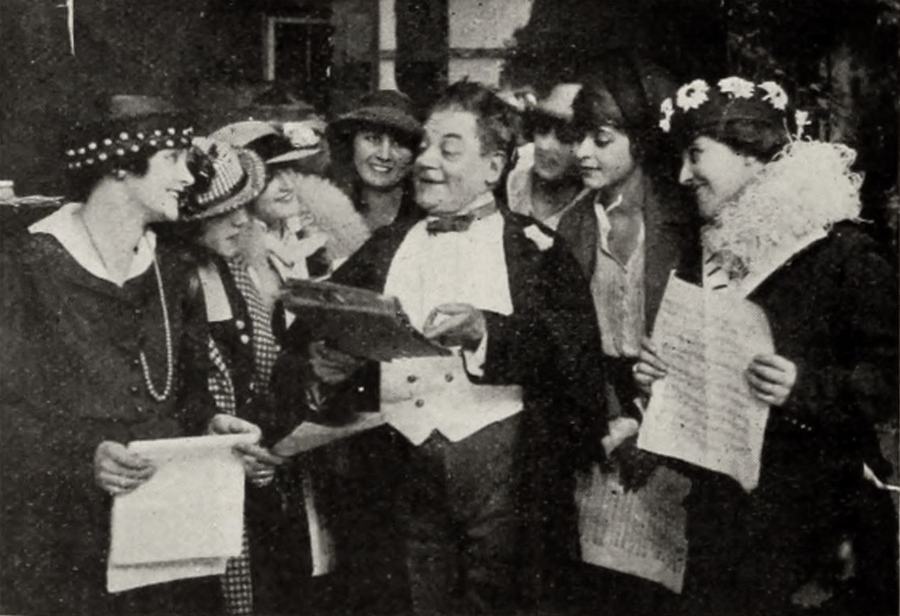
The premise alone feels like a Marx Brothers fever dream filtered through a Balzac ledger: Father, whose pockets jingle only with promissory notes, decides that art—specifically a frog-themed comic opera—will ransom his solvency. The gamble is so nakedly preposterous that the film’s title card might as well read: “What happened to Father? Capitalism happened.” Yet within this silent one-reeler lies a kinetic portrait of American anxiety circa 1915, when patriarchal authority was already wobbling on the pedestal of industrial modernity.
Carelton Bayne—part Barnum, part Pepe Le Pew—enters wearing spats so polished they mirror his ulterior motives. He bankrolls Frolic of the Frogs not for cultural philanthropy but for the intoxicating proximity to Father’s blossom-lipped youngest. The transactional haze is almost proto-noir: influence traded for flesh, applause for ownership. One senses that if the camera dollied any closer we would smell pomade and predation in equal wafts.
Fredericka’s matrimonial rite becomes the film’s ironic counter-melody: white lace, orange blossoms, and a congregation ignorant of the greasepaint apocalypse brewing downtown. When Father commandeers the honeymoon Pierce-Arrow—still festooned with tissue-paper roses—he effectively kidnaps his own family’s future, leaving the altar vacant and the organist vamping a mortified fugue. The sequence is cut like a chase through a carnival mirror: every turn reveals another strata of social embarrassment.
Arriving backstage, Father finds the production hemorrhaging talent; egos defect faster than rats on the Titanic. The ousted prima donna sobs into her ostrich fan while Bayne’s former paramour practices scales that sound like a hacksaw on sheet-metal. With less than an hour to ventilate, Father volunteers himself as the tenor lead—despite never having sung a note that didn’t frighten household pets. The resultant dress rehearsal is pure pandemonium: scenery wobbles, sheet-music becomes paper airplanes, and a chorus boy forgets whether he is a frog or a policeman, settling on a hybrid that hops in blue serge.
When the curtain rises, the audience—restless, powdered, reeking of gardenias—expects spectacle. What they receive is a sacrificial offering: Father, trussed in doublet and hose, flips from one bungled aria to the next, each missed cue a fresh wound. The boos begin as a murmur, swell into cyclonic jeers, and climax in a pelting of peanut shells. It is impossible to watch without recalling the existential comedies of The Golem, where the protagonist’s very existence is an affront to civic order.
Unable to suffer Bayne’s smug balcony guffaws, Father vaults into the proscenium box and delivers a haymaker worthy of Dempsey. The punch lands with such cartoon velocity that Bayne’s toupee pirouettes into the orchestra pit, where the conductor wields it like a baton. Minutes later Father is shackled, carted off to a jailhouse straight out of Dickens—if Dickens had allowed the inmates to harmonize in barbershop seventh-chords.
Behind bars Father discovers a motley troupe of pickpockets, forgers, and moonshiners who possess the theatrical instincts Stanislavski only dreamed of. Together they stage a diversionary revue so raucous that the warden forgets to lock the rear gate. The escape—executed via laundry chute, produce wagon, and one very confused goat—ranks among the era’s most inventive set-pieces, rivaling even the serial derring-do of An Odyssey of the North.
What follows is a breathless montage: Father clings to a delivery truck’s tailgate, swings aboard a fire-escape, crashes a suffragette rally where he is mistaken for the keynote speaker, then careens through Chinatown paper-lanterns that explode like festive artillery. Each locale is rendered in chiaroscuro by cinematographer John Hollis, whose love of low-key lighting anticipates German Expressionism even while servicing slapstick.
Ultimately Father staggers back to the church, tuxedo in tatters, boutonniere replaced by a policeman’s cufflink. Fredericka—no longer the tremulous bride but a resolute woman—descends the nave to embrace her disheveled progenitor. The ceremony resumes, now enriched by the oxygen of shared absurdity; the organist transitions from Wagner to a jaunty two-step, and even Bayne—face bandaged—offers a conciliatory wink. Love, like opera, requires improvisation.
Sellery’s performance is a master-class in calibrated hysteria: eyebrows semaphore distress, knees oscillate like faulty pendulums, yet the eyes remain plaintive, anchoring the clown in recognizably paternal panic. One sees echoes of his contortions in later titans—Keaton’s stoic grace, Langdon’s infantile bewilderment—but Sellery’s DNA is uniquely combustible.
Cecilie B. Peterson and mystery novelist Mary Roberts Rinehart lace the scenario with proto-feminist barbs: the elder daughter engineers her own marital destiny while the youngest wields parasols like épées. Dialogue titles crackle with Jazz-Age verve: “A creditor is just a pessimist with a timetable.” Such aphorisms glitter amid the mayhem, reminding viewers that satire—not sentiment—is the film’s true libretto.
In its anarchic spirit, What Happened to Father dovetails with the continental cynicism of Prestuplenie i nakazanie, yet replaces Russian gloom with American bounce. Conversely, its backstage back-stabbings prefigure the sexual-political chess matches of The Battle of the Sexes. And when Father languishes in his moonlit cell, one recalls the existential imprisonment of The Devil, though here salvation arrives not via metaphysical pact but via pratfall.
Tinted prints survive in archives: amber for domestic interiors, cerulean for exteriors, rose for the opera house, and sickly green for the frog choruses. These chromatic choices lend emotional shorthand, steering the viewer through tonal whiplash. Even in monochrome descriptions, reviewers of the day raved about “a rainbow that giggles.”
The film’s climactic chase cross-cuts between five parallel actions—altar, opera house, jail, produce wagon, suffragette march—anticipating Soviet montage by nearly a decade. Yet montage here serves not agitprop but adrenaline, a democratic embrace of chaos as the great American equalizer.
Exhibitors were advised to accompany the opera scenes with Offenbach pastiche, the jailbreak with Sousa marches, and the wedding with Mendelssohn filtered through ragtime. Such mash-ups foreshadow the ironic needle-drops of modern cinema, proving that even without synchronized dialogue, the film negotiates its own sonic irony.
Contemporary viewers, fatigued by algorithmic sameness, will discover a film that pirouettes on the knife-edge between order and entropy without ever tumbling into nihilism. It is a 63-minute espresso shot of possibility, reminding us that catastrophe and carnival share a hyphen in American English.
Father’s calamity is ours: we write operas on credit, marry futures on spec, and occasionally must punch the patron who bankrolls our dreams. The miracle is that the curtain keeps rising, the wedding march keeps playing, and somewhere a goat still chews the cuff of every great escape.
Seek What Happened to Father in the digital stacks, project it against your living-room wall, and let its flicker remind you that solvency is transient, but family—bruised, bewildered, and bound by laughter—endures the longest reel of all.
IMDb 5.4
1935
Community
Log in to comment.