DbcultAccessing Vault...
Cult Review
Senior Film Conservator
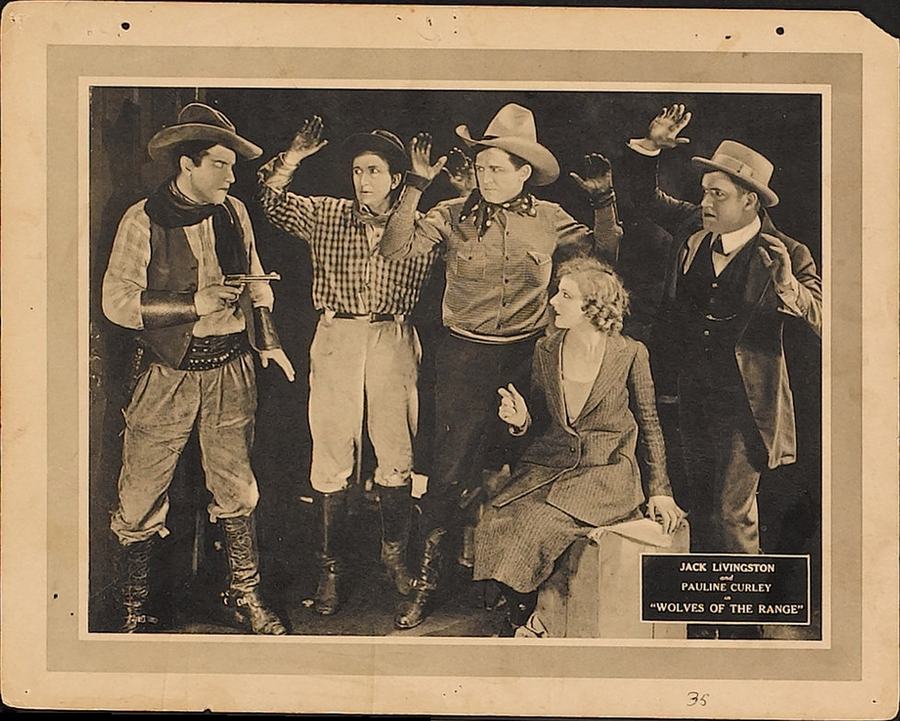
The first thing that strikes you about Wolves of the Range is how willingly it dirties its own fingernails. While contemporaries like The Haunted Pajamas preferred bedroom farce and Wife or Country trafficked in jingoistic sermonizing, this 1943 Alpha Pictures release plunges straight into the petroleum muck of a rigged economy. Director Wallace W. Fox shoots the opening credit sequence over a montage of oil derricks jack-hammering the earth like mechanical wolves, their silhouettes gnawing a bruised horizon. It’s a visual thesis statement: every barrel extracted costs somebody skin.
Jack Livingston’s Jim Hudson never strides into a room—he arrives as a ledger of liabilities. The actor, usually tasked with upright blandness in programmers like Hard Cider, here lets anxiety twitch beneath his cheekbones. When he signs the ranch over to the bank, the quill scratches parchment with the sickly rasp of a bone saw. Screenwriter Constance L. Brinsley, who had previously doled out piety in Hearts of Men, suddenly wields melodrama like a scalpel, carving out a protagonist who is simultaneously the picture’s white hat and its most endangered debtor.
The rodeo subplot—often dismissed as mere cowboy window-dressing—functions instead as a microcosm of American risk culture. The bronc Diablo is no animal but a four-legged foreclosure notice; every sun-bleached spectator in the stands holds a betting slip on Hudson’s vertebrae. Fox and cinematographer Marcel Le Picard film the sequence in long takes that stretch tension like wire. Dust motes ignite in the projector beam, turning the arena into a cosmic courtroom where the verdict is delivered via eight-second eternity.
As Cora, Pauline Curley refuses to inhabit the thankless porcelain-damsel slot typical of 40s oaters. Watch her eyes when Arthur Blake, silk-voiced and serpentine, proposes a “business marriage.” Curley lowers her gaze half a beat, then snaps it back up with the recoil of a pistol hammer. It’s a micro-gesture that signals complicity-turned-mutiny, a harbinger of the third-act abduction that will invert power dynamics. Compared to the ethereal suffering she projected in Graziella, here she weaponizes stillness; her silence in Blake’s parlor is more deafening than any scream.
Character actor John Merton, saddled throughout his career with monosyllabic henchmen, gets the role of a lifetime in Arthur Blake. Dressed in charcoal worsted that drinks in lamplight, Blake embodies the film’s core terror: legal theft. His embezzlement of Cora’s trust isn’t a subplot—it is the plot, the invisible machinery that herds our hero toward the rodeo chute. In an inspired set-piece, Blake tallies ledger entries while a phonograph croons “Sweet Genevieve,” turning nostalgia into an anesthetic. The moment foreshadows the kidnapping: both are acts of bookkeeping, reducing human beings to line items.
Where Fantômas: The False Magistrate used Parisian sewers to mirror criminal subterranea, Wolves employs gushing crude as moral solvent. When Hudson’s father strikes black gold, euphoria leaks into every frame—until the vultures circle. The film stages a montage of con-men in straw boaters, each promising faster pumps, richer seams, miracle bonds. Their patter syncopates with footage of actual oil fires, turning enterprise into apocalypse. No other B-western of the era dared implicate the spectator so nakedly; we, too, want the geyser, the payout, the dream.
The kidnapping, staged in a derelict way-station once used by the Pony Express, plays like The Silent Barrier turned inside out. Daylight, usually the ally of western righteousness, here exposes every splinter, every rusted nail. Fox shoots through broken clapboard, fracturing the screen into a jigsaw of captivity. Cora’s rescue isn’t a gallic charge but a stalking sequence: Hudson’s spurs muffled by sawdust, the creak of Blake’s revolver echoing like a death-knell. When the two men finally grapple, the fight is clumsy, visceral—fists mis-swing, furniture splinters. It’s violence without choreography, truth without varnish.
Stack Wolves of the Range beside On with the Dance, another 1943 release, and you see how economically Fox conjures scope. Both films were shot in under ten days, yet Dance feels like community-theater cabaret while Range carves Monument Valley out of back-lots and stock footage. Likewise, Neptune’s Daughter splurged on Esther Williams’ aquabelle extravagance; Range achieves spectacle through scarcity—empty skies, unpaid bills, a single horse no man can ride.
Listen past the dialogue and you’ll hear a sonic double-plot: wind harassing telephone wires, the metallic heartbeat of pumpjacks, the syncopated clatter of a telegraph spelling out foreclosure. Composer Frank Sanucci limits himself to two themes—a minor-key waltz for Cora’s inheritance blues, a riotous fiddle reel for rodeo days—then lets ambience do the rest. The absence of score during Hudson’s night ride to rescue Cora turns hoofbeats into percussion, crickets into choir. It’s a lesson modern thrillers could crib: silence can be a stake-through-the-heart louder than any orchestra sting.
Unlike Mrs. Erricker’s Reputation, where a woman’s virtue is her tradable stock, Range posits Cora’s dowry as the commodity and Cora herself as the reluctant broker. Yet the film grants her agency in the ledger’s final column: she bankrolls Hudson’s rodeo fee, slipping him a pawn-note against her own jewelry. It’s a fleeting beat, easily missed, but it reconfigures the damsel as silent partner, hinting at post-war shifts when women would balance checkbooks while men balanced on broncs.
Shot for roughly the cost of Jack and the Beanstalk ‘s catering budget, Wolves nevertheless stages several images that sear the cortex: Hudson framed between the legs of a rearing horse, the animal’s belly blotting out the sun; Blake’s shadow lengthening across a mortgage deed until it resembles a noose; Cora’s torn dress fluttering from a shack window like a surrender flag that refuses to wave. These flourishes testify to Fox’s ability to mine lyricism from thrift, a trick Poverty Row maestros learned from German expressionists fleeing L.A. with nothing but light and plywood.
Major studio westerns of the era—think Barbarous Mexico—reward virtue with deed-in-hand closure. Fox denies us that palliative. Yes, Blake is arrested, Cora emancipated, Hudson upright in the saddle, but the ranch remains mortgaged, the gushers still burn, and the bank’s shadow looms like a vulture. Final shot: Hudson and Cora ride toward a sunrise that looks suspiciously like another oil fire. It’s an ending that keeps the audience indentured, a reminder that in America’s extractive carnival, every buckle won is merely another bill to pay.
Seventy-eight years on, Wolves of the Range survives only in dupey 16mm prints and gray-market rips, yet its DNA snakes through everything from The Wrestler ‘s bodily gamble to There Will Be Blood ‘s petroleum baptism. The film’s rodeo DNA even echoes in European art houses—compare Hudson’s existential eight seconds to the Sisyphean tug-of-war in Prøvens Dag. Such is the strange immortality of Poverty Row: dismissed on arrival, resurrected by cine-poets mining thrift-shop nightmares for graduate-thesis gold.
So if you stumble across a battered DVD-R labeled Wolves of the Range, pay the flea-market ransom. Pop it in at midnight, turn the lights low, and let its grainy anxieties seep through your floorboards. You’ll witness a film that knew, long before the rest of us, that the American dream was mortgaged to the hilt, payable in blood, sweat, and crude.
IMDb 5.8
1929
Community
Log in to comment.