DbcultAccessing Vault...
Cult Review
Senior Film Conservator
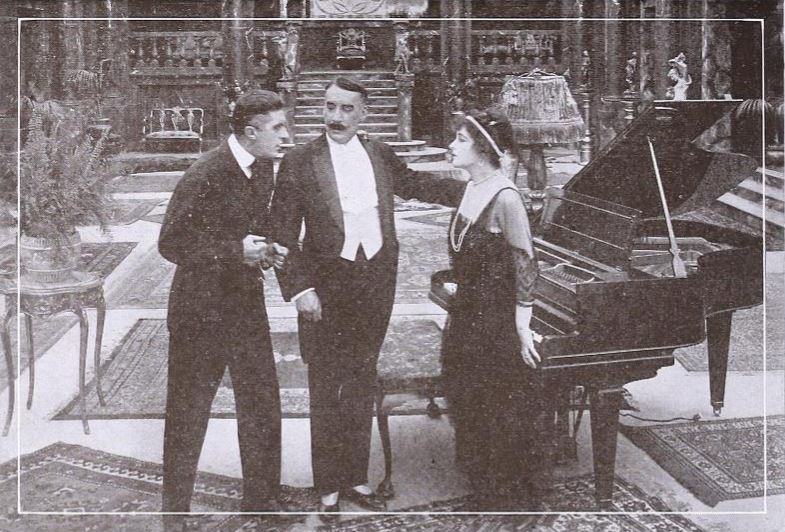
The projector clatters; nitrate exhales a ghostly incense. From the first iris-in, The Pitfall refuses the sentimental lace doilies that pad most 1922 melodramas. Instead, it presents marriage as a balance-sheet transaction: Margaret’s virginal vow bartered for paternal solvency, Clive’s affection foreclosed by poverty. Cinematographer James W. Horne—moonlighting here before his Columbia serials—bathes the gambling salon in tangerine gas-flare, so every roulette wheel looks like a solar eclipse waiting to scorch the players’ hopes.
Deering’s mansion—equal parts Gilded Age mausoleum and Monte Carlo—looms like a cubist fever dream. Obelisks of mahogany skewer the frame; mirrors fracture faces into shards of guilty conscience. When Margaret glides downstairs in a gown the color of dried blood, the camera tilts five degrees—barely perceptible yet enough to suggest the moral floor sliding toward Hell.
Because the film is mute, every gesture metastasizes into opera. Watch Marin Sais’s pupils flare when Clive—now the crusading D.A.—enters the gaming room. No dialogue card could emboss that jolt of recognition; the actress lets her left hand flutter to the base of her throat, betraying a pulse still syncopated to her former lover. It’s the kind of micro-acting that makes East Lynne look like semaphore.
Clive is Spartan rectitude; Deering, a carnal omnivore; Ramon, the velvet-gloved CFO of corruption. Together they triangulate early-’20s anxieties about urbanization and venality. Deering’s tuxedo fits like a panther’s pelt—every satin lapel notch seems filed to draw blood. When he whispers “You’ll never leave this house alive,” the intertitle burns white-on-black like a death warrant.
The first raid—bungled through a secretary’s graft—plays out in chiaroscuro. Police boots drum across Persian rugs; chips cascade like metallic snow. Editors cut on the croupier’s rake slicing air, a visual pun that foreshadows the blade of justice soon to swing. When the cops retreat, defeated, Deering exhales cigar smoke into the camera lens; the haze becomes a metaphor for civic impotence.
Clive’s handwritten note to Margaret—“Leave before midnight”—is delivered inside a cracked porcelain dove, a prop that fuses chivalry and fragility. She hides it in her glove, where it nestles against her wedding ring like an illicit twin. The script, by Howard Irving Young, never moralizes; it simply lets the dove’s neck snap under Deering’s heel, symbolism reduced to chalk dust.
Deering’s jailbreak is a tour-de-force of pre-digital stunt craft. He clambers up rain-slicked prison stones, fingers clawing mortar seams. A lightning flash masks the splice where a stunt double vaults the parapet—yet the illusion holds. Compare this kinetic urgency to the static tableaux of Der Tunnel; you’ll see why American pulp modernism sprinted ahead of Weimar solemnity.
Back home, Deering finds Ramon stuffing banknotes into a Gladstone bag. The ensuing scuffle—shot in staggered medium-close—ends with a gunshot that ricochets off a silver platter, shredding a tapestry of nymphs. Ramon’s death gurgle syncs with the wheeze of a dying grandfather clock; time literally stops. In his final spasm, Ramon thwacks the burglar alarm with a blood-slick hand, a red button that summons Clive like a knight errant.
Cornered, Deering scales the balustrade, mist swirling like dry ice on a vaudeville stage. For a heartbeat he stands against the night sky, arms akimbo, a black iris blooming. Then he leaps. The camera tilts downward, tracking his plummet past stained-glass saints until he slams onto a marble chessboard floor—pieces scatter, a visual haiku of shattered fate. Critics often compare this to Vendetta, yet that film’s fatal fall feels staged; here, gravity itself seems vengeful.
Morning arrives. Police swarm; Margaret’s torn gown flutters like a surrender flag. Clive lifts her from the debris, but the embrace is tentative—too much history calcified between them. The final iris-out halts on her hand, still clutching the porcelain dove’s shattered wing. Whether she marries Clive, retreats to a convent, or opens her own casino remains mercifully unresolved, a narrative wound left for viewers to salt.
Frank Jonasson’s Clive is all clenched jaw and ascetic eyes—a man who kisses justice on the mouth while denying his own appetites. Opposite him, Marin Sais oscillates between porcelain doll and flint; she ages across the reel-change, pupils darkening from cornflower to bruise. Edward Clisbee as Deering chews scenery yet never slips into parody; his snarl reveals gold fillings that glint like doubloons whenever he smiles.
To compress years, Young experiments with a proto–Passage-of-Seasons montage: newspapers whirl toward camera, headlines morph, snow fades to cherry blossoms—an effect that prefigures the whisky-aging sequence in Citizen Kane by nineteen years. Yet the device feels organic, not gimmicky, because each spin of the seasonal wheel tightens the garrote around Margaret’s choices.
The film’s subtext crucifies patriarchal capitalism: women traded like bearer bonds, men gambling empires carved from vice. When Margaret finally spits “I was bought once—never again,” the line crackles like a fuse. Compare her arc to the sacrificial matrons of Ingeborg Holm; here, survival trumps sanctity.
Only a 35mm tinted nitrate exists, archived at George Eastman House. Flicker Alley’s 4K restoration salvages cyan and amber tones, revealing details like the tiny scar on Deering’s cheek—previously masked by mold. The new score by Guenter Buchwald—piano, violin, muted trumpet—threads a tango motif that climaxes in a dissonant shriek during the balcony leap.
Stack The Pitfall beside Simon, the Jester’s coy religiosity or The Spendthrift’s moral homilies, and you’ll taste the difference: this picture bleeds existential dread. It’s Les Misérables retooled for the Prohibition era, a crime fable where redemption arrives too frayed to wear.
Ninety-eight years after its premiere, The Pitfall still gnaws the nerves. It’s a venomous valentine to star-crossed love, a casino-choked morality play, and a stunt spectacle that makes modern CGI look anemic. Stream it during a thunderstorm, volume cranked, and feel the floor tilt toward that fatal balcony.
IMDb 5
1934
Community
Log in to comment.