DbcultAccessing Vault...
6.8/10
Senior Film Conservator
A definitive 6.8/10 rating for a film that redefined the boundaries of cult cinema. When Doctors Disagree remains a cornerstone of transgressive art.
Stepping back into the silent era is often an exercise in historical appreciation, but every so often, a film emerges from the archives that transcends its temporal boundaries, speaking to universal human experiences with a wit and charm that remain undimmed. "When Doctors Disagree", a cinematic confection from 1919, is precisely such a treasure. It's a delightful concoction of mistaken identity, blossoming romance, and pointed social commentary, all wrapped in the effervescent packaging of a silent comedy. For modern viewers, it offers more than just a glimpse into early filmmaking techniques; it provides a vibrant, often uproarious, narrative that still resonates with its exploration of ambition, deception, and the serendipitous nature of love.
The narrative spine of "When Doctors Disagree" is a masterclass in escalating comedic chaos, a testament to the ingenuity of writer Anna F. Briand. We are introduced to Millie Martin, a young woman whose aspirations for social grace are continually thwarted by the iron fist of her father's parsimony. Her yearning for something beyond her modest circumstances is poignantly underscored during the May Day festivities in Ferryville, where she witnesses an incident that, perhaps surprisingly, sets the entire convoluted plot in motion. Violet Henry, the daughter of the town's wealthiest citizen, finds herself unceremoniously dunked into a stagnant pool by the "village bolshevik" – a delightful, if anachronistic, descriptor that immediately establishes the film's playful engagement with class dynamics. This act of populist defiance, instead of eliciting sympathy, tickles Millie's penny-pinching patriarch, who, in a rare moment of mirth-induced generosity, bestows upon his daughter a singular dollar.
Millie, with the pragmatism born of deprivation, immediately invests her newfound capital in a jar of beauty cream, a small but significant step towards her impending first railway journey. This journey, a symbol of her nascent independence and desire for a more glamorous life, becomes the crucible for her encounter with John Turner. John is not, as he appears, a man of medicine, but a carpet layer thrust into an identity crisis. His transformation into a faux physician is born of necessity and a touch of desperation: a high-stakes poker game, a perceived fatality, and the quick-witted appropriation of his uncle's railway ticket and doctor's bag. Here, the film skillfully lays the groundwork for the central conceit of mistaken identity, a trope that has fueled countless comedies, from Shakespearean farces to modern blockbusters. The sheer audacity of John's deception, coupled with his genuine panic, creates an immediate comedic tension.
Millie, ever the opportunist, seizes upon John's apparent medical profession, feigning a toothache to garner his attention. This is a classic romantic comedy maneuver, a small deception designed to spark connection. However, her father's chronic stinginess once again intervenes, prescribing chewing tobacco as a domestic remedy, a truly bizarre and hilarious alternative to a costly doctor's visit. When Millie inadvertently swallows this potent cure, the stage is set for John's most audacious performance yet. Embracing his adopted persona with newfound gusto, he dramatically orders an immediate operation, leading to an impromptu stop at a nearby sanitarium. The absurdity of a carpet layer performing surgery on a girl who swallowed tobacco is pure comedic gold, a testament to the film's commitment to heightening the stakes through ludicrous circumstances.
The sanitarium sequence further ratchets up the farcical elements. Millie, understandably terrified by the prospect of an unqualified surgical procedure, makes a daring escape. Her subsequent discovery by John in a room with a baby adds another layer of delightful confusion, leading to a crucial moment of mutual explanation. It's in these quiet, yet still visually expressive, moments that the characters begin to peel back their layers of pretense, allowing their genuine personalities and burgeoning affection to shine through. The film's ability to transition from broad physical comedy to more character-driven humor without losing momentum is one of its quiet strengths.
The climax of the comedic imbroglio arrives with John being mistaken for a burglar, a natural progression given his suspicious behavior and clandestine movements. This final twist intensifies the stakes, pushing the characters to their breaking point before the inevitable resolution. It is the timely arrival of John's uncle, the true owner of the doctor's bag and ticket, that finally untangles the intricate web of deceit and misunderstanding. With identities clarified and intentions revealed, John and Millie are liberated from the shackles of their chaotic circumstances, free to pursue a romance forged in the fires of farce. The ending is satisfyingly conventional for a silent comedy, affirming the triumph of love and honesty over pretense, however well-intentioned.
The success of "When Doctors Disagree" hinges significantly on the charismatic performances of its lead actors, Fritzi Ridgeway as Millie Martin and William Buckley as John Turner. Ridgeway, with her expressive face and energetic physicality, masterfully embodies Millie's blend of youthful ambition, resourcefulness, and vulnerability. Her portrayal of a young woman striving for a better life, willing to engage in minor deceptions to achieve her aims, makes her an immediately relatable and endearing protagonist. Her feigned toothache is a particular highlight, a wonderfully understated piece of comedic acting that speaks volumes without a single word.
William Buckley, as the unwitting imposter John Turner, delivers a performance that balances frantic panic with a burgeoning romantic charm. His initial desperation, born from the poker game incident, quickly gives way to a surprisingly convincing, if completely unqualified, medical persona. Buckley's ability to convey both his character's internal turmoil and his outward attempts at composure is crucial to the film's humor. The chemistry between Ridgeway and Buckley is palpable, evolving from initial suspicion and deception to genuine affection, forming the emotional core that anchors the comedic excesses.
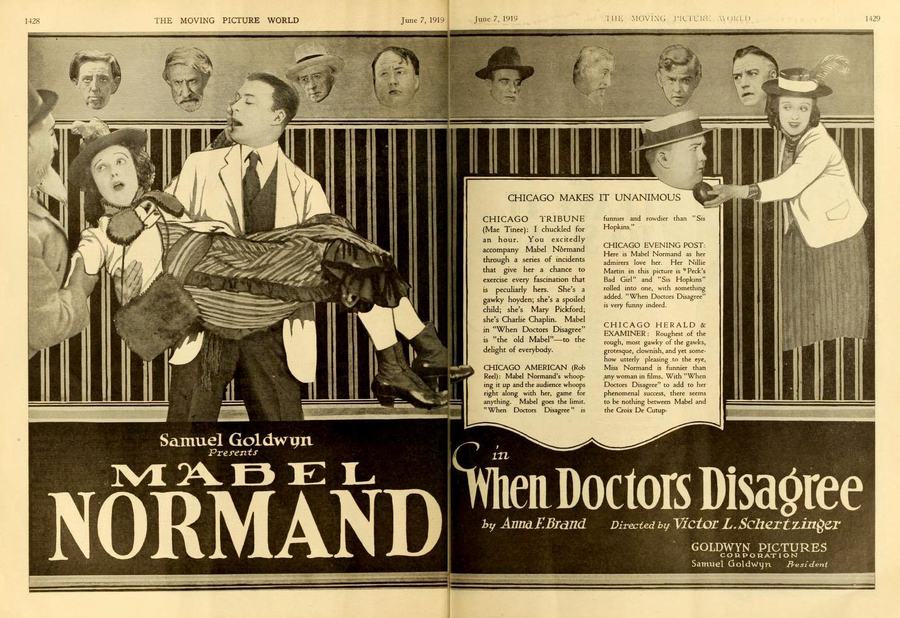
Supporting players like Alec B. Francis, portraying Millie's notoriously stingy father, add vital texture to the film's comedic landscape. Francis's character is a caricature of miserliness, yet his moments of accidental generosity and his bizarre medical advice ("chewing tobacco for a toothache!") are consistently amusing. James Gordon, George Nichols, and Walter Hiers, though perhaps with less screen time, contribute effectively to the ensemble, ensuring that the world of Ferryville and the train journey feel populated by distinct, if often eccentric, individuals. The ensemble's collective ability to convey character and narrative through exaggerated gestures, facial expressions, and precise physical comedy is a testament to the art of silent film acting.
Beyond its surface-level comedic brilliance, "When Doctors Disagree" subtly weaves in several thematic strands that elevate it beyond mere slapstick. The most pronounced is the theme of social class and aspiration. Millie's initial plight, her lack of proper clothes, and her father's stinginess immediately establish her as someone on the lower rung of the social ladder, yearning for upward mobility. Her purchase of beauty cream isn't just vanity; it's a symbolic investment in a perceived better future. The incident with Violet Henry, the rich man's daughter, and the "village bolshevik" is a clear, if lighthearted, nod to the simmering class tensions of the era. The film, in its own charming way, suggests that even in a world of rigid social structures, individual ingenuity and a touch of daring can open doors.
The pervasive theme of mistaken identity and deception is, of course, central. John's adoption of a doctor's persona, Millie's feigned toothache – these are not malicious acts but rather desperate attempts to navigate challenging circumstances or to forge connections. The film explores the thin line between necessary pretense and outright fraud, ultimately arguing for the power of honesty to resolve chaos. This thematic element finds echoes in other films of the period, where characters often assume new identities to escape pasts or seize opportunities. One might draw a parallel to the intricate deceptions found in mystery thrillers like The House of Fear or the dramatic irony prevalent in The False Friend, though "When Doctors Disagree" leans heavily into the comedic potential rather than the suspense.
Furthermore, there's a playful critique of medical authority and folk remedies. Millie's father's absurd chewing tobacco cure and John's unqualified diagnosis highlight a certain public skepticism towards formal medicine, or at least a humorous acknowledgment of the era's varying approaches to health. It's a subtle jab that adds another layer of social commentary to the narrative, reflecting perhaps a time when medical science was still consolidating its authority. The film, in its gentle lampooning, invites us to question superficial appearances and the pronouncements of those in perceived positions of power.
While the director is not explicitly credited in the provided information, the film's narrative coherence and comedic timing speak volumes about the craftsmanship involved in its production. Anna F. Briand's writing is undoubtedly the backbone, providing a tightly structured plot that allows for both character development and escalating farce. Silent films relied heavily on visual storytelling, and "When Doctors Disagree" excels in this regard. The staging of scenes, the exaggerated yet clear expressions of the actors, and the use of intertitles to convey essential dialogue and plot points are all handled with a practiced hand. The film effectively uses its settings – from the bustling May Day celebration to the confines of a train carriage and the sterile environment of a sanitarium – to create distinct atmospheres that enhance the narrative.
The pacing is brisk, a characteristic often found in successful silent comedies, which understood the importance of maintaining momentum to keep audiences engaged without the benefit of spoken dialogue. Each scene builds upon the last, adding new layers of complication or revelation that propel the story forward. This energetic rhythm is essential for a film that relies on a constant stream of misunderstandings and near-misses. The visual gags are well-executed, from the initial dunking of Violet Henry to Millie's horrified reaction to the proposed surgery, all contributing to the film's overall lighthearted and engaging tone. Comparisons could be made to the spirited narrative drive of other period comedies, perhaps even some of the more elaborate escapades seen in films like There Goes the Bride, if that film shared a similar comedic tempo and focus on romantic entanglements amidst chaos.
In an era of cinematic experimentation and rapid evolution, "When Doctors Disagree" stands as a charming example of a well-crafted silent comedy. It doesn't aim for the epic scale of a D.W. Griffith production or the profound social commentary of a more dramatic work, but rather delights in its tightly constructed plot and effervescent humor. Its enduring appeal lies in its relatable characters and its exploration of universal themes like the desire for upward mobility, the awkwardness of burgeoning romance, and the comedic potential inherent in human error and deception.
For film historians and casual viewers alike, this film offers a valuable insight into the comedic sensibilities of the late 1910s. It showcases how silent cinema, even without synchronized sound, could create intricate plots, develop engaging characters, and elicit genuine laughter and empathy from its audience. The film's ability to balance its farcical elements with a genuine sense of romance is particularly noteworthy, preventing it from devolving into mere slapstick. It reminds us that good storytelling, compelling characters, and a keen understanding of human foibles are timeless ingredients for cinematic success.
Ultimately, "When Doctors Disagree" is more than just a historical curiosity; it's a vibrant, entertaining piece of cinematic art that continues to charm over a century after its release. It offers a delightful escape into a world of innocent deception, unexpected romance, and the kind of good-natured chaos that still manages to bring a smile to one's face. If you're looking for a silent film that delivers on both laughs and heart, this forgotten gem is a prescription for pure enjoyment. It's a testament to the fact that sometimes, even when doctors – or carpet layers pretending to be doctors – disagree, the outcome can be surprisingly delightful.
IMDb —
1924
Community
Log in to comment.