DbcultAccessing Vault...
Cult Review
Senior Film Conservator
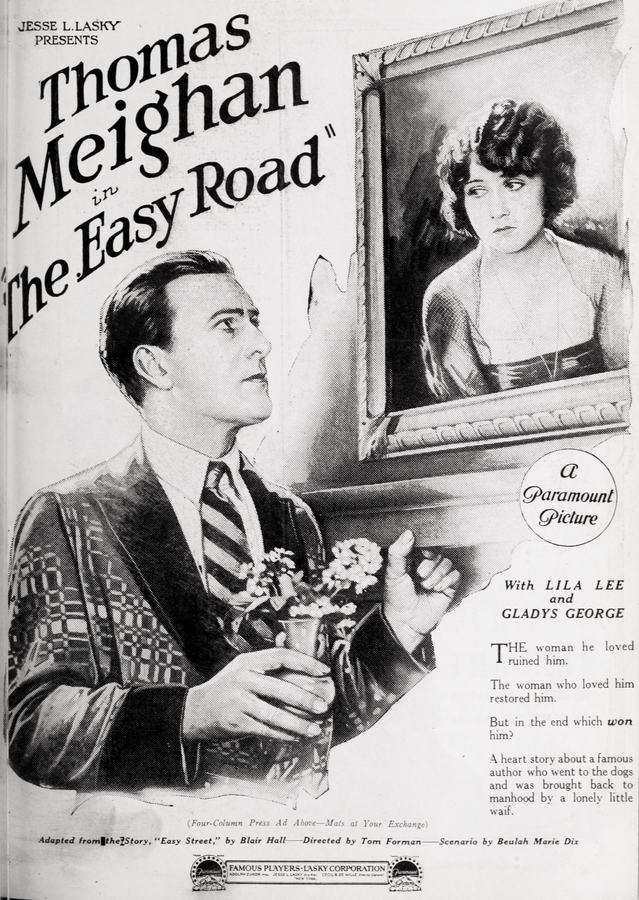
Picture a man adrift between two harbors: one paved with gold leaf, the other with blank sheets starving for ink. The Easy Road—a title dripping with sardonic bite—unfurls like a fever dream for anyone who has ever sold a sliver of soul for comfort. Director Beulah Marie Dix and scenarist Hugh McNair Kahler lace this 1921 silent with the acrid perfume of privilege; every intertitle wafts closer to an existential cliff.
Leonard Fayne, essayed by Arthur Edmund Carewe with the hollow eyes of a poet who’s misplaced his tongue, boards a luxury yacht as a sailor yet disembarks as the kept husband of Isabel Grace (Lila Lee, all porcelain arrogance and lace). Their marriage contract might as well be embossed in arsenic: the bigger the checks, the quieter the muse. Cinematographer Frank Urson shoots the wedding banquet like a baroque still-life—oysters on crushed ice, champagne cascading in molten arcs—while Leonard’s gaze keeps sliding toward a half-finished manuscript that wilts beneath candelabra glare.
Enter Katherine Dare (Laura Anson), a sculptress whose chisel chips away more marble than pretense. She whispers exile into Isabel’s ear: Europe will season the bride, leave the groom alone to “find his voice.” The moment Isabel’s ocean-liner recedes, the palette shifts from gilt to gun-metal. Dix lets silence pool; we hear only gulls and the thud of coins in a deserted study. Leonard’s creative impotence is rendered as a literal empty room—an audacious tableau that prefigures later surrealist silents like Out of the Shadow.
Salvation arrives in the guise of catastrophe. Ella Klotz (Viora Daniel, waif-thin yet incandescent) teeters atop a warehouse roof, her vision already fogging into milky twilight. Leonard, poised to gulp chloral hydrate, mistakes her silhouette for a hallucination of his own desperation. Their meet-cute is a duet of mutually assured destruction—until he hauls her back from the void and she, in turn, hauls him into language. The studio becomes a triage room: Leonard spoon-feeds Ella oatmeal while she, sight dimming, dictates colors from memory (“the inside of a seashell is a scream of pink”). Those dictations seed the novel he thought had ossified.
Note Dix’s subversion: the archetypal ingenue here is half-blind, liminal, a conduit rather than conquest. Their co-dependence sidesteps erotic cliché—touch is medicinal, not predatory. In an era when melodrama usually punished female vulnerability, Ella’s arc feels almost radical; her impending darkness becomes the negative space that lets Leonard’s prose re-emerge.
Meanwhile, the Continent toys with Isabel. Monte Carlo chandeliers glitter like hypodermics; Heminway (Thomas Meighan), an old suitor whose smile never reaches the pupils, circles her like a couture shark. Dix cross-cuts between Isabel’s roulette spillage and Leonard’s typewriter hammers—each clack a coin tumbling from her purse. The montage is proto-Eisensteinian; emotion is measured in montage meters rather than dialogue.
Crucially, Lee plays Isabel’s awakening without moustache-twirling villainy. A single close-up—lip trembling beneath a Cartier pearl choker—telegraphs her realization that wealth, not absence, has shackled her marriage. The return voyage becomes a penitent pilgrimage; she strips off jewels like bandages, arriving at the dock almost ascetic in plain wool. It’s a costume choice that silently rebukes the gaudy excess of, say, La belle Russe.
Carewe’s Leonard is a study in atrophy; shoulders slope as though the clavicles themselves were melting candles. Watch his pupils in the chloral scene—two pin-pricks of self-disgust. Opposite him, Viora Daniel gifts Ella a tremulous dignity: fingers skimming wallpaper to “see” texture, a half-smile that acknowledges the cosmic joke of impending night. Their chemistry is less sparks than flint—each strike yields prose instead of flame.
Lila Lee, often relegated to flapper fizz, here simmers. She lets silence smudge kohl around her eyes, telegraphing regret long before the intertitle confesses it. Meighan’s Heminway exudes oleaginous charm—you half expect him to leave fingerprints on the celluloid.
Dix, a veteran of Griffith’s stable, wields chiaroscuro like a ledger. In Leonard’s studio, debts accrue as shadows: unpaid bills pinned beside unfinished sketches, each frame a balance-sheet of light. Note the shot where Ella’s opaque eyes reflect the window’s cruciform lattice—an accidental but chilling premonition of blindness as secular crucifixion.
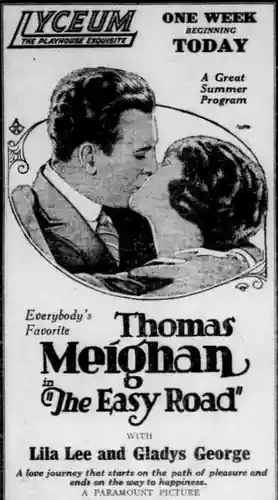
The ocean-liner sequences indulge in art-deco geometry—rails slice frames into rhomboids, lifeboat davices echo the bars of Isabel’s invisible cage. Compare this to the pastoral horror of The Church with an Overshot Wheel, where nature devours; here, industry imprisons.
Though originally accompanied by a live orchestra, the surviving prints carry a recommendatory score by Grace Goodall (repurposed from cue sheets). Syncopated violins mimic typewriter rhythms; harp glissandi trace Ella’s failing sightline. The climactic reunion is scored only with a solitary snare—each beat a thud of Leonard’s heart against the door Isabel will either open or bolt forever.
Cinephiles will detect DNA shared with The Undying Flame—both probe marriage as crucible. Yet where that film leans into spiritual hokum, The Easy Road keeps its metaphors terrestrial: money is the soul’s ball-and-chain. Conversely, the suicide-pact motif anticipates the morbid romanticism of The Fatal Night, though Dix refuses nihilism; art, not death, gets final cut.
1921 audiences expected the prodigal wife’s return to spell penitent submission. Dix inverts: Isabel’s restitution is financial autonomy surrendered, yet her agency remains intact. She bankrolls Leonard’s revival, but only after choosing love over security—an act more revolutionary than the era’s suffrage headlines. Ella, too, refuses the consumptive-damsel trope; her blindness is not punishment but catalyst, a darkroom in which Leonard’s voice re-develops.
Heminway’s final gambit—intercepting Isabel’s letter to Leonard—unfolds inside a train compartment bathed in sodium light. The sealed envelope becomes Hitchcockian MacGuffin avant la lettre. Yet Dix withholds villainous triumph; Heminway’s confrontation with Leonard ends not with fisticuffs but with a typewriter platen slammed like a gauntlet. Words, not blows, win the duel—a meta-commentary on the screenwriter’s own turf war.
The closing tableau—Leonard and Isabel standing on either side of Ella, now totally blind, each holding one of her hands—forms a living triptych. Dix freezes on this trinity, no iris-in, no moralizing title. The ambiguity is Brechtian: does art thrive only through sacrifice? Can marriage survive when solvency hinges on insolvency of spirit? The camera doesn’t answer; it merely lingers until the projector’s click becomes existential metronome.
For decades, The Easy Road languished in the Library of Congress’s paper-print archive, misfiled under its working title Permission. A 2019 4K restoration by Silent ReVue utilized a Czech nitrate tinted print to reconstruct original amber and turquoise tones. The result: waves of metallic sea-blue that lap against Leonard’s studio windows, and the sickly saffron of gaslight that seems to smell of coal dust.
In an age when content is commodified faster than popcorn, The Easy Road feels like a handwritten letter slipped under the door. Its thesis—that comfort can corrode creativity, and that salvation might wear a shabby dress and eyes clouded by cataract—remains scalding. Dix’s direction is lean yet lyrical; every dissolve feels like a sigh, every shadow a debt collector.
Yes, certain intertitles sprout the thorny prose of its source novel (“Her love was a coin too heavy for his palm”), but even the purple patches serve the film’s operatic pitch. Compared to the baroque excesses of Flirts and Fakirs or the Expressionist twitching of Vampyrdanserinden, this is chamber cinema: small rooms, big ideas.
So seek it out—stream the restoration, project it on a bedsheet if you must, let the photochemical flicker remind you that every fortune casts a shadow, and sometimes the only road back to oneself begins at the precipice where we nearly step off. In 2024, as Patreon wallets swell and Substack coffers overflow, The Easy Road whispers a century-old warning: beware the gilded cage, for its bars are forged from your own unwritten pages.
IMDb 5.5
1935
Community
Log in to comment.