DbcultAccessing Vault...
Cult Review
Senior Film Conservator
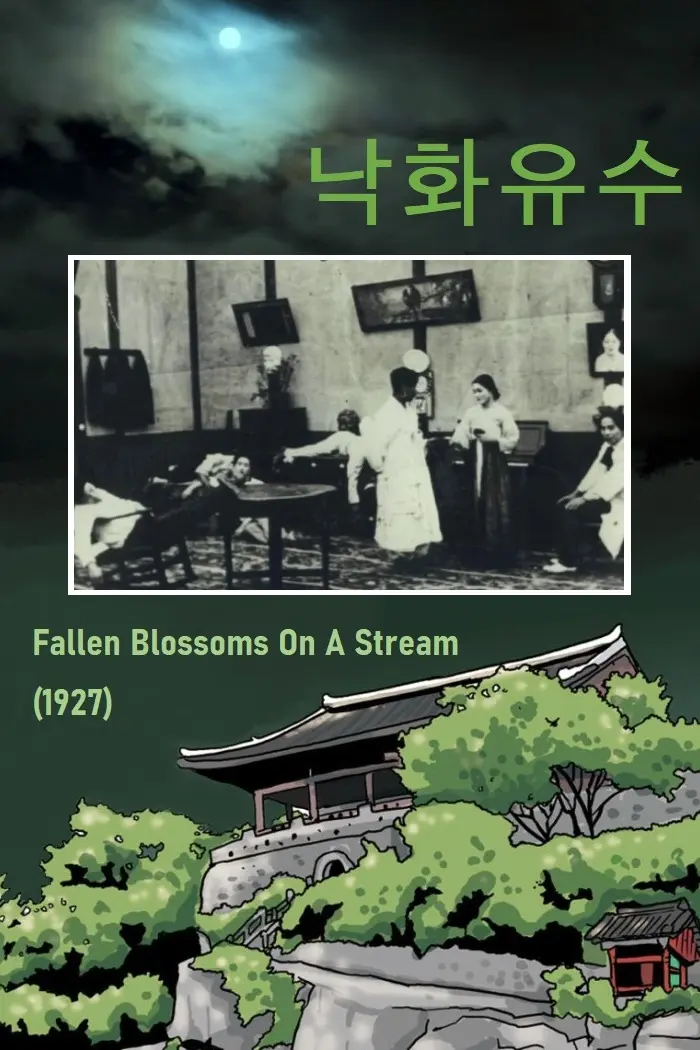
Is this film worth watching today? Short answer: No, unless you are a dedicated film historian or a glutton for the structural rigidness of silent-era melodrama. This film is for the archival obsessive who wants to see the literal birth of Korean cinema tropes, and it is absolutely not for anyone who expects a coherent narrative flow or a story that doesn't rely on extreme, dated emotional manipulation.
Fallen Blossoms on a Stream (1923) is a ghost. It is a remnant of a cinematic era that was still figuring out how to balance the theatricality of the stage with the intimacy of the lens. It exists now as a curiosity, a foundational stone in the building of the Korean film industry, but as a piece of entertainment, it is a grueling experience. It is slow. It is repetitive. Yet, it possesses a certain raw power that modern, polished films often lack.
1) This film works because it utilizes the natural landscape of Korea to mirror the internal devastation of its characters, creating a visual language that feels more honest than the script itself.
2) This film fails because its central romance is built on a power dynamic that feels more like stalking than love, making it difficult for a modern audience to sympathize with the 'suffering' artist.
3) You should watch it if you want to witness the debut of Bok Hye Sook, a legendary figure who defined the early era of Korean performance, or if you are tracking the evolution of the kisaeng archetype in media.
To be brutally honest, watching this film in the 21st century is an academic exercise. It does not offer the thrill of discovery found in other silent works like Söhne der Nacht, 1. Teil: Die Verbrecher-GmbH, nor does it have the sweeping political weight of Bismarck. Instead, it lingers in a small, suffocating space of personal tragedy. It is a film about a man who thinks his feelings are the center of the universe, and a woman who has no choice but to be the orbit.
However, there is value in the grit. The cinematography, though limited by the technology of 1923, captures a Korea that no longer exists. The scenes by the stream are not just pretty; they are atmospheric. They feel damp and cold. If you can look past the over-the-top acting, you find a genuine sense of despair that is universal. It works. But it’s deeply flawed.
The direction by Ku-yeong Lee is surprisingly focused on the eyes. In an era where many directors were still filming wide shots like they were in the back row of a theater, Lee pushes the camera toward the faces of his leads. When the artist watches the kisaeng, the camera lingers on his expression of hunger. It’s not love; it’s a desire to possess. This makes the film feel more like a psychological thriller than the melodrama it claims to be.
Consider the scene where the artist first sketches her. The way the light hits Bok Hye Sook’s face is reminiscent of the delicate lighting in La p'tite Lili. There is a softness to the frame that contrasts sharply with the harsh reality of their social situation. The film uses the 'stream' as a recurring motif for the passage of time and the loss of purity, a trope we see in many films of this period, including Midst Peaceful Scenes.
Bok Hye Sook is the only reason this film remains in the conversation. Her performance is surprisingly restrained for the 1920s. While San-Seok Jeong, playing the artist, leans into the theatrical 'hand-to-forehead' school of acting, Bok uses her stillness. She understands that the kisaeng is a woman who must hide her true self behind a mask of entertainment. Her eyes tell a story of exhaustion that the script doesn't quite reach.
Compare her work here to the more traditional heroine roles in The Return of Mary or A Kentucky Cinderella. In those films, the women are often victims of circumstance who wait for rescue. Bok’s character in Fallen Blossoms on a Stream feels like she is already resigned to her fate. There is no rescue coming. This cynicism is what makes the film stand out from its contemporaries like God's Country and the Law.
The pacing is where the film truly struggles. At times, it feels as though the director was paid by the minute. Scenes of walking, sitting, and staring into the distance are stretched to their absolute breaking point. While this might have been intended to build 'mood,' for a modern viewer, it creates a barrier to entry. It lacks the rhythmic editing found in Not Built for Runnin'.
The writers, Hyeong-Hwang Kim and Ku-yeong Lee, rely heavily on the 'fated encounter' trope. Every movement feels scripted by destiny rather than character choice. This is common in early melodrama, but here it feels particularly heavy-handed. When the artist loses his wealth, the transition is so abrupt it feels like a reel is missing. It lacks the political nuance of a film like The Battle of Ballots.
Pros:
The location shooting provides a rare glimpse into pre-industrial Korea. The use of natural light is sophisticated for its time. The central metaphor of the 'fallen blossom' is effectively carried through the visual motifs. It serves as a vital historical record of early acting techniques.
Cons:
The narrative is repetitive and predictable. The male lead’s performance is distractingly exaggerated. The film’s view of women is purely objectifying, even within its own tragic framework. The technical quality of surviving prints is often poor, making it a literal chore to watch.
Most critics view this as a 'sad love story.' They are wrong. This is a horror movie about the ego. The artist doesn't love the kisaeng; he loves the idea of himself as a tragic figure who loves a kisaeng. Every action he takes is designed to heighten his own drama. When she suffers, he paints. He is a vampire of emotion. This realization makes the film much more interesting than the standard 'rich boy meets poor girl' narrative.
Fallen Blossoms on a Stream is a difficult, often boring, but ultimately necessary piece of cinema history. It isn't 'good' in the way we think of modern films, but it is 'important.' It captures the specific melancholy of a nation under occupation, expressing its pain through the proxy of a doomed romance. It is a film of fragments—fragmented lives, fragmented beauty, and a fragmented history. Watch it once, take your notes, and then go watch something with a bit more life in it, like Smith's Baby. You’ve been warned. It’s a museum piece. Respect it, but don't expect to enjoy it.
IMDb —
1926
Community
Log in to comment.