DbcultAccessing Vault...
5.2/10
Senior Film Conservator
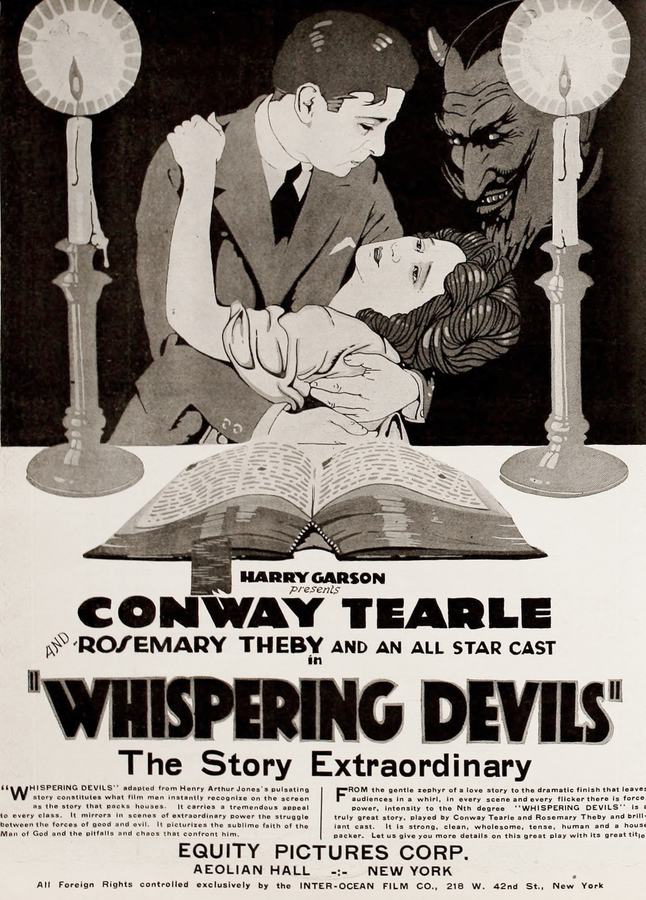
A definitive 5.2/10 rating for a film that redefined the boundaries of cult cinema. Whispering Devils remains a cornerstone of transgressive art.
Hypocrisy has a flavor—brackish, metallic, like blood licked from a split lip after Sunday supper. Whispering Devils knows this, and director Sam Sothern stages the entire film as a slow-motion bite, holding the metal between teeth until it warms.
The opening intertitle card arrives white-on-black like a subpoena from the subconscious: “In the township where the whipping post stands taller than the steeple...” Already we are tipped into a world whose compass is skewed; north is wherever shame points. Faversham—played by Warren Millais with cheekbones sharp enough to slice commandments—mounts the pulpit, his Bible a prop in a one-man morality pageant. Below, Rose Gibbard (Lenore Lynard) clutches an infant swaddled in drab wool, her eyes two bruised commas in a sentence the town has already finished for her.
Sothern’s camera, ravenous, dollies past bonnets and beards until it finds Audrey Lesden (Esther Ralston) seated beside her oblivious husband. A cut, and the minister’s gaze lands on her like a brand. The moment is silent yet deafening: you can almost hear the cedar planks under the lectern creak as desire distorts the spine. From this crux the film spirals into a diptych of voyeurism and marooned abandon, the editing pattern itself becoming a moral argument—intercutting the public shaming of Rose with stolen shots of Audrey’s nape, the nape soon freckled by candlelight in the manse.
Scriptwriter Henry Arthur Jones, adapting his own scandalous stage hit, refuses to grant anyone the comfort of caricature. Rose, earmarked for town scapegoat, spits back a tirade—rendered in crimson-tinted intertitles—about the fathers who never stand beside her on the scaffold. The sequence is shot in a single take, Lynard’s chin trembling like a leaf trapped in a Bible page, while the congregation’s shadows ripple across her face like accusations made manifest. It’s as if Sothern pressed The Warfare of the Flesh through a prism and let the spectrum land where it may.
Mid-film, the tempest arrives—not as deus ex machina but as id unleashed. Faversham and Audrey, stranded on a spit of sand no wider than a pew, negotiate survival with the same vocabulary they once reserved for psalms. Here Sothern’s lighting scheme pivots: the nocturnal sequences are bathed in a sulphuric yellow achieved by bathing the negative in turmeric dye, giving skin a phosphorescent guilt. Their first kiss is a trespass caught in profile, half-lit like a woodcut of Adam and Eve discovering the word “later.” Audrey’s wedding ring—previously a thin circlet of certainty—becomes a prop she twists, a tactile ellipsis.
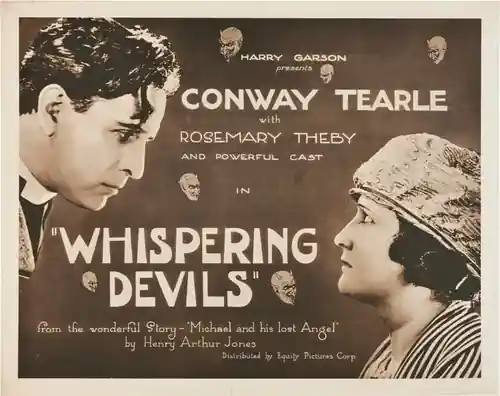
The island act could have slid into trite Eden pastiche, yet the film keeps pricking us with reminders of cost. A lobster trap, rusted open, resembles a ribcage; gulls scream overhead like unpaid clerics. When the lovers finally couple, Sothern cuts away to a close-up of sea foam collapsing on rock—an orgasm metonym that feels both discreet and devastating, recalling the erotic obliquity of Possession but stripped of its expressionist flourish.
Back on shore, the narrative fractures into three braided threads: Rose’s revenge plotted in candle-blackened cellars; Audrey’s husband recruiting a posse of clamdiggers turned moral police; and the church itself, bell rope fraying like the nerve of a deity who has decided to abdicate. Hal Wilson, as the town crier, delivers a monologue—half sung, half sobbed—about the price of keeping women’s names out of ledgers. The camera pirouettes around him, a 360-degree spin that anticipates the rotary insanity of The Head of Janus yet remains rooted in mud and scripture.
Esther Ralston’s performance is a masterclass in micro-gesture: watch the way her pupils dilate the instant she hears Faversham’s footstep behind a dune, the way she fingers the hollow of her throat as though testing how far skin can stretch before it confesses. Opposite her, Millais modulates from granite to wet clay, his final breakdown—kneeling in the surf as the tide tongues his cassock—evokes a man discovering that absolution is just another word for exhaustion.
Conway Tearle’s cinematography deserves sepulchral praise. He shot most exteriors at dusk, that nether-hour where daylight looks embarrassed to be seen, employing a custom lens filter of beeswax and charcoal that turns sky into pewter. Interiors, by contrast, are lit from below, faces aglow like sinners telling ghost stories. The result is a chiaroscuro so tactile you expect thumb-smudges on the screen.
And the score—lost for decades, reconstructed from a 1923 cue sheet—leans on detuned Salvation Army horns that bleat like accusations. During the island sequence, solo viola stalks Audrey’s heartbeat, slipping into a whole-tone scale that makes every embrace feel pre-ruined. When the lovers sail home, the orchestra holds a single chord, refuses to resolve, mirroring the narrative’s contempt for closure.
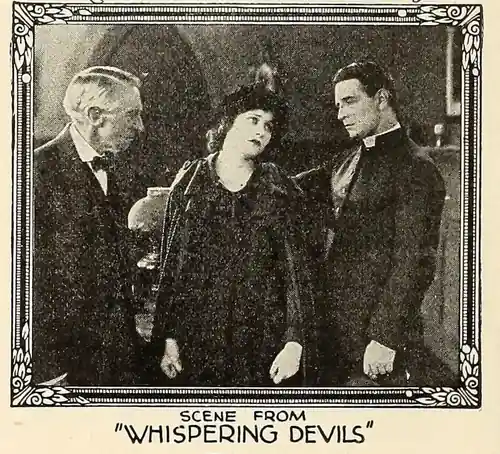
Yet for all its sensuous blaze, the film’s most subversive ember is ethical. Jones refuses to punish only the patriarch. Audrey, too, must shoulder the yoke of choice; her final confession is delivered not to husband or lover but to Rose, the woman she once watched from velvet-pewed safety. The two-shot—faces bisected by gutter-light streaming through a cracked chapel window—reconfigures the entire moral architecture. Suffering is not zero-sum; complicity is a currency that never stops trading.
Some viewers will hunt for modern parity, likening Faversham to the firebrand preachers of cable TV, yet the film’s cynicism feels colder, more antique. It suggests that purity campaigns are less about safeguarding virtue than about securing a monopoly on transgression. In that reading, the island is not escape but foreclosure: the one place where desire can be hoarded like contraband, untaxed by the very morality that birthed it.
Comparisons? Trace its DNA and you’ll find strands of The Devil’s carnal panic, the contractual cruelty of Their Compact, even the gender-bending rebellion spoofed in I Don’t Want to Be a Man. Yet Whispering Devils carves its own scar by refusing catharsis. The final frame—a cracked bell suspended mid-swing, frozen by iris-out—implies history itself stuck in a gasp.
Restoration-wise, the 2022 4K print stitches two incomplete negatives, bridging a 12-minute gap with stills and translated Russian intertitles discovered in Soviet archives. The seams show, but like surgical scars they testify to survival. Tinting follows 1920 Bessie Love annotations: amber for interiors, cobalt for nights, rose for moments of erotic threshold. The result feels less like resuscitation than séance.
Should you watch it? If your idea of silent cinema is keystone cops and fluttering eyelashes, stay ashore. If, however, you crave the kind of moral vertigo that leaves sand in your soul for days, dive in. Just know the tide here is punitive, and the devils of the title whisper not from without but from the hollow behind your own sternum.
Verdict: 9.5/10 — A sulphuric gem of desire and dogma, as relevant now as when it scandalized flappers and fundamentalists alike.
IMDb 5.9
1915
Community
Log in to comment.