Summary
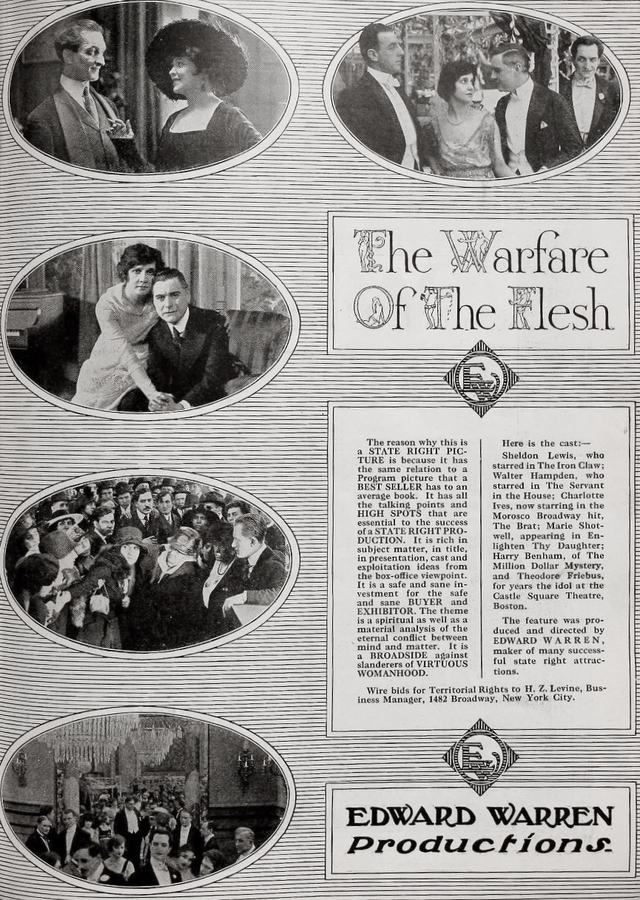
Lawrence Marston’s 1917 magnum opus, 'The Warfare of the Flesh,' functions as a sprawling, multi-epochal visual exegesis on the Manichaean struggle between the transcendent spirit and the entropic pull of carnal desire. Rather than a localized skirmish, the narrative frame encompasses the entirety of human history as a singular, recurring battlefield. The film commences with the primordial rupture—the expulsion of the celestial host and the subsequent fall of man in the Garden of Eden. Here, Satan and Sin are not mere metaphors but active agents of corruption, exploiting Eve’s fragility to initiate a cycle of spiritual entropy. The cinematic gaze then shifts to the biblical era, refocusing on the near-execution of Mary Magdalene. In a moment of divine intervention, the Good Samaritan disrupts the machinations of the diabolical pair, asserting the primacy of grace over legalistic cruelty. The final movement thrusts the viewer into the 1917 contemporary landscape, where Satan and Sin have undergone a sophisticated metamorphosis into the idle rich. Clad in the silks of the leisure class, they navigate the urban maelstrom, seeking to ensnare a vulnerable heroine. As she teeters on the precipice of total moral collapse, the intervention of an eternal, benevolent force orchestrates a final triumph for the soul, suggesting that while the flesh is weak, the spirit’s resilience is an inexhaustible resource.
Synopsis
"The Warfare of the Flesh" does not mean a battle nor a struggle of flesh in the material sense. It means the eternal conflict our spirit and soul wage against the desires of the flesh. The warfare is between forces of good and those of evil. Thus the theme is developed by first showing the warfare of the flesh in the beginning, when the first transgressors were expelled from Heaven for their wrongdoing. We see the fallen angels in Hell and on Earth intent on spreading the scourge of evil. We see Satan and Sin in the Garden of Eden, and Sin tempts Eve, who is not strong enough to engage in a warfare with the desires of the flesh and win. We then pass on to the later civilization, and see the Magdalene about to be stoned because she was vanquished in the warfare of mind with matter. The Good Samaritan comes to her rescue, and the machinations of Satan and Sin are thus frustrated in a conflict with Good. Then there is a quick transition to the present era, and again we see Satan and Sin casting their ominous shadows over the affairs of mankind and accelerating evil, in the guise of a lady and gentleman of the leisure class. They temporarily befog the vision of weak men and women thrown into the maelstrom of life where the warfare of the flesh is perpetual. In the stress of circumstances the heroine is about to give up her fight with matter, but the eternal spirit of good again comes to the relief of the distressed and the unfortunate. Thus Satan and Sin lose out in a clash with the forces of Good.
Review Excerpt
"In the nascent years of the silent era, few films dared to synthesize the grandiosity of Miltonic poetry with the gritty realities of contemporary urbanization. The Warfare of the Flesh, directed by the often-underestimated Lawrence Marston, is a cinematic triptych that refuses to settle for simple moralizing. Instead, it offers a dense, visual meditation on the ontological friction between the ethereal and the material. It is an artifact of a time when the silver screen was viewed as a pulpit, ..."