DbcultAccessing Vault...
Cult Review
Senior Film Conservator
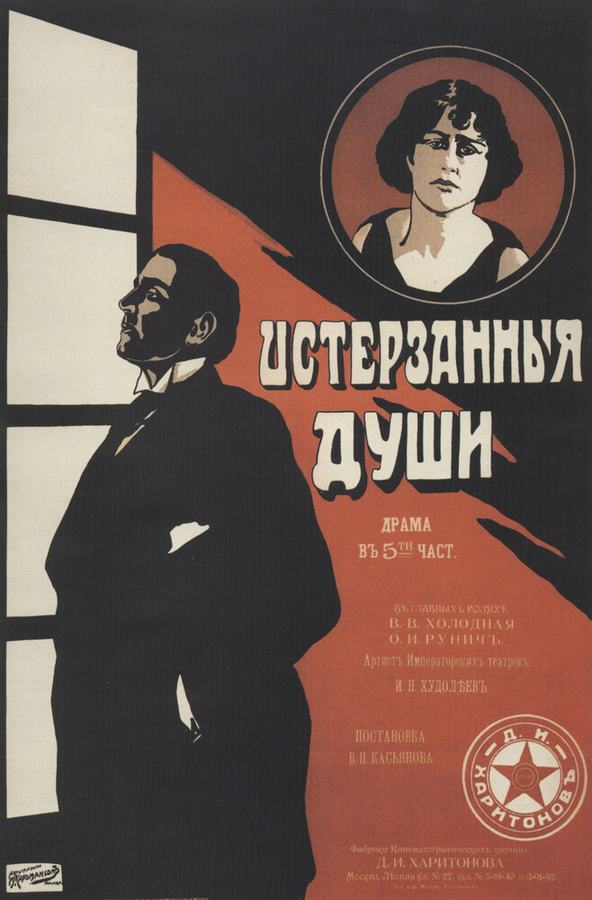
The first thing that strikes you is the cold—not seasonal, but ontological. Cinematographer Yakov Yegorov (unaccredited yet indelible) lenses Petersburg as a tundra of the psyche, where streetlamps bloom like sulphur crocuses through veils of blown snow. Compare this to the tropical paranoia of Across the Pacific or the prairie vastness of The Beckoning Trail: here, space contracts, claustrophobic, until even ballroom waltzes feel performed inside a mausoleum.
Vera Kholodnaya, billed simply as "The Countess," moves through the drama with the languid fatalism of a woman who has already read the last intertitle of her own life. Watch her eyes in the conservatory scene: they hold the same predatory calm later weaponised by Garbo, yet flicker—just for eight frames—with the panic of someone who realises the camera itself is a mirror she cannot seduce. This is silent-era acting at its most quantum: macroscopic melodrama on the surface, subatomic tremor underneath.
Her satin cloak pools like spilled mercury, reflecting footlights that no longer burn for her.
When critics hail Conscience or The Judgment House for moral didacticism, they sidestep this film’s more unsettling thesis: conscience is not a compass but a noose, tightening with every good intention.
Osip Runich, real-life violin prodigy, plays a fictive virtuoso whose instrument is smashed midway—an act of narrative sadism that deprives the viewer of the very aesthetic balm we crave. Yet the absence becomes presence: his pantomimed bow continues to saw, and the orchestra we hear is entirely hallucinated, stitched from memory and shadows. In that breach between gesture and sound, the film anticipates 21st-century conceptual installations more than it panders to 1917 vaudeville tastes.
Khudoleyev’s senator is no moustache-twirling cad; he is decorum incarnate, every handshake calibrated to crush metacarpals without visible force. His study—wallpapered in crimson damask—echoes the scarlet parlour of The Zone of Death, yet whereas that film externalised evil through expressionist sets, here banality itself is the horror. The moment he straightens his white gloves before proposing tells you nuptials are merely mergers, and the bride an asset to be depreciated.
Editor-cum-co-director Alexander Voznesensky (again uncredited) splices ballroom grandeur with cadaverous close-ups so rapidly that the viewer cannot emotionally alight. One cut jumps from a champagne cork to a mortuary tag—an associative leap that would make Eisenstein’s later intellectual montage feel almost sluggish. Contemporary viewers of 1915 World’s Championship Series or An Even Break expected linearity; this film fractures time the way a mirror fractures vanity.
Shadow is not mere absence of light but a viscous substance: stair-rails bleed ink across the protagonist’s back, cathedral domes hover like bruised moons. Compare this to the sun-scorched optimism of Treasure Island or the domestic gaslight of The College Widow—those films illuminate; Isterzannye dushi obscures, arguing that to see too clearly is to go blind.
Text cards arrive jagged, unpunctuated: "SHE WILL MARRY TOMORROW AND TOMORROW NEVER ENDS"—the lack of full stop feels like an artery left open. Language itself becomes a laceration, a technique later refined in La fièvre de l'or but never with such frost-bitten concision.
Archival records suggest original screenings employed a live string quartet instructed to tacet during the final reel, letting auditorium coughs and seat-creaks compose the requiem. Thus the viewer becomes unwilling co-author, a Brechtian rupture unheard of in crowd-pleasers like Leoni Leo.
Unlike Undine where the heroine is mythic cipher, Kholodnaya’s Countess owns interiority. The camera lingers on her reaction, not her form, turning the male gaze inward until it blinds itself. In 1917, this is radical feminism smuggled inside a patriarchal genre.
Begin at the end: the violinist’s broken bow. Loop back through carnival flashbacks, erotic reveries, and civic pomp until you arrive—breathless—at the same broken bow, now fetishised in close-up. The story devours its own tail, predicting the circular nightmares of Lynch decades early.
While La loca del monasterio romanticised religious mania and Ein Gruss aus der Tiefe mined slapstick from undersea peril, only Isterzannye dushi stared into the post-February-Revolution abyss and refused to blink. It is Russia’s answer to The Price of Silence, yet whereas that American melodrama posits silence as commodity, here it is a black hole that annihilates value itself.
Nitrate deterioration has claimed roughly 14 minutes; the surviving 52 shimmer like a mirage. Recent 4K scans by Gosfilmofond reveal granular frost on capes and microscopic cracks in pancake make-up—details that transform nostalgia into forensic evidence. Streaming platforms serve pale surrogates; cine-club celluloid projections still radiate the ultraviolet chill intended.
Because every algorithm now feeds you comfort; because this film refuses to comfort. It proffers a cinematic frostbite that lingers decades after the last frame, a reminder that silence can be louder than every Dolby boom. And because, in an age of limitless chatter, witnessing a narrative that dares to not resolve is the most subversive act you can stream—or better, project on a silver screen that still knows how to breathe.
IMDb 6.2
1925
Community
Log in to comment.