DbcultAccessing Vault...
5.6/10
Senior Film Conservator
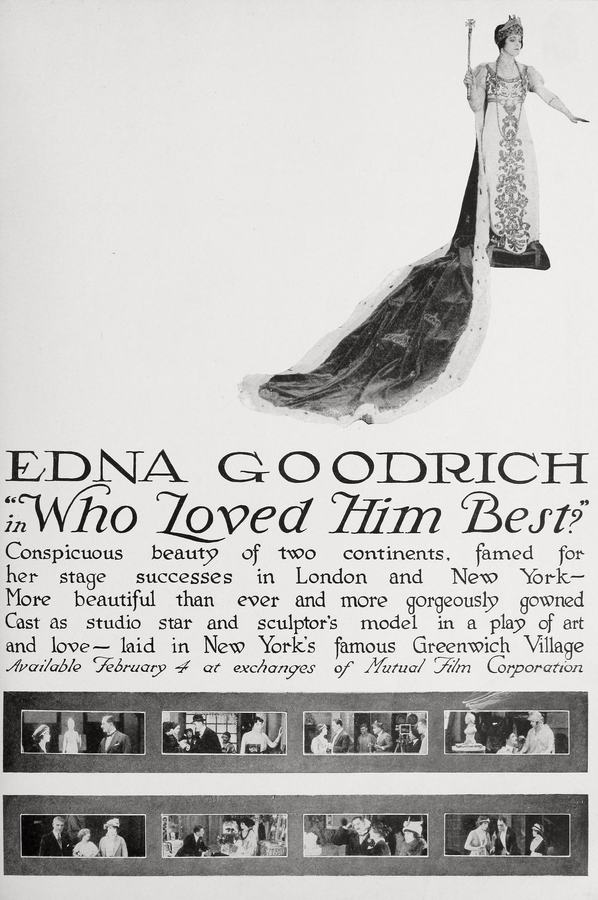
A definitive 5.6/10 rating for a film that redefined the boundaries of cult cinema. Who Loved Him Best? remains a cornerstone of transgressive art.
The silent era, often romanticized and sometimes unfairly dismissed, offered a canvas for narratives of profound emotional depth, often tackling universal themes with a directness that modern cinema sometimes shies away from. Among these compelling productions stands 'Who Loved Him Best?', a film that deftly navigates the treacherous waters of ambition, artistic integrity, and the enduring power of genuine affection. It presents a world where the ascent to stardom can be as swift as it is precarious, and where the human heart remains the ultimate arbiter of value. This cinematic gem, despite its vintage, resonates with a timeless quality, inviting audiences to ponder the true cost of fame and the sacrifices made in the pursuit of both artistic greatness and authentic love.
Our story introduces us to Doria Dane, a young seamstress whose life, initially woven with threads of humble toil, is unexpectedly unravelled and re-stitched into a tapestry of dazzling opportunity. Possessing an unassuming charm and an innate photogenic quality, Doria catches the discerning eye of a shrewd motion picture producer. This encounter serves as the catalyst for her dramatic transformation, plucking her from obscurity and catapulting her into the nascent, glittering world of early cinema. The allure of the silver screen, with its promise of glamour and recognition, proves irresistible, and Doria soon finds herself a rising star, basking in the glow of public adoration and professional success. Her journey from the quiet confines of her sewing room to the bustling sets of a film studio is a testament to the era's fascination with rags-to-riches narratives, a dream made tangible through the magic of celluloid.
However, the bright lights of the film industry are soon eclipsed by a different kind of illumination for Doria: the incandescent spark of love. She encounters George Steele, a sculptor whose artistic vision and passionate dedication immediately captivate her. Their connection transcends the superficiality of her newfound fame, grounding her in a world of profound creative expression. George, recognizing in Doria a muse of extraordinary grace and spirit, invites her to pose for his ambitious new work, a statue he intends to title "American Militant." This collaboration becomes more than a professional arrangement; it blossoms into a deep, abiding romance, a sanctuary from the often-fickle demands of public life. It is in George's studio, amidst the clay and chisels, that Doria finds a truer sense of belonging and purpose than any film set could offer.
Under Doria's steadfast and inspiring influence, George undergoes a significant artistic metamorphosis. Previously prone to the distractions of his bohemian Greenwich Village friends, a circle perhaps more interested in ephemeral pleasures than enduring artistic achievement, George now finds a renewed focus. Doria's presence acts as an anchor, steadying his hand and sharpening his vision, allowing him to channel his considerable talent into the demanding creation of "American Militant." This period marks a pivotal moment in his career, as he dedicates himself wholeheartedly to the sculpture, pushing the boundaries of his craft. The result of this intense concentration and Doria's unwavering support is nothing short of triumph: George Steele's statue wins a prestigious award, elevating him from a promising artist to a celebrated figure in the art world. The critical acclaim and public adoration that follow are a testament to the power of a dedicated muse and the purity of artistic pursuit.
Yet, as history often teaches us, the pinnacle of success can be a treacherous vantage point. Basking in the dazzling, often intoxicating, limelight of his newfound fame, George begins to lose sight of the very person who helped him achieve it. The quiet devotion and profound connection he shared with Doria are slowly eroded by the insidious allure of social climbing and superficial accolades. He becomes increasingly distant, neglecting Doria for the more immediate gratification of society's embrace. This shift in George's character is a classic narrative arc, reminiscent of the corrupting influence of power seen in films like A Wall Street Tragedy, where success blinds individuals to their moral compass. The delicate balance of their relationship, once so robust, begins to teeter precariously, threatened by the very recognition George had so ardently sought.
The catalyst for George's further descent into social ambition arrives in the form of Mrs. Schuyler, a wealthy widow whose fashionable demeanor belies a calculating heart. She represents the epitome of the superficial high society George now finds himself drawn to, a world where appearances often supersede substance. Mrs. Schuyler, with her considerable influence and undeniable charm, sets her sights on George, not merely as an artist to patronize, but as a prize to possess. Her machinations are subtle yet persistent, gradually drawing George into her orbit and further alienating him from Doria. This entanglement highlights the societal pressures of the era, where material wealth and social standing could easily sway even the most artistically inclined, a theme explored with poignant detail in films like The House of Mirth. Doria, witnessing this painful estrangement, finds herself caught in a vortex of heartbreak and betrayal, her love for George clashing against his escalating vanity.
The emotional crescendo of the film arrives with a dramatic, almost operatic, confrontation. George's friends, who have observed his transformation with growing dismay and disappointment, are horrified when Doria, driven by a potent cocktail of anguish and righteous indignation, bursts into his studio. In a moment of raw, unbridled emotion, she seemingly shatters his masterpiece, the award-winning "American Militant," into a thousand fragments. The act is shocking, a visceral representation of her shattered hopes and the destruction of their shared dream. It's a scene that would have undoubtedly elicited gasps from contemporary audiences, a powerful visual metaphor for the irreparable damage George's neglect has inflicted upon their love. The silent medium, relying heavily on exaggerated gestures and facial expressions, would have amplified the emotional impact of Nadia Gary's portrayal of Doria's despair, making her dramatic outburst all the more devastating.
However, 'Who Loved Him Best?' is not content to end on such a tragic note. The narrative, with a cleverness that elevates it beyond mere melodrama, introduces a brilliant twist. Shortly after the apparent destruction, Doria, with a newfound sense of purpose, leads a bewildered George and his stunned friends to the studio of fellow artist, Harry North. There, to their collective astonishment, stands the magnificent "American Militant", entirely intact and resplendent. The initial shock gives way to a profound revelation: Doria had not destroyed George's original work, but rather a meticulously crafted replica, a masterpiece of deception orchestrated to expose the true nature of George's affections and priorities. This narrative sleight of hand is a stroke of genius, turning what seemed like an act of destructive vengeance into a calculated, albeit desperate, test of love and artistic integrity.
Doria's explanation, delivered with a quiet dignity that belies her earlier outburst, clarifies her audacious gambit. She reveals that her dramatic act was not born of malice, but of a desperate desire to shock George back to reality, to force him to confront the superficiality into which he had descended. It was a test, a crucible designed to burn away the dross of his vanity and reveal the pure gold of his original character. George, confronted with the intact statue and the profound depth of Doria's love and wisdom, is utterly humbled. The realization of his folly, his neglect, and Doria's extraordinary loyalty washes over him. His heartfelt apology is not merely an expression of regret, but a genuine acknowledgment of his errors and a renewed appreciation for the woman who, despite everything, truly loved him best. This moment of reconciliation, skillfully portrayed by Charles Martin as George, is the emotional core of the film, signifying the triumph of authentic connection over ephemeral glory.
The reunion of Doria and George is not merely a happy ending, but a testament to a love that has been tested by fire and emerged stronger. It speaks to the idea that true affection can withstand the corrosive effects of fame and the seductive whispers of superficiality. Their journey reflects a deeper understanding of partnership, where mutual support and unwavering belief in each other's true selves are paramount. The film, through this resolution, suggests that artistic success, while gratifying, is hollow without the foundation of meaningful relationships. The performances of Nadia Gary as Doria, Frank Otto as the producer, and Charles Martin as George, along with the supporting cast including Edna Goodrich, Herbert Evans, Francois Du Barry, Tallulah Bankhead, Miriam Folger, and A.H. Busby, would have been crucial in conveying these complex emotional shifts, relying on the nuanced expressions and body language characteristic of silent film acting.
The narrative, while seemingly straightforward, is imbued with layers of social commentary relevant to its time. It subtly critiques the burgeoning star system of Hollywood, where talent could be manufactured and relationships often strained by public scrutiny and the demands of celebrity. It also scrutinizes the art world, where genuine talent could be overshadowed by social maneuvering and the patronage of the wealthy. The film's message, however, transcends these specific critiques, speaking to the universal struggle between ambition and personal values. It's a theme echoed in other films of the era, such as Life's Whirlpool, which often depicted individuals caught between societal expectations and their inner desires. The film's direction, even without explicit details, can be inferred as effective in building suspense and conveying emotional arcs through visual storytelling, a hallmark of the silent film medium.
The portrayal of Doria Dane is particularly compelling. She is not merely a damsel in distress or a passive recipient of George's affections. Instead, she emerges as a woman of remarkable strength, intelligence, and agency. Her decision to orchestrate the replica's destruction is not an act of childish spite, but a deeply considered, albeit risky, strategy to salvage her love and George's soul. This proactive approach sets her apart from many female characters of the period, whose roles were often more constrained. Doria's character arc, from an innocent seamstress to a shrewd and emotionally mature woman, provides the film with its moral compass and its most enduring message about the power of self-respect and unwavering devotion. Her actions elevate the film from a simple romance to a nuanced exploration of character and consequence.
The film's use of the "American Militant" statue as a central motif is also noteworthy. It symbolizes not only George's artistic aspirations but also the very core of his identity. Its apparent destruction and subsequent revelation serve as a powerful metaphor for the fragility of reputation and the resilience of true artistic spirit. The statue's survival, orchestrated by Doria, becomes a symbol of their renewed relationship – rebuilt on honesty and a deeper understanding. This symbolism adds a layer of intellectual depth to the film, inviting viewers to consider the philosophical implications of art, integrity, and the human condition. It is a device that allows the silent film to communicate complex ideas without a single spoken word, relying instead on visual storytelling and the audience's interpretation.
Comparing 'Who Loved Him Best?' to other cinematic works of its time illuminates its unique strengths. While films like A Mormon Maid or Judith of the Cumberlands delved into specific cultural or regional dramas, 'Who Loved Him Best?' focuses on a more universal, albeit equally dramatic, internal conflict. Its exploration of artistic temperament and the temptations of the social elite resonates with the psychological intensity often found in European cinema of the period, perhaps even hinting at the moral dilemmas that would later define works like Raskolnikov. The film's ability to blend high drama with nuanced character development ensures its place as a significant, albeit often overlooked, entry in the silent film canon.
In conclusion, 'Who Loved Him Best?' is far more than a simple romantic drama from the silent era. It is a sophisticated examination of human nature, a cautionary tale about the pitfalls of fame, and a celebration of enduring love. Through its compelling characters, its ingenious plot twist, and its profound thematic explorations, the film offers a timeless narrative that continues to captivate and provoke thought. It reminds us that while the external glitter of success may be alluring, the true treasures of life lie in authenticity, integrity, and the unwavering devotion of those who truly love us best. This film, with its rich emotional landscape and clever narrative construction, stands as a powerful testament to the artistry and storytelling prowess of early cinema, deserving of renewed appreciation and study.
IMDb 6.1
1929
Community
Log in to comment.