DbcultAccessing Vault...
Cult Review
Senior Film Conservator
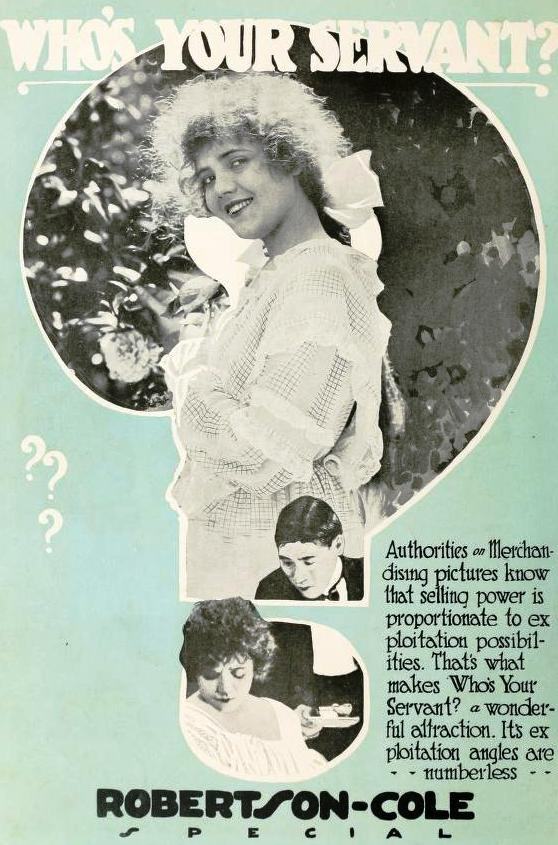
In the flicker-and-pause universe of 1920 American cinema, when the world still smelled of unfiltered cigarettes and wet varnish, Who's Your Servant? arrives like a cracked signal flare—brief, blinding, then swallowed by the dark. Few prints survived; fewer still have been transferred to anything warmer than an archivist’s whisper. Yet what remains is a bruise-colored jewel of storytelling: equal parts naval procedural, upstairs-downstairs melodrama, and racially-charged fever dream.
Director Robert Ensminger (never renowned before or after) seems to have borrowed the chiaroscuro anxiety of German corridors seen in Die lebende Tote and smuggled it onto a California back-lot pretending to be Annapolis. The result is a film that feels pre-noir, pre-screwball, pre-code—an unclaimed bastard child racing ahead of its legitimate siblings.
Rear Admiral Bancroft—portrayed by Albert Morrison with mutton-chop gravitas—discovers that the holiest of holies, the schematic for a new super-destroyer, has vanished from his locked bureau. Suspicion ricochets onto Lt. Clifford Bruce, played by William Scott whose pencil-thin smile never quite convinces us he could helm a rowboat, let alone win a woman’s heart. The audience knows Bruce is innocent because we watch him shimmy down the trellis gripping nothing more subversive than a love letter perfumed by Frances Burnham’s Madeline. The real thief is Ito, the admiral’s Japanese manservant—Yukio Aoyama in a performance that oscillates between porcelain restraint and volcanic desperation.
Here the screenplay, penned by the pulp-savant Julian Johnson
Lois Wilson, though second-billed, has maybe three minutes of screen time as the admiral’s spinster sister; she pivots like a decorative cypher, but her eyes—caught in lingering close-up—harbor the entire film’s suppressed commentary on patriarchal rot. It is Yukio Aoyama who shoulders the picture’s moral mass. Contemporary trade sheets dismissed him as “the house villain,” yet his micro-gestures—a swallow that ripples the collar, fingers drumming a nervous gagaku on the tabletop—suggest a man colonized by his own dreams of assimilation. The tragedy is not that he is evil; it is that he believes the ladder exists. Opposite him, Frances Burnham’s Madeline is no fluttering belle. She weaponizes flirtation the way pickpockets wield razor blades: swift, hidden, lethal. Burnham’s kinesics borrow from both Pickford and the vamps—curls that bounce with childlike innocence, yet when she lowers her eyelids half-mast, the frame temperature plummets. You understand why Ito risks empire and life for her; you also understand why she will never reciprocate, because the empire has already scripted her womb. Cinematographer Gus Peterson (never lauded in any hall of fame) shoots Annapolis as if it were Caligari’s naval academy: oblique angles, iron staircases webbed like spider legs, searchlights slicing through dry-ice fog borrowed from the trenches of Breakers Ahead. Interior scenes exploit paper screens, allowing silhouettes to swell into demon shapes; the battleship blueprints themselves are rendered like occult mandalas, each inked bulkhead a sigil of state power. Tinting alternates between nicotine amber for daylight naval offices and venomous cyan for Ito’s nocturnal lair—an early, crude version of the teal-and-orange palette modern blockbusters regurgitate. Scholars sometimes slot Who's Your Servant? beside A Woman's Awakening or Away Goes Prudence as proto-feminist fare. Yet the film is more honest about patriarchal currency: Madeline’s agency is real but predatory, dependent on another disenfranchised body. She is both colonizer and colonized—her gender constrains her, her whiteness empowers her. The admiral’s final blessing of marriage feels not like resolution but like a treaty signed over Ito’s corpse, sealing both the lovers’ future and the empire’s continuity. No original cue sheets survive, so every modern screening becomes a séance where musicians conjure their own fog. I recommend a duo of shō and prepared piano: the shō’s reedy exhalations echo Ito’s interior monologue, while the piano’s detuned strings scrape like hull plates against a dry dock. When Madeline betrays Ito, let the shō sustain a microtonal cluster that wobbles between lament and lullaby, until the fatal stab lands on a single, muted key—an aural blackout. The racial hysteria here predates A Victim of the Mormons’ religious paranoia by months, yet its DNA reappears decades later in Fargo’s marginalised immigrant killers and Shutter Island’s asylum hallucinations. Meanwhile, the upstairs-downstairs theft motif resurfaces—mutated—in The Edge of the Law, though that film swaps racial anxiety for class antagonism. Surviving prints are battered—scratches like bayonet wounds, emulsion bubbling like trench foot—but the film’s malignant heartbeat still thumps beneath the decay. It is neither a crowd-pleasing romp like You Never Saw Such a Girl nor a moralistic pamphlet like The Miracle of Life. Instead, it occupies a liminal slipstream where desire and empire swap fluids, where every kiss smells faintly of industrial ink and gunpowder. Seek it at a repertory archive, project it at 18 fps, and let the beam of light carry Ito’s unvoiced question across the auditorium: who, in this house of flags and fathers, is truly the servant?
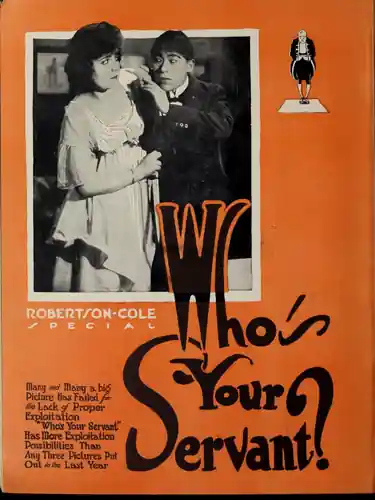 Cinematic perspective: Exploring the visual vocabulary of Who's Your Servant? (1920) through its definitive frames.
Performances: A Dance of Masks
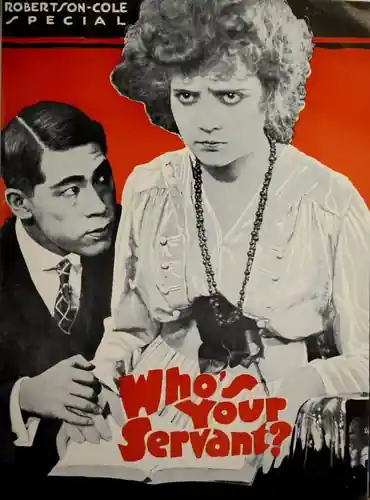 Cinematic perspective: Exploring the visual vocabulary of Who's Your Servant? (1920) through its definitive frames.
Visual Lexicon: Shadows, Grates, and Gaslight
Gender & Empire in a Single Reel
Sound of Silence, Music of Absence
Comparative Echoes
Verdict: A Phantom You Should Chase
IMDb 6.7
1927
Community
Log in to comment.