DbcultAccessing Vault...
Cult Review
Senior Film Conservator
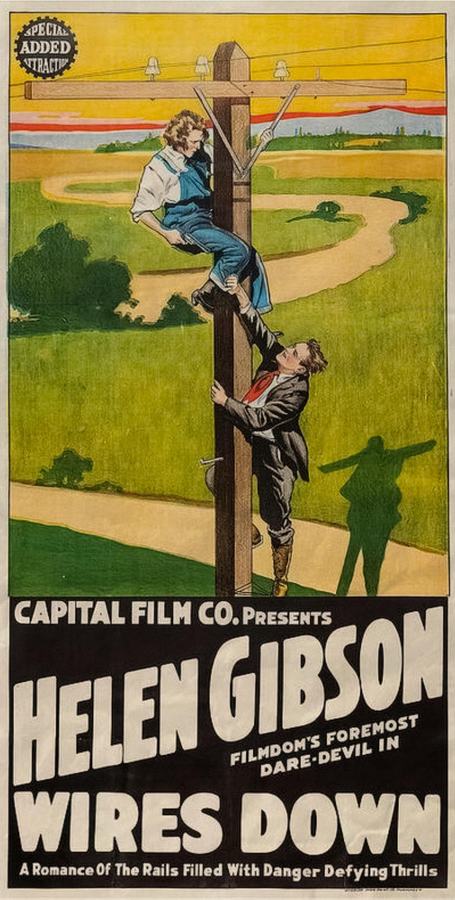
Stepping back into the flickering shadows of early cinema, one occasionally unearths a gem that, despite its vintage, resonates with an almost primal energy. Such is the case with 'Wires Down,' a silent-era marvel that, even a century later, still manages to tighten the chest with its sheer, unadulterated tension. This isn't just a film; it's a testament to the raw power of visual storytelling, propelled by the indomitable spirit of its star, Helen Gibson. In an age where spectacle often meant grand theatricality, 'Wires Down' delivered a different kind of thrill: the visceral, heart-stopping reality of a woman against impossible odds, a narrative tapestry woven with threads of desperate courage and the stark fragility of human connection.
The film opens with a deceptively serene panorama of the American West, a landscape both breathtakingly beautiful and terrifyingly indifferent. Mary, portrayed with an unyielding grace by Helen Gibson, operates a solitary telegraph station, an almost anachronistic bastion of modernity amidst the vast, untamed wilderness. This station is more than just a building; it's the nerve center, the whispering conduit through which the scattered veins of civilization communicate. The initial scenes establish a quiet rhythm, a sense of routine punctuated by the rhythmic click of the telegraph key, a sound that, even in a silent film, feels palpably present, signifying order and connection. This carefully constructed tranquility, however, is merely the calm before the storm—a literal tempest that descends with an almost biblical fury, tearing through the landscape and, more critically, severing the very 'wires' that lend the film its evocative title. The sudden cessation of communication is depicted with an almost terrifying abruptness; the once-vibrant key falls silent, plunging Mary and, by extension, the audience, into a profound, suffocating isolation.
This isolation isn't merely physical; it's an existential dread. The world, once within reach, is suddenly distant, unknowable. It's a powerful thematic undercurrent, reminding us how utterly dependent we are on the unseen threads that bind us. The genius of 'Wires Down' lies in its ability to translate this abstract concept into a tangible, pressing threat. The storm itself is not just a plot device; it's a character, an antagonist as formidable and relentless as any human villain. Its howling winds, depicted through frenetic camera movements and dramatic lighting, are a palpable force, trapping Mary in her remote outpost, a solitary sentinel against the encroaching chaos.
Helen Gibson, a name synonymous with daring and resilience in the annals of early Hollywood, delivers a performance that transcends the limitations of the silent medium. Her Mary is not a damsel in distress, but a woman forged in the crucible of the frontier, possessing an inner steel that radiates from the screen. When the dire message — a dam is about to burst, threatening a town downriver — arrives just moments before the lines go dead, her transformation from telegraph operator to desperate messenger is instantaneous and utterly convincing. There's no histrionic wailing; only a grim determination that hardens her features and propels her into action.
Gibson’s physicality is, of course, legendary, and 'Wires Down' provides a magnificent showcase for her unparalleled stunt work. We see her mount her horse with a practiced agility that speaks volumes of her character's competence, her movements fluid and decisive. The ensuing ride is a masterclass in kinetic filmmaking. The camera, often mounted precariously close to the action, captures every straining muscle, every mud-splattered gallop, every perilous leap over fallen trees and swollen rivers. There are moments in this sequence that feel genuinely dangerous, a testament to Gibson's unwavering commitment to her craft. Unlike many of her contemporaries, whose action sequences often relied on clever editing or obvious stand-ins, Gibson was the real deal, and her authenticity lends an incredible weight to Mary's struggle. This raw, unvarnished heroism places her in a lineage of cinematic trailblazers, far removed from the more delicate sensibilities often associated with actresses of the era.
The central act of 'Wires Down' is Mary's epic journey to warn the town. This isn't merely a plot device; it's a meticulously crafted visual narrative that explores themes of human endurance against the vast indifference of nature. The storm-ravaged landscape becomes a character in itself, a relentless gauntlet of mudslides, torrential rivers, and treacherous ravines. The filmmakers utilize a dynamic array of shots, from sweeping long shots that emphasize Mary's solitary vulnerability against the immense backdrop, to intense close-ups that capture the strain and desperation etched onto her face. The editing, surprisingly sophisticated for its time, maintains a relentless pace, cutting between Mary's arduous progress and brief, impactful glimpses of the unsuspecting town, amplifying the ticking clock motif.
One particular sequence, where Mary's horse struggles through a waist-deep, rapidly flowing river, is nothing short of breathtaking. The sheer force of the water is conveyed with startling realism, and Gibson's interaction with the animal demonstrates a profound connection, a partnership born of necessity and mutual trust. This scene, devoid of dialogue, speaks volumes about the primal struggle for survival, a woman and her steed united against a common foe. It recalls the raw, unvarnished grit seen in later Westerns, where the landscape itself becomes an antagonist, forcing characters to confront their limits. This particular ordeal, more than any other, showcases the sheer physical demands placed upon Gibson, elevating her performance beyond mere acting into something truly athletic and inspiring.
Just when nature's fury seems insurmountable, 'Wires Down' introduces another layer of peril: the malevolence of humankind. Silas the Shadow and his gang, a collection of opportunistic brigands, become aware of the communication blackout and the impending disaster. Their cynical plan to exploit the chaos, to loot the doomed town under the cover of the flood, adds a chilling dimension to Mary's struggle. This isn't just about outrunning a natural catastrophe; it's about outwitting human greed and depravity. The contrast between Mary's selfless mission and Silas's predatory ambition is stark, highlighting the best and worst of humanity.
The cat-and-mouse game that ensues between Mary and Silas's gang is expertly choreographed. Chase sequences, a staple of early serials and Westerns, are elevated here by Gibson's authentic stunt work. There's a particular moment where Mary, after a narrow escape, has to cut her own telegraph wires – the very symbols of connection she's fighting to restore – to create a diversion, a poignant sacrifice that underscores the desperation of her situation. Silas, with his shadowy demeanor and ruthless efficiency, makes for a compelling antagonist, a mirror reflecting the destructive potential of unchecked self-interest. The film cleverly uses the lack of sound to amplify the tension of these encounters; every widened eye, every clenched jaw, every sudden movement becomes freighted with meaning, drawing the audience deeper into the wordless drama.
'Wires Down' is more than just an action film; it's a meditation on the fragility of civilization and the enduring power of the individual spirit. The broken wires symbolize not just a technological failure, but a breakdown in societal order, a return to a more primal state where survival depends on wit, courage, and sheer physical prowess. Mary's journey is a microcosm of humanity's constant struggle against chaos, both natural and man-made. Her unwavering resolve, even when faced with overwhelming odds, serves as an inspiring testament to the human capacity for heroism.
The film's impact on its contemporary audience must have been profound. In an era where telegraphs and nascent radio were rapidly shrinking the world, the idea of these vital connections being severed would have resonated deeply. It tapped into anxieties about isolation and the vulnerability of technological progress. For modern viewers, it offers a fascinating glimpse into the nascent language of cinema, demonstrating how skilled filmmakers could evoke intense emotion and complex narratives without the benefit of spoken dialogue or sophisticated special effects. The reliance on visual storytelling, body language, and expressive acting often results in a more immersive and emotionally direct experience, compelling the audience to actively engage with the narrative on a deeper, more empathetic level.
While 'Wires Down' stands tall on its own merits, its brilliance is often illuminated when viewed alongside its contemporaries. The raw, physical heroism of Helen Gibson finds a spiritual cousin in the relentless pursuit and daring escapades seen in films like Riders of Vengeance, though 'Wires Down' imbues its action with a heightened sense of urgency and a more singular, focused purpose. Where 'Riders of Vengeance' might explore the broader dynamics of frontier justice, 'Wires Down' narrows its lens to the individual's desperate fight for survival and the preservation of innocent lives. The intricate plotting and moral ambiguity of films such as Cheating the Public offer a stark contrast to Mary's unambiguous heroism; in 'Wires Down,' the lines between good and evil, though silent, are drawn with striking clarity.
Furthermore, the dramatic stakes in 'Wires Down' transcend the personal tragedies often explored in melodramas like Camille or The Unwelcome Mother. While those films plumb the depths of emotional anguish and societal constraints, 'Wires Down' presents a more externalized, existential threat, where the very fabric of a community hangs precariously in the balance. The internal struggles of a character in The Girl from His Town, for instance, are deeply personal, whereas Mary's battle, though intensely personal in its execution, carries the weight of an entire populace on her shoulders. Even the more lighthearted romantic escapades of Romance and Brass Tacks or A Youthful Affair serve to highlight the stark, life-or-death seriousness that permeates every frame of 'Wires Down,' positioning it as a thrilling counterpoint to the more gentle narratives of its time.
The technical prowess displayed in 'Wires Down' also invites comparison. The dynamic camera work and inventive stunt choreography, for instance, arguably laid groundwork for the more elaborate set pieces seen in later adventure films. The way the film builds suspense through rapid cross-cutting and carefully constructed visual cues, rather than overt exposition, demonstrates a nascent mastery of cinematic language that would become standard. While films like The Fall of the Romanoffs might have focused on historical grandiosity and political drama, 'Wires Down' grounds its narrative in a visceral, immediate threat, making it feel remarkably modern in its approach to action and suspense. It eschews the theatricality of some European productions like Le destin est maître or Addio giovinezza!, opting instead for a distinctly American brand of rugged individualism and practical heroism.
'Wires Down' stands as a powerful testament to the ingenuity and daring of early filmmakers, and particularly to the extraordinary talent of Helen Gibson. It’s a film that speaks across the decades, reminding us that true heroism is often found in the most desperate circumstances, and that the human spirit, when pushed to its limits, can achieve the seemingly impossible. The absence of spoken dialogue only amplifies its universal appeal, allowing the raw emotion and breathtaking action to communicate directly with the viewer's heart. It's a foundational piece of action cinema, a thrilling ride that continues to resonate with its timeless themes of courage, community, and the fight against overwhelming odds. For anyone seeking to understand the roots of cinematic spectacle, or simply desiring an hour of genuine, edge-of-your-seat thrills, 'Wires Down' remains an essential, electrifying watch, its silent narrative echoing with a profound and enduring power. The film's conclusion, a triumphant, albeit exhausted, success, leaves one with a deep sense of satisfaction, not just for the resolution of the immediate crisis, but for witnessing such an extraordinary display of human fortitude. It’s a stark reminder that even a century ago, cinema was capable of crafting narratives that were both deeply personal and universally resonant, stories that transcended their technological limitations to capture the very essence of the human struggle.
IMDb 7.1
1929
Community
Log in to comment.