DbcultAccessing Vault...
Cult Review
Senior Film Conservator
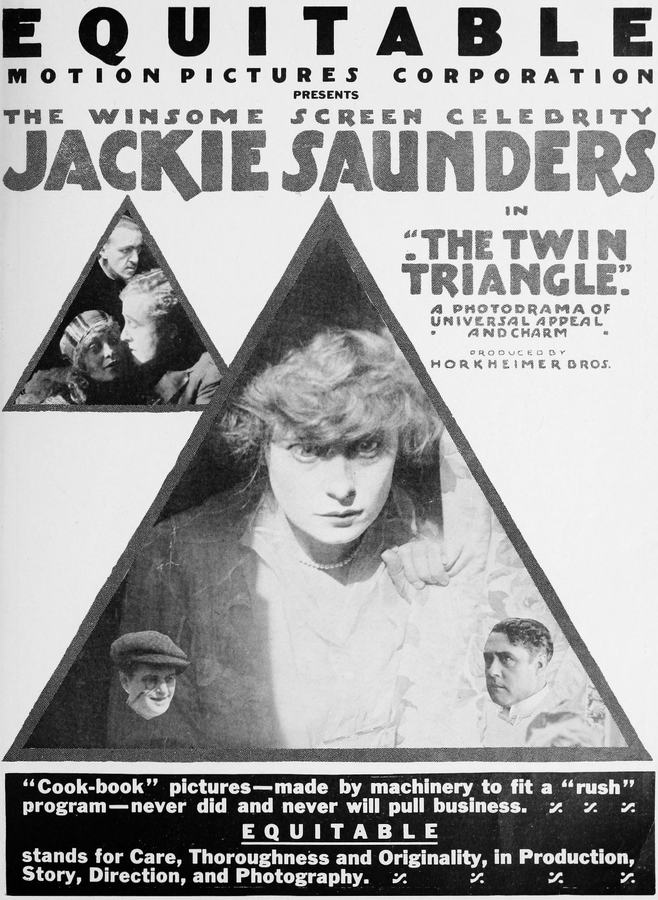
Stepping back into the hallowed halls of silent cinema often feels like a journey through a dreamscape, a world where gestures speak volumes and the flicker of an emotion across an actor's face carries the weight of a thousand words. Among these spectral visions, Bess Meredyth's 'The Twin Triangle' emerges not just as a film, but as a profound meditation on identity, destiny, and the often-cruel hand of fate. While many cinematic treasures of this era have faded into obscurity, this particular work, with its intricate narrative and compelling performances, demands a rediscovery. It's a testament to Meredyth's unparalleled skill as a storyteller, a writer whose sensitivity to human frailty and societal pressures allowed her to craft narratives that resonated deeply with audiences of her time and, remarkably, continue to echo in ours.
The film’s brilliance, beyond its technical prowess, lies in its audacious exploration of a concept as old as literature itself: the doppelgänger. Here, it’s not merely a plot device but a crucible in which the characters' very souls are tested. We are introduced to Mary (Ruth Lackaye), a character imbued with an almost ethereal innocence, whose life is a tapestry woven with threads of quiet dignity and burgeoning hope. Her world, initially circumscribed by the modest rhythms of her existence, expands dramatically with the entrance of John (William Conklin), a man whose charm and social standing promise a different future. Their connection is immediate, palpable, a classic cinematic romance blossoming under the watchful eye of a society that rigidly defined boundaries of class and propriety. Conklin, with his debonair presence, perfectly embodies the romantic lead of the era, conveying both sincerity and the inherent privilege that often blinded such characters to the complexities beneath the surface.
However, Meredyth, ever the master of dramatic tension, quickly introduces the pivotal complication: Lillian (Joyce Moore), Mary's identical twin. But Lillian is no mere reflection; she is a distorted mirror image, a woman who has navigated the harsher currents of life, her experiences etching a different kind of wisdom, or perhaps cynicism, onto her features. Moore’s portrayal of Lillian is a masterclass in duality, presenting a character who is both sympathetic in her struggles and formidable in her resolve. The visual conceit of identical twins, especially in the silent era, relies heavily on subtle acting choices and costuming, and both Lackaye and Moore rise to the challenge, crafting two distinct personalities despite their shared visage. The 'twin triangle' thus becomes a complex geometric problem, where the lines of affection, deception, and identity intersect with devastating consequences. John, caught in the bewildering web of mistaken identity, finds himself drawn into a vortex of confusion, his affections unknowingly misdirected, his judgment clouded by the striking similarity between the two women.
What truly elevates 'The Twin Triangle' beyond a simple melodrama is Meredyth’s keen understanding of human psychology. The film doesn't just present a series of events; it delves into the emotional landscape of its characters, exploring the profound impact of societal judgment, the agony of miscommunication, and the desperate yearning for acceptance. Mary's heartbreak, as she witnesses the man she loves seemingly betraying her with her own image, is rendered with an almost unbearable poignancy. Lackaye’s performance here is particularly striking; her silent tears and anguished expressions convey a depth of sorrow that transcends the limitations of the medium. Similarly, Lillian's internal conflict—her desire for a better life clashing with the moral compromises she is forced to make—adds layers of complexity to her character, making her far more than a mere antagonist. This nuanced characterization is a hallmark of Meredyth's writing, distinguishing her work from many of her contemporaries who often relied on more simplistic portrayals of good and evil.
The supporting cast, too, contributes significantly to the film’s rich tapestry. Ed Brady, often cast in roles that exuded a certain rugged intensity, likely brings a grounding presence, perhaps as a figure of authority, a rival, or a loyal friend caught in the crossfire of this emotional maelstrom. Jackie Saunders, known for her vivacious screen presence, could have provided moments of levity or served as a confidante, offering a contrasting perspective to the central drama. Mollie McConnell, a veteran character actress, would have lent gravitas, perhaps as a matriarchal figure or a stern societal arbiter. R. Henry Grey, with his distinctive features, probably filled a more villainous or scheming role, further complicating the already intricate plot. Each actor, in their silent pantomime, contributes to the intricate dance of deception and revelation that defines the film, demonstrating the collaborative artistry inherent in early filmmaking.
Bess Meredyth's writing for 'The Twin Triangle' is a masterclass in narrative architecture. She understands how to build suspense not through overt action, but through the slow, agonizing unfolding of misunderstandings and the gradual revelation of truths. The screenplay is a tightly wound spring, each scene adding another layer of tension, another twist to the emotional knot. Her ability to weave together disparate lives and circumstances into a coherent, compelling whole is truly remarkable. The themes she explores—identity, morality, social class, and the nature of love—are universal, yet she grounds them in the specificities of her characters' experiences, making their struggles feel intensely personal and relatable. This film, like many of Meredyth's works, functions as a social commentary, subtly critiquing the rigid class structures and the unforgiving judgment that often defined early 20th-century society. It asks profound questions about what truly defines a person: their birthright, their circumstances, or their intrinsic character?
In terms of its thematic depth, one might draw parallels between 'The Twin Triangle' and other films that grapple with issues of identity and societal perception. For instance, The Case of Becky, with its exploration of multiple personalities and psychological drama, shares a common thread of questioning the singular self. While 'Becky' delves into internal fragmentation, 'The Twin Triangle' examines external confusion and its devastating personal impact. Both films, however, highlight the fragility of identity and how easily it can be manipulated or misunderstood, whether by internal forces or external circumstances. Similarly, the romantic entanglements and the moral dilemmas faced by the characters could be compared to films like He Fell in Love with His Wife or The Road to Love, though 'The Twin Triangle' injects a unique layer of complexity through its use of identical twins, elevating the stakes and the dramatic irony considerably. The sheer weight of misunderstanding and the societal implications of perceived impropriety are amplified by the visual identicality of Mary and Lillian, turning every interaction into a potential minefield.
Meredyth’s screenplay doesn't shy away from the darker aspects of human nature, nor does it preach. Instead, it observes, allowing the audience to witness the consequences of choices and the ripple effects of deception. The film’s resolution, while providing a sense of closure, doesn't offer easy answers, reflecting the complex moral landscape it so meticulously constructs. This refusal to simplify moral quandaries is a hallmark of truly great storytelling, and Meredyth, as one of the most prolific and respected writers of her time, consistently delivered narratives that challenged and engaged her audience on a deeper level. Her ability to craft such intricate plots, often featuring strong female protagonists navigating difficult situations, set a precedent for future storytellers and solidified her reputation as a formidable creative force in Hollywood.
The performances in 'The Twin Triangle' are a testament to the artistry of silent film acting. Ruth Lackaye, in particular, delivers a performance that is both delicate and powerful. Her Mary is not a passive victim but a woman of quiet strength and profound resilience. The subtlety of her expressions, the way her eyes convey a world of unspoken emotion, is captivating. It is through her portrayal that the audience truly feels the weight of the injustice and the agonizing pain of betrayal. William Conklin, while playing the somewhat oblivious romantic lead, manages to infuse John with enough charm and underlying decency that his mistakes feel born of circumstance rather than malice, making him a sympathetic figure despite his unwitting role in the deception. Joyce Moore, as Lillian, is equally compelling. She brings a raw edge to her character, allowing us to see the scars of her past while also hinting at the yearning for redemption. Her ability to switch between the hardened exterior and moments of vulnerability is crucial to the film's success, preventing Lillian from becoming a one-dimensional villain.
The visual language of the film, typical of its era, relies heavily on close-ups to capture these nuanced performances. The director, though uncredited in the prompt, would have expertly utilized the camera to draw the audience into the emotional core of each character. The use of intertitles, while necessary for dialogue and exposition, would have been sparse, allowing the actors' expressions and body language to carry the bulk of the narrative. This visual storytelling, a characteristic feature of films from this period, demanded a particular kind of actor, one capable of conveying complex emotions without uttering a single word. The cast of 'The Twin Triangle' clearly possessed this rare talent, transforming what could have been a convoluted plot into a deeply affecting human drama.
Placing 'The Twin Triangle' within the broader context of silent cinema reveals its significance not just as an individual work, but as a representative piece of an era of immense creative ferment. The early 20th century was a period where filmmakers were still defining the language of cinema, experimenting with narrative structures, visual techniques, and thematic explorations. Meredyth’s contributions were instrumental in this evolution. Her ability to craft compelling, character-driven stories helped push the boundaries of what film could achieve, demonstrating its potential for psychological depth and social commentary. One might even see echoes of the social dynamics and moral struggles in films like The Idler, which also delved into societal expectations and the consequences of personal choices, albeit often with a focus on male protagonists. The subtle critique of class distinctions, a recurring theme in 'The Twin Triangle,' also resonates with the undercurrents found in many contemporary literary and cinematic works that grappled with the changing social fabric of America.
The film’s intricate plot, while unique in its specific configuration, draws from a long tradition of dramatic narratives involving mistaken identities and hidden pasts. These tropes were popular because they offered rich opportunities for conflict, suspense, and emotional catharsis. The way 'The Twin Triangle' leverages these elements, however, feels particularly sophisticated. It’s not just about the shock of recognition, but about the profound emotional and ethical dilemmas that arise from it. The film forces its characters, and by extension the audience, to confront uncomfortable truths about perception, judgment, and the inherent biases that shape our understanding of others. This level of thematic engagement elevates it beyond mere entertainment, positioning it as a work of art that grapples with fundamental questions of human experience.
Consider the contrasts available in the cinematic landscape. While a film like The Virginian presented a clear-cut world of good versus evil in the rugged frontier, 'The Twin Triangle' plunges into the murky moral waters of urban melodrama, where intentions are often ambiguous and consequences far-reaching. The stark differences highlight the breadth of storytelling in the silent era, from epic Westerns to intimate psychological dramas. Even films like A Man and His Mate, which explored primal relationships, did so in a less convoluted, albeit equally dramatic, fashion. Meredyth's work here is a testament to the power of narrative complexity, proving that silent films could tackle nuanced emotional landscapes with as much, if not more, impact than their sound-era successors.
Bess Meredyth's contribution to 'The Twin Triangle' cannot be overstated. As one of the most prominent female screenwriters of her time, her influence extended far beyond individual films. She was a pioneering figure, demonstrating that women could not only write compelling stories but could also shape the very direction of the nascent film industry. Her writing is characterized by its emotional honesty, its sharp observation of human behavior, and its ability to craft narratives that, while often melodramatic, always felt grounded in a recognizable reality. The structure of 'The Twin Triangle,' with its escalating tension and cleverly conceived plot twists, is a hallmark of her sophisticated approach to storytelling. She understood the visual grammar of film and how to translate complex psychological states into actions and expressions that resonated on screen.
The legacy of films like 'The Twin Triangle' is not just in their preservation, but in their continued ability to speak to modern audiences. Despite the passage of a century, the core themes of identity, betrayal, and the search for truth remain profoundly relevant. The film serves as a powerful reminder of the artistic achievements of the silent era and the foundational role played by visionaries like Bess Meredyth. It’s a call to look beyond the technological advancements of contemporary cinema and appreciate the sheer narrative power that could be conveyed through the subtle interplay of light, shadow, and human emotion. This film, in its quiet brilliance, offers a window into a bygone era, yet its heart beats with a timeless rhythm, exploring the universal complexities of the human condition.
In conclusion, 'The Twin Triangle' is far more than a historical curiosity; it is a captivating piece of cinematic artistry that deserves a place in any serious discussion of silent film. Meredyth’s intricate plot, coupled with the compelling performances of Ruth Lackaye, William Conklin, and Joyce Moore, creates a melodrama of rare depth and power. It's a film that challenges perceptions, tugs at the heartstrings, and ultimately celebrates the enduring resilience of the human spirit. For those willing to immerse themselves in its silent world, 'The Twin Triangle' offers a rewarding and thought-provoking experience, a testament to the fact that true storytelling transcends the limitations of sound and time. Its intricate web of identity and romance remains as compelling today as it was a century ago, a true testament to its enduring quality and the genius of its creators.
IMDb —
1922
Community
Log in to comment.