DbcultAccessing Vault...
Cult Review
Senior Film Conservator
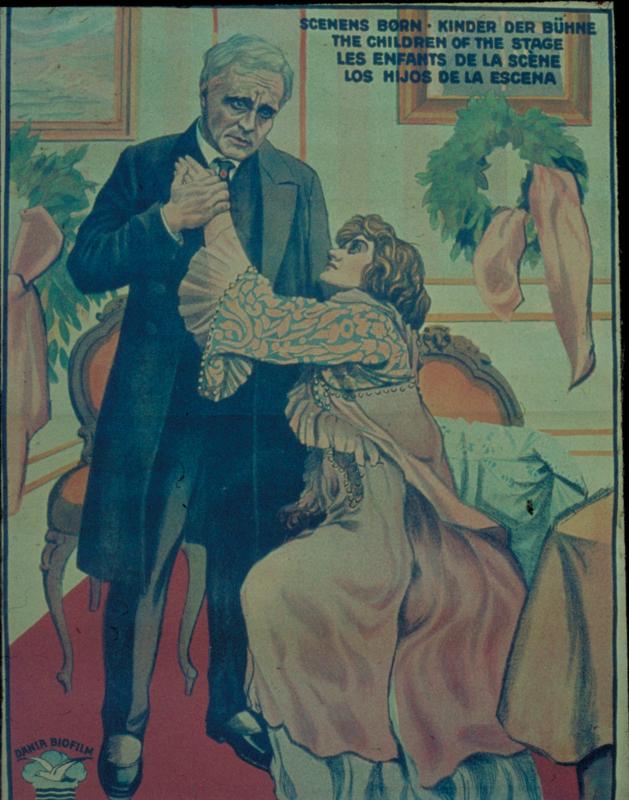
Scandinavia, 1914: while Europe arms itself for industrial slaughter, a Copenhagen studio whispers a smaller, more intimate apocalypse—the implosion of a theatrical marriage caught in the klieg lights.
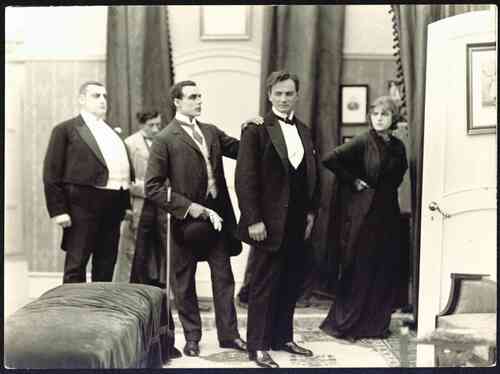
Children of the Stage, or When Love Speaks arrives like a moth-eaten playbill you discover pressed inside a 19th-century Bible: fragile, sepia, yet somehow radiating the heat of the footlights it depicts. Directed by Bjørn Bjørnson—yes, blood of Ibsen’s nemesis—the picture distills a boulevard melodrama into something approaching chamber music, all tremulous strings and sudden cymbal crashes. The plot pirouettes around three poles: Walther, a lion in winter whose mane has thinned but whose roar still rattles chandeliers; Leonie, his springtime spouse, part ingénue, part strategist; and Charles Lacour, the virile comet whose trajectory disrupts their private cosmos. Age, art, and ambition collide—then fracture like a dropped mirror—leaving every character bleeding from reflections they cannot reassemble.
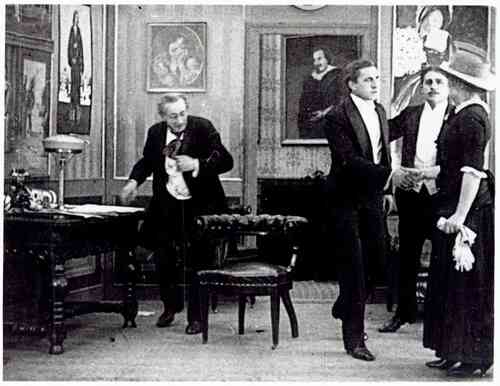
Age-gap romances were catnip to early cinema—think of Les Amours de la Reine Élisabeth or Cleopatra—yet few silents dared to stage the erotic arithmetic so bluntly: a man twice his wife’s vintage, confronted by a rival half his own.
Bjørnson’s camera never forgets it is watching performers watch themselves. Early scenes luxuriate in the narcotic glamour of backstage: greasepaint tubs exhaling mineral dust, gas-jets hissing like impatient snakes, velvet curtains so heavy they seem to possess gravitational pull. When Walther crashes to the parquet—one ankle twisting at an angle that makes the audience wince—the film cuts to a close-up of his grease-smeared face superimposed upon the leering mask of Mephistopheles. It is as if the role he embodies has reached out to claim its interpreter.
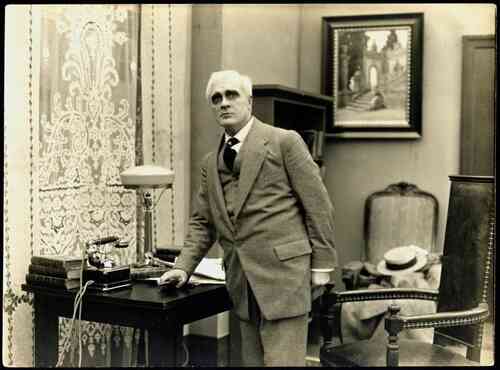
This metatheatrical pulse quickens once the narrative leaps ahead three months. Crutches become props in Walther’s private drama of emasculation; every thud of wood on floorboards is a metronome ticking toward catastrophe. Bjørnson intercuts domestic skirmishes with on-stage rehearsals, so that shouted accusations echo across empty seats, multiplying like ghosts. The motif crescendos in the final reel when a stage revolver—supposedly harmless—discharges a very real bullet. The blast punches through artifice; footlights dim, the orchestra pit erupts in discord, and for a heartbeat spectators cannot tell whether their horror is scripted or authentically lethal.
Bodil Ipsen’s Leonie is a marvel of flickering registers: flirtatious yet fatigued, compassionate yet calculating. Watch her eyes during the post-gala reception—how they dart to Lacour’s applause, then slide back to Walther’s protective grip on her elbow. The moment is silent, but Ipsen orchestrates a sonata of micro-gestures: the slight stiffening of the spine, the exhale that flutters a single curl. It is the birth of desire and the death of innocence in one breath.
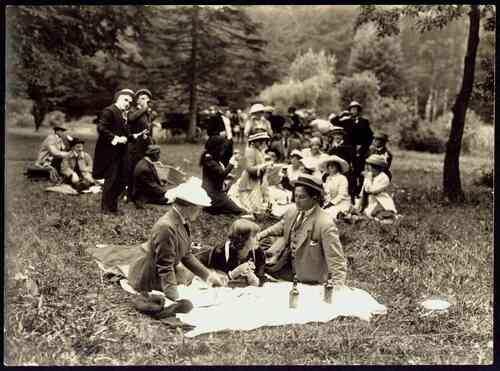
Adam Poulsen’s Walther could have descended into Lear-on-a-cane bombast, yet he plays the decline as entropy rather than eruption. His voice—rendered via Norwegian intertitles—retains rhetorical flourishes, but the body encasing it dwindles: shoulders cave, pupils dilate into abysses. The transformation is so gradual that when he finally presses a farewell letter into Leonie’s palm we realize we are no longer looking at an actor but at the hollow echo of one.
And then there is Aud Egede-Nissen’s Dora, the discarded lover who engineers the tragedy. Egede-Nissen channels a lineage of vengeful women—from Camille’s consumptive diva to Trilby’s mesmerized muse—but gives them a surgical edge. Her revenge is not tempestuous; it is methodical, almost scientific. The way she swaps the revolvers—fingers gloved in lace to muffle the clink of metal—feels like a gynecologist of fate delivering doom with clinical dispassion.
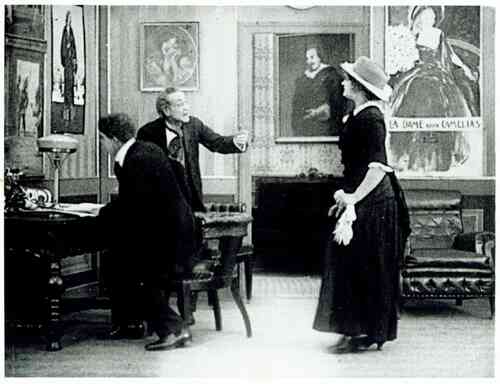
Cinematographer Hugo J. Fischer (rumored to have studied with the Danish impressionists) bathes interiors in umber and candle-gold, so that every frame resembles a canvas by Krøyer half-submerged in twilight. Note the sequence where Leonie, framed against a dressing-room mirror, is shot from behind; her reflection looks outward, confronting us, while the flesh-and-blood woman remains obscured. The split is not merely compositional—it is epistemological. Who is real: the tangible spouse or the idealized image her husband worships?
Exterior shots—rare, almost contraband—are soaked in Nordic cobalt. When characters exit the theatre they gulp fjord-cold air as though surfacing from drowning. One brief scene beside Copenhagen’s Nyhavn canals renders gas-lamps as trembling yellow orbs upon black water, echoing the footlights left behind. The city becomes a second auditorium where private dramas play to an audience of gulls and masts.
Editing here is proto-Soviet before Soviets had coined montage. Cross-cutting between Walther’s claustrophobic apartment and Leonie’s moonlit rehearsals escalates tension through temporal compression. A single evening dilates into a labyrinth of glances, letters, and slammed doors. Bjørnson even fractures chronology: he revisits the fateful banquet twice—first in chaotic real time, later in ghostly flashback—each repetition layering new meaning upon gestures once thought innocuous. By the climax the spectator has imbibed so many perspectives that the shooting onstage feels like an inevitable chord resolving a prolonged dissonance.
Though originally accompanied by live orchestras, surviving promptbooks suggest an unconventional score: sparse strings, punctuated by long stretches of absolute hush. These lacunae function like moral vacuums—spaces where the audience’s own heartbeat becomes percussion. When the fatal revolver fires, the prescribed direction reads simply, “Orchestra tacet—let the powder speak.” The absence of music is more terrifying than any stab of brass.
Early scholars dismissed the film as patriarchal caution: older husband punished for clinging to youthful wife. Yet modern readings uncover a triangulated power flux. Leonie wields soft power—her goodwill can revive careers; Walther clings to residual patriarchal authority; Lacour embodies emergent virility endorsed by the market. Dora’s sabotage is not merely erotic spite—it is an act of institutional subversion, sabotaging the commodity value of both rivals. Thus the tragedy indicts not simply aging masculinity, but a cultural economy that auctions intimacy to the highest bidder.
For decades the film was lost, known only through a smattering of production stills and a censored Swedish export print discovered inside a disused Oslo church organ. Recent 4K reconstruction by the Danish Film Institute weaves together partial nitrate reels with tinting guides salvaged from Fischer’s estate. The result? Scratches remain—like surgical sutures—reminding us the artifact itself bears stigmata of its resurrection. Some frames quiver like gelatin on the verge of liquefaction, as if the medium itself were nervous about revealing too much.
Set it beside Les Misérables or The Redemption of White Hawk and you’ll note how sparingly Bjørnson deploys exterior spectacle. Where Hollywood of the period flaunts alpine locomotives and circus infernos, this Copenhagen chamber piece trusts the human face to provide the avalanche. Conversely, contrast it with the continent’s more transcendental fare—Parsifal’s grail mysticism or Pilgrim’s Progress’s allegorical sweep—and you’ll appreciate how steadfastly secular, how ferociously psychological, Children of the Stage remains.
By the time Walther slips his farewell note under Leonie’s door, the film has long since abandoned melodrama’s stock binaries. No villain twirls a moustache; no martyr expires beneath a stained-glass halo. Instead we get a triptych of wounded people orbiting a void called trust. The final intertitle reads: “I set you free”—four syllables freighted with so much exhaustion that liberation feels indistinguishable from abdication. One exits the viewing experience not with cathartic purge but with the dull ache of recognition: perhaps we too have brandished empty guns, perhaps we too have swapped live rounds into another’s chamber, perhaps freedom is merely the courtesy of walking away before the trigger is squeezed.
Children of the Stage will not lunge at you with grand guignol shocks; it will seep under your ribs like Copenhagen fog. Its triumph lies in demonstrating how the most confined spaces—a pair of dressing rooms linked by a corridor—can contain multitudes of yearning, terror, and grace. If you crave the pyrotechnics of The Great Circus Catastrophe or the biblical pageantry of From the Manger to the Cross, look elsewhere. But if you believe, as I do, that cinema’s most explosive set pieces sometimes unfold in the tremor of a lower lip, then seek out this resurrected Norwegian jewel. Let its shadows pool in your retinas; let its silence colonize your pulse. Just don’t blame me if, days later, you hear the echo of a gunshot in the hush between heartbeats and find yourself wondering which of your own relationships are loaded—and which are merely waiting for someone to swap the props.
Community
Log in to comment.