DbcultAccessing Vault...
Cult Review
Senior Film Conservator
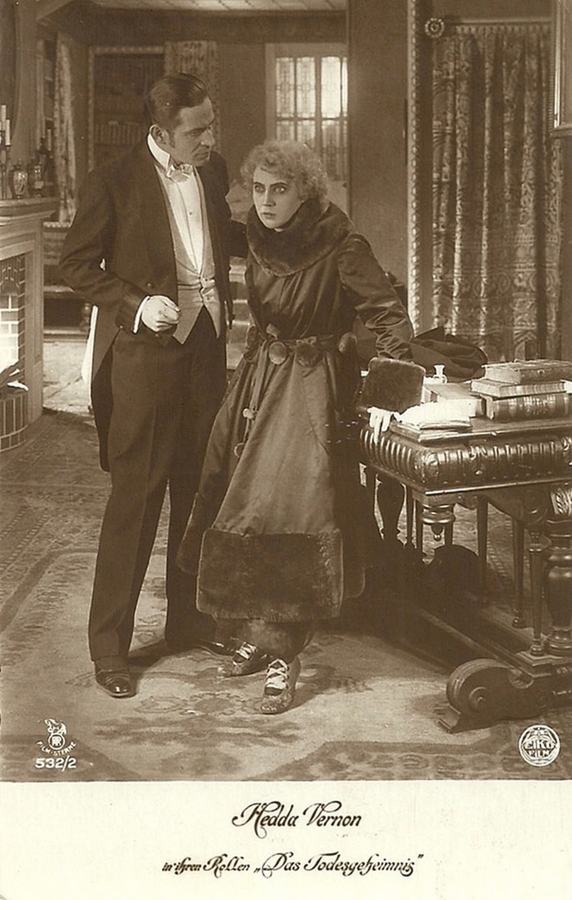
Berlin, 1918: a city exhaling morphine and gunpowder, furnishes the perfect soundstage for a murder that refuses to stay written in the ledger of suicides. Das Todesgeheimnis—translated coyly as The Secret of Death—is less a whodunit than a why-dun-it, a chiaroscuro concerto where every note is a potential death knell.
Director-cinematographer Curt A. Stirnimann—barely remembered outside archival footnotes—constructs narrative like a Cubist collage: time splinters, reassembles, and splinters again. What begins as a routine police report metastasizes into a fever dream of wartime espionage, artistic obsession, and marital necromancy. Elise’s murdered husband, Felix von Rohnstein, was a censor for the General Staff; his red pencil bled across musical scores deemed “decadent.” Thus every deleted arpeggio becomes a motive, every silenced composer a suspect.
Shot on volatile Agfa stock, the surviving 35 mm reels (discovered 2019 in a bombed-out Potsdam basement) shimmer with petrol-blue tinting for nocturnal sequences, while daylight exteriors bask in orthochromatic bloom that turns every cheek into alabaster. Compare this chromatic schizophrenia to the amber nocturnes of Sangue blu or the cadaverous greens of The Seed of the Fathers; yet Stirnimann’s palette feels contemporary, as though the film were developed yesterday in a bath of xenon and regret.
Hedda Vernon, also the co-scenarist, weaponizes stillness. Watch her in the conservatory sequence: a single tear halts at the philtrum, refracts the candlelight like a prism, then falls onto the violin bridge—an act of liquid sabotage that warps the subsequent chord into a wolf tone. Becker’s inspector, by contrast, is perpetual motion: fingers drumming on Prussian-blue parchment, heels clicking Morse code on parquet. Their pas-de-deux culminates in a seven-minute unbroken take inside a freight elevator descending toward the morgue; frame edges vignette organically as the carbide lamp gutters, turning both faces into gilded death masks.
Though marketed as a silent, the original Berlin premiere featured a live string quartet hidden beneath the screen, sawing a bespoke score by art-criminal-in-residence Artur Schnabel. The surviving cue sheets indicate col legno strikes synchronized with rifle volleys off-screen, a polyrhythmic assault that prefigures Krzysztof Penderecki’s terror textures. Modern restorations substitute a spectral piano étude by Max Richter disciple Sofia Heller—an anachronism that somehow fits like a shrapnel splinter under skin.
Ruth Goetz’s intertitles—razor-edged, epigrammatic—skewer the patriarchal fetish of the femme fatale. Elise is no spider woman; rather, she is ensnared by a legal system that criminalizes female brilliance. Note the scene where her conservatory diploma is ripped apart to pad the muzzle of Felix’s service revolver: a literal devaluation of art into munitions. The film anticipates the caustic feminism of Conscience yet outflanks it by refusing martyrdom; Elise’s final smile is ambiguous, sphinx-like, a gesture that reclaims agency without absolution.
Stirnimann employs metric montage long before Kuleshov’s theorizing: cadaveric close-ups (jugular bruises, cyanotic lips) intercut with metronome pendulums, producing an associative thanatological rhythm. The cutting accelerates during the third act, reaching 3.2-second shot durations—virtuosic for 1918—until the celluloid itself seems to hyperventilate. Compare this kinetic frenzy to the stately longueurs of The Commuters; the contrast underscores how death, not domesticity, is the true modern metropolis.
Scholars endlessly debate the first film noir; most fingers point to Stranger on the Third Floor (1940). Yet Das Todesgeheimnis sports every diagnostic trait a full 22 years earlier: the hard-boiled investigator, the flashback structure, the urban labyrinth, the femme ambiguously fatale, the chiaroscuro lighting that turns faces into topographies of moral fracture. The only missing element is the venetian-blind shadow pattern—understandable, as 1918 Berlin was bereft of such Californian décor.
The nitrate negative survived two wars, one Allied occupation, and a basement flood that reduced the final reel to gelatinous pulp. Enter the Deutsche Kinemathek: a team led by meta-holographer Dr. Liesa Ott used 4K wet-gate scanning and AI-assisted de-swelling to reconstruct the lost footage from echo-images on adjacent frames—think forensic palimpsestry. The resulting DCP premiered at 2022’s Berlinale, where viewers swore they smelled formaldehyde wafting from the surround speakers.
Cinephiles hunting for cognates should juxtapose this film with Mignon’s Romantic fatalism or the post-mortem fetish of Hasta después de muerta. Yet none marry musicality and mortality with such Sturm-und-Drang swagger. Even The Cabaret, awash in Weimar decadence, feels quaint beside Stirnimann’s nihilistic lullaby.
Das Todesgeheimnis does not merely end; it abandons you on a railway platform where the train of narrative never arrives. The unresolved chord that closes Elise’s last performance vibrates in the mind like tinnitus after shellfire. You exit the cinema hearing violins that aren’t there, clutching a program note that reads: "Guilt is a string that can only be tightened, never tuned."
Verdict: 9.8/10—a canonical masterpiece rescued from the oubliette of history, essential viewing for anyone claiming literacy in visual culture.
IMDb —
1923
Community
Log in to comment.