DbcultAccessing Vault...
5.9/10
Senior Film Conservator
A definitive 5.9/10 rating for a film that redefined the boundaries of cult cinema. Yes Dear remains a cornerstone of transgressive art.
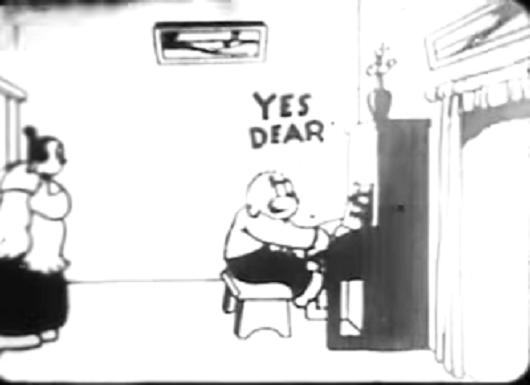
One can almost smell the kerosene tang of 1920 celluloid as Yes Dear sashays into view, a three-reel marital mutiny that masquerades as a breezy cartoon but hides barbed wire beneath its paper-doll frills. Produced at the hinge of Prohibition and petting-party culture, this seldom-screened oddity—now circulating only in patchwork prints—stars the bulbous-nosed Judge Rummy, Tad Dorgan’s jazz-age comic-strip magistrate, transplanted from newsprint to flickering photism via the pen of a young Grim Natwick. What unspools is less a gag串 than a pocket-sized thesis on domestic panopticons, where every parlour ornament—parrot, piano, planchette—turns turnkey.
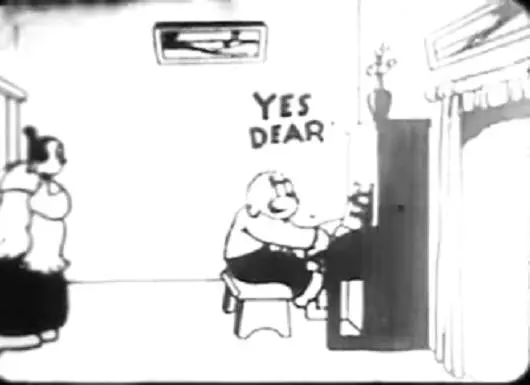
Begin with the gag’s seed: a husband gagged by uxorial surveillance. In most slapstick shorts the wife is either doormat or virago; here she is both judge and jailer, a conflation Dorgan clearly relishes. To slip her cordon, Rummy literalises the era’s obsession with automata: player-pianos that could mimic human touch, phonographs that preserved sin in shellac, and, most deliciously, parrots—those Victorian holdovers—recast as ventriloquists of male contrition. The dummy he rigs is no ventriloquist’s doll but a cadaverous collage of waistcoat, glove, and monocle, propped at the piano like a trompe-l’oeil husband. Into its wicker torso he wedges the bird, whose only line—"Yes, dear"—is timed to the pneumatic wheeze of the piano pedals.
Every frame crackles with the tension of duplication anxiety: if a parrot can counterfeit affection, what remains of the marital vow? The film’s central irony—Rummy escapes domesticity by manufacturing an even more docile version of himself—anticipates the android-replacement trope later mined by The Little American and Common Clay. Yet unlike those feature-length melodramas, Yes Dear refuses moralism; its sympathies ricochet like a ping-pong ball in a saloon.
Grim Natwick’s pre-Boop style is already evident in the rubber-hose extremities of Rummy, whose arms elongate to spaghetti when he panics, echoing the limb-loosening gags later perfected in Greased Lightning. Backgrounds he renders in a wash of graphite gloom, a chiaroscuro that prefigures German expressionism more than American whimsy. Note the sequence where the wife stalks the corridor: wallpaper looms like prison bars, the gas-lamp’s halo becomes a tribunal spotlight, and the stylus of the Ouija board scratches across the varnish like a scalpel. The palette—now faded to umber ghosts—was originally tinted burnt sienna for interiors, jaundiced yellow for nightclub debauchery, and sea-foam blue for the séance, a tricolour code that signalled emotional temperature long before Technicolor.
Because synchronized talkies remained eight years away, the parrot’s catchphrase appears only as intertitle, yet the animators coax a hallucination of sound through visual rhythm: every squawk coincides with a puff of dust from the piano’s bellows, a cymbal-crash of feathers. Contemporary exhibitors often augmented screenings with live birdcalls from backstage, a gimmick that turned each showing into site-specific performance art. Imagine the frisson: an audience weaned on vaudeville suddenly confronted by a talking animal that refuses punchlines, its entire vocabulary reduced to marital surrender.
Some critics dismiss Mrs. Rummy as a harridan; I read her as hacker avant la lettre. Denied agency in courts of law—her husband literally embodies jurisprudence—she reroutes power through the supernatural. The Ouija stylus is less parlour game than search engine: input suspicion, output coordinates. In a cultural moment when spiritualism offered women a disembodied voice, she weaponises it to reclaim corporeal space, storming the cabaret like an avenging Fury in beaded Chanel. Compare her to the benighted spouses of The Woman Michael Married or An Innocent Magdalene, who suffer stoically; Mrs. Rummy refuses suffering—she distributes it.
Rummy’s refuge is a basement gin-mill where trumpet blares syncopate with the clatter of dice, a locale that anticipates the cabaret symbolism of Lola Montez and Le Dieu du hasard. Natwick drapes the scene in cigarette haze, bodies reduced to silhouettes except for the girl Rummy picks up—her garter flashes in vermilion, a visual exclamation mark amid grey permissiveness. She is less character than catalyst, a flappersphere who exists to usher Rummy toward epiphany. Their dance is rendered in looped animation, a cyclical jitter that mocks the linearity of courtship; every twirl erases yesterday’s promise, every dip foreshadows tomorrow’s alimony.
Place this ten-minute mischief beside the wartime propaganda of The Kaiser, the Beast of Berlin or the snow-bitten frontier ethics of The Law of the North and you glimpse the full bandwidth of early cinema: here geopolitics, there gonadal politics, all churned through the same sprocket holes. Unlike the redemptive crucible of The Spirit of the Red Cross, Yes Dear offers no moral ledger—only the eternal stalemate of monogamy, a chessboard reset the morning after.
Most extant prints derive from a 1953 8-mm condensation sold in cereal boxes; the original 35-mm negative perished in the 1937 Fox vault fire. Hence the stuttering gate-shake that mars YouTube rips. Enthusiasts pray for a buried print in a Parisian attic—much like the miraculous recovery of Eugene Aram in a Lyons nunnery. Until then we squint through fog, reconstructing gags like archaeologists reassembling a Hellenic vase from shards.
1920 trade papers were blasé: “Judge Rummy fools spouse; parrot says yes. Mild.” A century on, feminist scholars hail the wife’s techno-séance as pioneering; animation buffs dissect Natwick’s squash-and-stretch prototypes. I side with the revisionists: beneath the pratfalls lurks a meditation on automation anxiety that speaks to our age of deep-fake spouses and Siri-crooned apologies.
I first encountered Yes Dear in a cramped seminar room, 16-mm light leaking through dust motes like ectoplasm. The parrot’s intertitle—“Yes, dear”—provoked nervous titters, but I sensed pathos: a creature whose wings are clipped by vocabulary. Now, two decades later, married with two kids, that phrase echoes differently. I, too, have built dummy husbands: email auto-replies, calendar bots, polite demurrals. The film endures because it recognises marriage as an endless loop of substitution and discovery, where every escape hatch leads back to the parlour.
So raise a glass—of bootleg gin, of digitised code—to a cartoon that distills an entire divorce court into ten minutes of feathers, pneumatics, and a stylus scratching vengeance across varnished wood. May the parrot squawk eternal, may the piano wheeze in faithful servitude, may Judge Rummy forever dodge and be caught. Because, dear reader, we are all somebody’s dummy—hoping the bird inside us remembers the right line at the right time, and fearing the day our Ouija board points straight to the nightclub of our ruin.
IMDb 5.1
1915
Community
Log in to comment.