DbcultAccessing Vault...
Cult Review
Senior Film Conservator
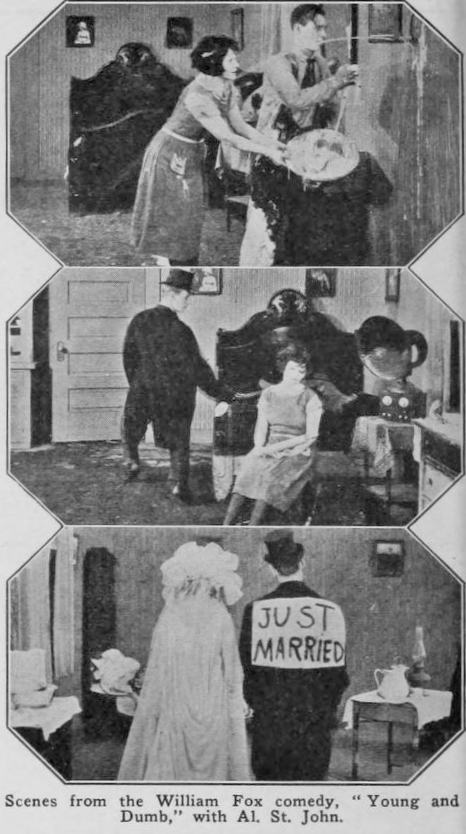
The silent era was not merely a precursor to modern cinema; it was a distinct, high-energy language of its own, and Young and Dumb stands as a vibrant, albeit frantic, dialect of that language. Starring the inimitable Al St. John, this short film is a masterclass in what I call 'kinetic storytelling.' While many critics focus on the heavyweights like Chaplin or Keaton, St. John—often relegated to the shadows of his uncle Roscoe 'Fatty' Arbuckle—demonstrates a level of acrobatic prowess and comedic timing that demands a contemporary re-evaluation. The film operates on a frequency of pure motion, where the plot serves as a skeletal framework for a series of increasingly perilous physical feats.
In Young and Dumb, the protagonist is the quintessential 'rube,' a character type that was ubiquitous in the early 20th century. However, St. John breathes a peculiar life into this trope. Unlike the more sophisticated urbanites found in The Social Code, St. John’s character is a creature of instinct and accident. There is a raw, unpolished quality to his performance that feels more human than the polished personas of the era's leading men. He isn't trying to navigate high society; he is simply trying to navigate a world that seems fundamentally designed to trip him up.
The lexical diversity of his physical movements is staggering. He doesn't just fall; he crumples, bounces, and ricochets. This isn't the calculated, geometric precision of Keaton, but rather a chaotic, improvisational energy that feels dangerously close to actual injury. When comparing this to the more structured narrative beats of Ambrose's Matrimonial Mixup, one can see how St. John was pushing the boundaries of what the human body could endure for a laugh. He was the quintessential 'tough guy' of comedy, a man whose bones seemed made of vulcanized rubber.
The film lacks the sprawling dramatic ambition of something like The Squaw Man (1918), but it replaces that scope with a concentrated intensity. The 'plot' is a thin thread used to hang a series of spectacular stunts. Yet, there is a subtle brilliance in its simplicity. The pacing is relentless. Each sequence builds upon the last, creating a rhythmic crescendo of slapstick. The cinematography, while primitive by today's standards, utilizes the fixed frame to maximize the impact of every entrance and exit. The camera doesn't need to move because the actors never stop moving.
Consider the use of props. In the world of Young and Dumb, objects have a life of their own. A simple bicycle becomes a bucking bronco; a ladder becomes a see-saw of doom. This transformation of the mundane into the hazardous is a hallmark of the era, but St. John executes it with a frantic desperation that feels remarkably modern. It’s a stark contrast to the more somber, atmospheric tension found in Out of the Night or the romantic entanglements of The Kiss (1921). Here, the only romance is between the performer and the pavement.
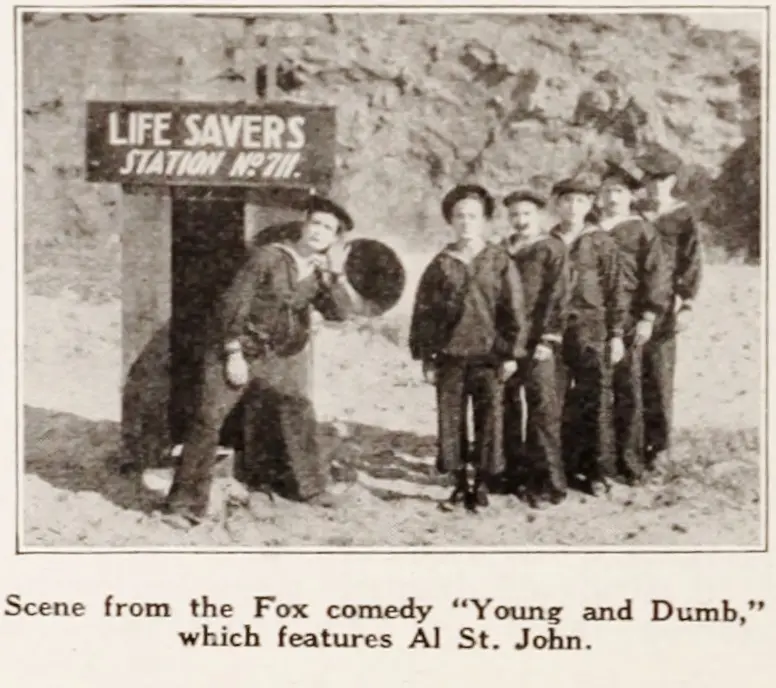
To truly appreciate the artistry of Young and Dumb, one must look at it through the lens of its contemporaries. While films like The Evangelist were grappling with moral quandaries and religious fervor, St. John was grappling with gravity. There is a purity in that struggle. Slapstick is often dismissed as 'low art,' yet it requires a level of technical precision and physical discipline that few dramatic actors could ever hope to achieve. The timing required for a successful pratfall is as exacting as the timing for a Shakespearean soliloquy.
In the broader context of 1920s cinema, we see a divergence. On one hand, you have the burgeoning sophistication of films like Girls or A Daughter of the Law, which attempted to reflect changing social mores. On the other hand, you have the anarchic spirit of the short comedies. Young and Dumb belongs firmly in the latter camp, acting as a pressure valve for a society undergoing rapid modernization. It allowed audiences to laugh at the confusion and the 'dumbness' of a world that was moving too fast to understand.
Al St. John’s contribution to the genre is often overshadowed by his transition to 'Fuzzy Q. Jones' in later Westerns, but his early work is where his true genius lies. In Young and Dumb, we see a performer at the height of his physical powers. He doesn't rely on facial contortions alone; his entire body is a comedic instrument. His movements echo the frantic energy seen in Cupid's Roundup or the rugged physicality of The Fighting Stranger, but with a subversion that turns heroism into hilarity.
Even in the more obscure titles of the era, such as The Stormy Petrel or the Danish production I de unge Aar, we rarely see the specific brand of 'determined clumsiness' that St. John perfected. He was a pioneer of the 'destructive protagonist'—the character who, in his quest for a simple goal, leaves a trail of debris in his wake. This influence can be traced through the decades, from the Three Stooges to the modern-day stunts of Jackie Chan.
Watching Young and Dumb today requires a certain degree of historical empathy. The film stock is often grainy, the lighting inconsistent, and the frames sometimes jittery. Yet, these imperfections add to the visceral experience. There is a tangible sense of the past—a feeling that we are peering through a keyhole into a world that was louder, faster, and more dangerous than our own. It lacks the polish of Pirates of the Air, but it possesses a soul that many high-budget productions of the time lacked.
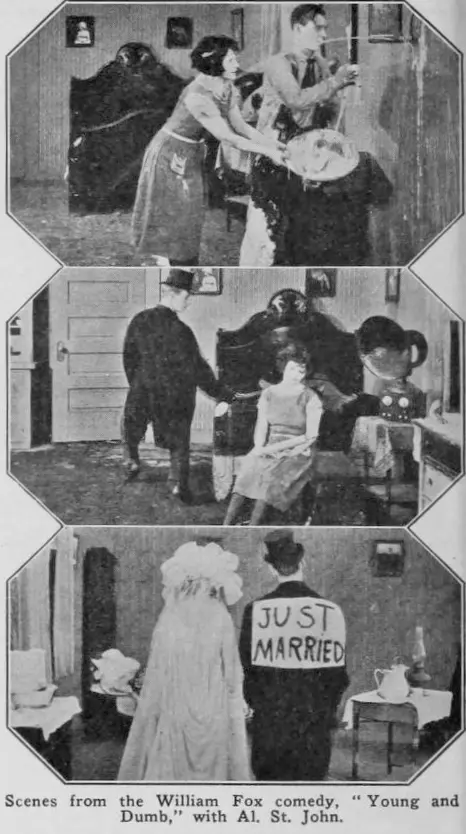
The film also serves as a reminder of the fragility of cinematic history. So many shorts from this era have been lost to the ravages of nitrate decay. The fact that we can still witness St. John’s gravity-defying antics is a minor miracle. It invites us to consider what else has been lost—perhaps more nuanced performances like those in The Bushranger's Bride or the early experimental works that paved the way for the blockbusters of the 1930s.
There is a philosophical undercurrent to Young and Dumb that is easy to miss if one is only looking for the next gag. It is a film about the inevitability of failure and the nobility of trying anyway. The protagonist is 'dumb' not because he lacks intelligence, but because he lacks the cynicism of the world around him. He approaches every obstacle with a misplaced confidence that is both pitiable and admirable. In this sense, he is a more relatable figure than the stoic heroes of Don't Weaken!.
The brilliance of Al St. John lies in his ability to make this failure beautiful. There is a grace in his falls, a rhythm in his collisions. He turns the act of being 'dumb' into an art form. As he navigates the obstacles of the plot, we aren't just laughing at his misfortune; we are marveling at his persistence. It is a celebration of the human spirit’s ability to endure, to get back up, and to walk straight into the next disaster with a smile.
In conclusion, Young and Dumb is a vital piece of the silent comedy puzzle. It showcases a performer who was a bridge between the broad slapstick of the early 1910s and the more sophisticated physical comedy of the late 1920s. It is a film that rewards multiple viewings, as each watch reveals new layers of choreographic complexity and subtle character work. For anyone interested in the roots of visual humor, it is an essential text—a loud, crashing, hilarious reminder that sometimes, the best way to deal with life is to simply fall down and enjoy the ride.
Reviewer's Note: While Al St. John's career would eventually lead him to the dusty trails of the B-Western, his work in shorts like this remains his most creatively potent output. It is the raw essence of cinema: light, shadow, and a man falling off a roof.
IMDb 4.1
1934
Community
Log in to comment.