DbcultAccessing Vault...
Cult Review
Senior Film Conservator
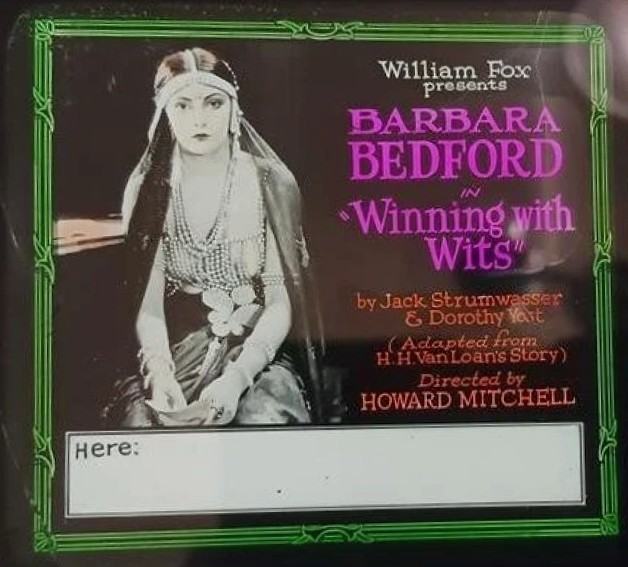
The camera iris opens like a wary eye onto a Broadway rehearsal room where Mary Sudan rehearses Desdemona’s death scene while her own father is measured for a convict’s stripes. That cruel counterpoint—artifice versus agony—ignites Winning with Wits, a 1926 Vitagraph release that most reference books misfile under melodrama when it is closer to a fever-chart of capitalist panic.
What follows is not the linear plod of so many silents but a spiral staircase of disguises, each step lacquered with deception. Mary’s transformation from ingénue to widow is accomplished in a jump-cut so abrupt it feels like a slap: one splice she is clutching a dog-eared script, the next she glides through mahogany corridors veiled in sable and the hauteur of inherited wealth. The intertitle reads, simply, "She bought a past with pearls." No further exposition is offered; the film trusts the viewer to surf the dissonance.
Director H. H. Van Loan, working from a triangulated script by Dorothy Yost and John Stone, keeps his frames as crowded as a stock-exchange floor. Clerks dart like water beetles across the screen; ticker tape snowstorms the mise-en-scène. Even the president’s office, normally a bastion of masculine stillness, is invaded by oscillating desk fans that blow contracts into fluttering white birds—an omen of paper fortunes about to take flight. The film’s visual mantra might be: everything that can tremble, will.
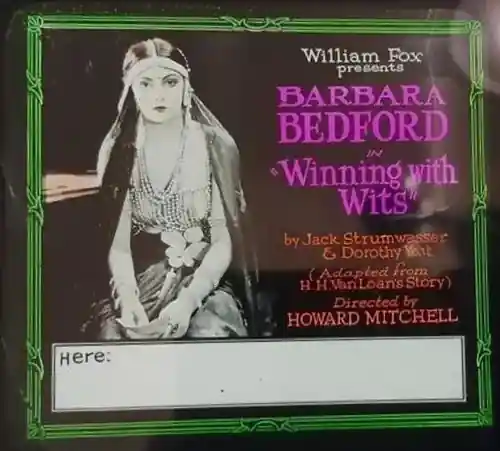
Barbara Bedford, an actress too often relegated to wilted ingenues, here operates like a shutter between two exposure settings. Watch her pupils dilate when she rehearses Juliet’s soliloquy—an almost clinical ecstasy—then contract to pinpricks when she rehearses the role of predator in the same mirror. The performance is a master-class in micro-gesture: a gloved finger absently stroking the rim of a teacup becomes a promise of ruin.
Clarence Wilson’s Corday, meanwhile, carries the fleshy arrogance of a man who believes ledgers are promissory notes from God. His body seems upholstered rather than clothed; when fear finally punctures that upholstery he deflates with a sigh almost comic, like air squealing from a punctured settee. Wilson lets the camera witness the moment his pupils realize he is not the protagonist of this narrative—an exquisite relinquishment of power.
The séance sequence arrives halfway, a set-piece so baroque it tilts the film into near-horror. Cinematographer William Marshall lights faces from below with tapers, turning human countenances into gargoyles. A bell rings without touch; a tambourine hops like a gutted frog; Mary recites figures—stolen bond serial numbers—in a monotone that seems piped in from Hades. Corday’s confession erupts not as coherent guilt but as a stammering rosary of numbers, dates, and safe-crack combinations. The moment is silent, yet the intertitle explodes: "The dead speak through arithmetic."
Compare this to Malombra’s ghostly hypnosis or Heimgekehrt’s funereal nostalgia: where those European imports wallow in the morbid perfume of ruin, Winning with Wits treats the supernatural as a stock-exchange tactic—fraud by other means. The séance is not mystical but managerial, an earnings call held in Hades.
The final reel stages the safe-cracking scene with Eisensteinian montage: inserts of trembling hands, clock gears, the nickel door of the vault breathing like a lung. When Corday is cornered, the camera assumes his POV: we see the vice-president’s smile—King, played by an impish William Scott—framed by two detectives who lean in like bookends of destiny. The depth of field collapses; the world becomes a corridor with only one exit: confession.
Dorothy Yost’s scenario is flecked with proto-feminist barbs. Mary’s theatrical vocation is never presented as mere placeholder for marriage; indeed, the climactic honeymoon is deferred until after she has directed an entire morality play starring herself. Yost also slips in a sly critique of financial patriarchy: every man in the film either counts, steals, or audits something, whereas Mary fabricates realities—first on stage, then in boardrooms. Art, not capital, becomes the ultimate liquidity.
Yet the film refuses to crown its heroine with unblemished sainthood. Notice the curl of satisfaction on her lips when Corday’s knees buckle; revenge tastes sweet, and she savors it. That ambiguity rescues the narrative from the moral absolutism that hobbles so many silents. Compare it to Triumph, where virtue is a blonde stereotype, or Slaves of Pride, where sin is punished with the blunt force of a Sunday sermon.
The restoration circulating among cine-clubs derives from a 35 mm Dutch print, its tinting salvaged with sea-foam greens and bruised roses. The tints are not mere ornament; they chart emotional equities—cyan for corporate dread, amber for the séance’s sulphuric panic. A modest electro-acoustic score by Matti Bye, all tremolo strings and bowed vibraphone, amplifies the uncanny without drowning the flicker of the shutter.
One could argue the film peaks too early: after the séance confession, the mechanical business of catching Corday red-handed feels procedural. But that lull is cunning; it allows the audience to breathe, to calculate moral ledgers, to wonder if Mary’s stratagem has in fact infected her with the very greed she seeks to exorcise. The safe-cracking thus becomes not just retribution but a mirror—will she too reach for the bonds?
Performances aside, the picture’s temporal frisson is its prescient vision of white-collar crime. Released a year before the Ticking-Bomb scandal that rocked New York trust companies, the film anticipates how abstract numbers can incarcerate more efficiently than guns. Corday’s larceny is not a back-alley mugging but a spreadsheet subterfuge, a preview of Enronomics a century early. The movie thus doubles as a time-capsule warning: when value becomes vapor, only theatrics—Mary’s métier—can reify truth.
And so the curtain falls on a train compartment, the newlyweds framed by a window that scrolls past birch forests and telegraph wires. Her father, exonerated, dozes like an elderly bear roused from hibernation. The final intertitle is a single, unadorned phrase: "The show continues elsewhere." No moral, no kiss, no iris-out on embracing lovers—just the promise of perpetual performance. In that refusal of closure, Winning with Wits wins its wager: life, like theatre, is a run-on sentence, and only the savviest actors dictate punctuation.
For viewers fatigued by superhero rehashes, this 68-minute relic offers the narcotic of narrative economy: every glance is a transaction, every shadow a plot coupon. Seek it out in the damp cellar of some cinematheque, let the projector clatter like a stock-ticker, and emerge blinking into neon daylight, newly vaccinated against the next century’s confidence tricks.
IMDb 5.9
1932
Community
Log in to comment.