DbcultAccessing Vault...
Cult Review
Senior Film Conservator
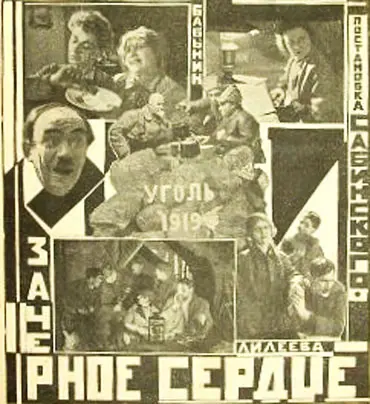
Is 'Za chornoye serdtse' worth watching today? Short answer: absolutely, but with significant caveats. This is a film for the dedicated cinephile, the history buff, and anyone fascinated by early Soviet cinema's raw, propagandistic power. It is decidedly not for those seeking a polished, character-driven narrative or light entertainment.
This obscure piece of cinematic history offers a unique window into a pivotal moment, both politically and artistically. While its messaging is overt, its execution often transcends mere polemic, revealing a surprisingly potent visual language that resonates even a century later.
At its core, 'Za chornoye serdtse' is a cinematic document of its time, a powerful, if blunt, instrument crafted to rally support for the Bolshevik cause by dramatizing the harrowing realities of class warfare in the Donetsk region. For contemporary audiences, its primary value lies in its historical significance, offering an unfiltered look at how revolutionary ideals were translated into popular culture.
The film doesn’t just tell a story; it issues a call to arms, depicting the Donetsk workers as heroic figures of collective struggle and the White Guards as archetypal villains. This stark dichotomy is not a flaw in its design but rather its very purpose, a testament to the didactic nature of early Soviet filmmaking.
This film works because of its unflinching commitment to its ideological vision, delivering a raw, visceral depiction of class conflict that leaves an indelible impression. It fails because its narrative sacrifices individual character depth for collective symbolism, making emotional connection challenging for modern viewers. You should watch it if you have a keen interest in film history, political cinema, or the origins of Soviet propaganda, and appreciate films that prioritize message over nuanced storytelling.
'Za chornoye serdtse' is less a narrative in the conventional sense and more a series of powerfully staged tableaux designed to evoke specific emotional and political responses. Directed with a clear, almost militant vision by Andrey Bykhovskiy and Grigori Gritscher-Tscherikower, the film’s structure is built around escalating confrontations, illustrating the relentless pressure exerted by the White Guards and the workers' eventual defiant uprising.
The film's strength lies in its ability to transform abstract political concepts into tangible, often brutal, visual metaphors. The factories of Donetsk are not just backdrops; they are characters themselves, their smokestacks billowing defiance, their machinery a symbol of worker power. This is particularly evident in scenes depicting the workers’ daily grind, where the rhythm of the machines mirrors their collective pulse, a striking visual motif.
The direction is undeniably stark, prioritizing impact over subtlety. Bykhovskiy and Gritscher-Tscherikower employ a visual language that feels both urgent and declarative. Wide shots dominate, emphasizing the scale of the conflict and the mass movements of the workers, often contrasted with the more rigid, almost theatrical formations of the White Guards.
Consider the sequence where the White Guards attempt to break a strike: the camera remains distant, capturing the overwhelming numbers and the systematic, almost dehumanizing, approach of the oppressors. This choice amplifies the sense of collective vulnerability, making the workers' eventual resistance feel all the more heroic.
The cinematography, while rudimentary by today’s standards, possesses a raw, documentary-like quality. The use of natural light, often harsh and unforgiving, lends an authenticity to the industrial settings. Shadows are deep, contrasts are sharp, creating a visual aesthetic that is both gritty and expressionistic. There's a particular shot of a worker's face, streaked with coal dust and defiant resolve, that transcends its propagandistic intent to become a genuinely powerful human image.
The cast, including Tatyana Mukhina, Georgi Bobynin, and Nikolai Okhlopkov, delivers performances that are largely emblematic rather than deeply psychological. This is not a criticism, but an observation of the acting style prevalent in early Soviet cinema, where characters often serve as representations of broader social classes or ideals.
Mukhina, as a resolute female worker, embodies the strength and unwavering spirit of the proletariat. Her expressions are often bold, her gestures sweeping, designed to be read clearly even from a distance. Bobynin, likely playing a worker leader or a heroic figure, carries the weight of collective hope with a stern, unwavering gaze. Okhlopkov, known for his later work, even in this early role, hints at the intensity he would bring to more complex characters.
The White Guards, conversely, are often portrayed with exaggerated villainy – sneering, arrogant, and cruel. While this lacks nuance, it effectively serves the film's purpose, clearly delineating the 'good' and 'evil' forces at play. It’s a theatricality that belongs to a specific era, and judging it by modern standards of realism misses its historical context entirely.
The film's pacing is often deliberate, building tension through a series of escalating confrontations. There are moments of quiet desperation among the workers, punctuated by bursts of intense action – a sudden raid, a violent clash. This ebb and flow creates a sense of urgency, reflecting the life-or-death stakes of the class struggle.
The tone is, without question, serious and polemical. There is little room for levity or individual introspection. Every scene, every shot, is designed to reinforce the central message of class solidarity and the necessity of revolution. It’s a relentless cinematic experience, mirroring the relentless struggle it depicts.
One might compare its didactic approach to early American propaganda films like The Rough Lover, which, despite its different political agenda, also prioritizes clear messaging over complex character arcs. However, 'Za chornoye serdtse' possesses a raw artistic ambition that often elevates it beyond mere political tract.
Absolutely, for the right audience. This is not a film for casual viewing. It demands patience and an appreciation for historical context. If you are a student of film history, particularly early Soviet cinema, or if you are intrigued by the visual rhetoric of political propaganda, then 'Za chornoye serdtse' offers a fascinating, if challenging, experience.
It serves as a powerful reminder of how cinema was harnessed as a tool for social change and ideological indoctrination in its nascent years. Its raw energy and visual audacity, despite its clear agenda, make it a compelling artifact.
An unconventional observation about 'Za chornoye serdtse' is the surprising aesthetic beauty often found within its brutal depictions. Despite its overt propagandistic goals, there are moments where the cinematography, particularly in capturing the industrial landscapes of Donetsk or the collective movement of the workers, achieves an almost poetic grandeur. The stark black and white imagery, far from being merely functional, often creates compositions that are visually arresting, lending an unexpected artistry to the harsh realities portrayed.
It’s a surprising juxtaposition: the film's ideological bluntness often gives way to genuinely powerful visual statements, suggesting that even within the confines of a strict political agenda, artistic instinct can find a way to express itself. This tension between message and artistry is what makes the film more than just a historical curiosity; it makes it a subject of ongoing critical fascination.
‘Za chornoye serdtse’ is not a film to be enjoyed in the conventional sense. It is a film to be studied, to be understood, and to be respected for its place in cinematic history. It works. But it’s flawed. Its power lies not in its ability to entertain but in its capacity to transport the viewer to a specific, tumultuous period, offering a direct, unfiltered conduit to the revolutionary fervor of early 20th-century Russia.
While its propagandistic elements are undeniable, its raw energy and occasional flashes of artistic brilliance elevate it beyond a mere historical curiosity. For those willing to engage with its particular style and ideological leanings, 'Za chornoye serdtse' offers a profoundly valuable, albeit challenging, cinematic experience. It reminds us that cinema, from its earliest days, has always been a battleground for ideas, and this film is a potent weapon forged in that ideological fire.
It’s a powerful testament to the revolutionary spirit, captured with a raw intensity that few films, even today, manage to replicate. Seek it out if you dare to peer into the 'black heart' of a revolution.
IMDb —
1925
Community
Log in to comment.