DbcultAccessing Vault...
Cult Review
Senior Film Conservator
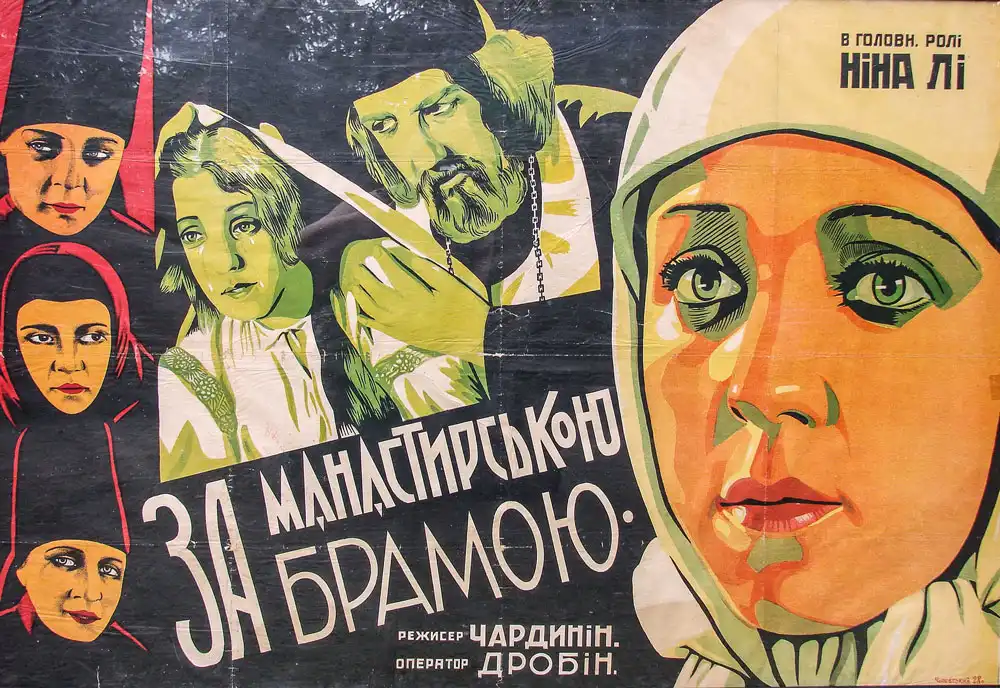
If you have a couple of hours and don't mind a lot of flickering black-and-white footage, Za monastyrskoyu bramoyu is a weirdly fascinating watch.
It is definitely for the kind of person who likes movies that feel like they were dug up from a basement. If you need explosions or people talking every five seconds, you will absolutely hate this one.
The story takes us behind the gates of a convent in Russia before the revolution changed everything. It is not exactly a happy place to be.
Right from the start, you get the sense that this isn't going to be a feel-good religious movie. The film really wants you to see the gloom behind those thick stone walls. 🕯️
Anastasiya Suvorina plays the main girl, and her face is basically the entire movie. She has these huge, expressive eyes that seem to catch every single bit of light on the set.
There is one scene early on where she is just standing by a window. The way the light hits her headscarf is actually quite pretty, even if she looks like she's about to cry.
I noticed that the actors in this movie don't move like people do today. Everything feels very stiff and deliberate, almost like they were told every step had to be "holy."
Even A. Belov, who plays a smaller role, has this way of standing that makes him look like he's posing for an old painting. It is a bit like watching the quiet intensity in The Vixen, but without the more modern drama.
The pacing is... well, it is a silent movie from 1927. It takes its sweet time getting anywhere at all.
There is a sequence where they are just walking through a garden that felt like it lasted ten minutes. I found myself looking at the background more than the actors during that part.
The trees look so strange in these old films, almost like they are made of paper. It’s funny how some parts of the film are super clear and others are just a blur of grey and scratches.
My copy had these long vertical lines running through it during the big emotional scenes. In a weird way, it made the whole thing feel more real, like I was looking at a ghost from the past.
It is a bit like the atmosphere in Bánk bán but without the fancy operatic costumes. Everything here is very plain and very cold-looking.
The director and the writers—Boris Shcharansky and Nikolay Yatko—really liked their metaphors. We get a lot of shots of locked gates and heavy keys. 🗝️
I think I liked the scenes with the older nuns the best. They have these wrinkled faces that look like maps of the old world.
One lady, I think it was L. Nordt-Lundina, has a glare that could probably peel paint off a wall. She doesn't even say anything, but you just know she is judging everyone in the room.
There’s a subplot with Arseni Kuts that felt a little bit rushed to me. Maybe some of the footage was lost over the years? That happens a lot with these old reels.
The whole "pre-revolutionary" setting is handled with a lot of bitterness. You can tell the people who made this weren't exactly fans of the old church system.
It is a propaganda piece, for sure, but it’s a very moody one. It reminded me of the heavy, serious feeling in The Birth of Patriotism.
I forgot to mention the costumes. The robes look so heavy and thick.
I kept wondering how they didn't all pass out from the heat on the movie set. The fabric looks itchy and uncomfortable, which probably helped the actors look miserable for their scenes.
Is it a masterpiece? I don't know.
It feels more like a time machine than a movie sometimes. But there is something about the way Suvorina looks at the camera at the very end.
It is a haunting moment that stays with you after you turn the screen off. If you like stuff like Little Speck in Garnered Fruit, you might appreciate the smallness of this story.
It doesn't try to be a giant epic. It just wants to show you one girl and one very big, very cold building.
I did find myself checking my phone once or twice during the middle bit. The middle 20 minutes is mostly just people praying or looking like they are about to pray. ⛪
But the ending makes up for it. It gets quite dramatic, even if the acting gets a little over the top with the arm-waving and the gasping.
It’s worth a look if you’re a film nerd or just like seeing how people used to live. Just make sure you have some coffee ready, because it is a long sit for a movie that is mostly about silence.
The shadows are the real star here. They stretch across the floors and make everything feel like a dream you can't wake up from. 🌑
I think I saw a fly on the lens in one shot, which made me laugh. It's those little things that make these old movies feel so human.
The subtitles—or intertitles, I guess—were a bit hard to read because of the old font. But you don't really need to read them to understand that everyone is sad.
I wonder what happened to the sets after they finished filming. They looked so solid, like they had been there for hundreds of years already.
Anyway, it's a solid choice for a rainy night when you want to feel a bit melancholy. Don't expect a happy ending, though.

IMDb —
1929
Community
Log in to comment.