DbcultAccessing Vault...
Cult Review
Senior Film Conservator
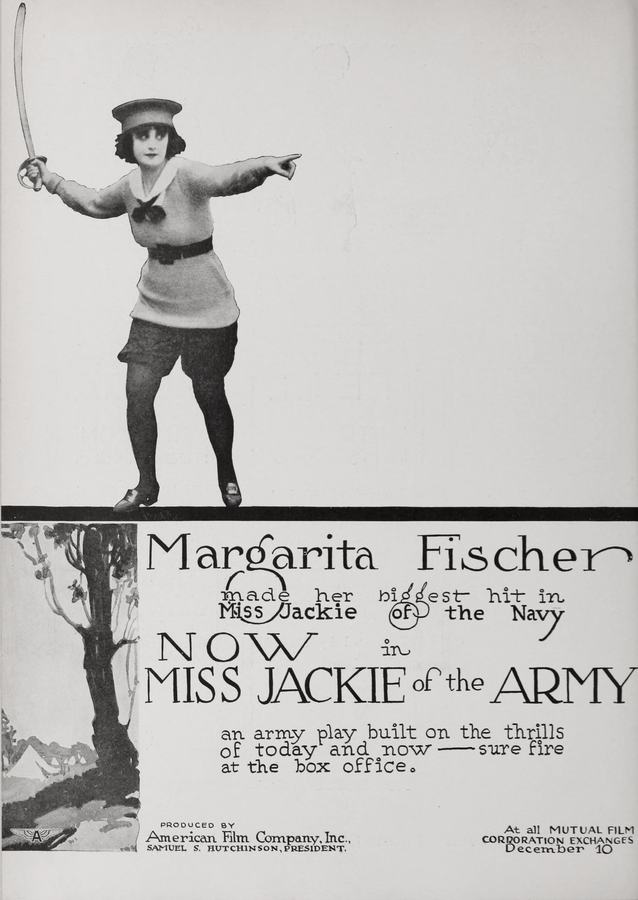
A Bugle for Rebellion, A Fuse for Treason
Imagine Griffith’s The Waif cross-pollinated with the sabotage anxiety of The Smugglers and you begin to glimpse the tonal whiplash Miss Jackie of the Army brandishes. The film is both recruitment-poster pomp and kitchen-sink insurrection, stitched together by Margarita Fischer’s kinetic eyebrows and the flicker of nitrate that has somehow survived a century’s neglect. Beatrice Van’s scenario, laced by Parker and Clapp’s intertitles, treats militarism as a corset—meant to constrain, yet begging to be ripped open by a well-timed inhale.
Jackie’s first act of sedition is aesthetic: she drapes her father’s cast-off saber with silk poppies, turns a target range into a maypole, and teaches bugle calls in three-four time. Cinematographer John W. Brownell tilts the camera as if the world itself has tripped over her audacity. When the colonel stomps in, moustache bristling like a porcupine in full salute, the frame snaps upright—patriarchy re-leveling the horizon.
The Silent Syntax of Surveillance
Midway, the movie shape-shifts. Close-ups of semaphore flags and telegraph wires invade the pastoral montage; intertitles shrink, letters jitter as if tapped in Morse. Jackie’s discovery of the plot is conveyed in a bravura set-piece: she descends a ladder into the munitions cellar, lantern in hand, while superimposed numbers count down to detonation hour. The sequence predates the proto-noir shadows of The Return of Draw Egan by two years, yet already flirts with the vertiginous staircases of German Expressionism.
The spy ring’s mastermind, revealed through a dissolve rather than a door-slamming confession, exploits the very hierarchies Jackie detests. Rank becomes camouflage; protocol becomes alibi. The film cannily suggests that patriarchal rigidity—so laughable on the parade ground—mutates into lethal bureaucracy when infected by treason.
“Your stripes blind you, sir,” Jackie taps onto the colonel’s desk in a daring intertitle, “while the enemy wears them as disguise.”
Performances that Outrun the Footlights
Fischer plays Jackie like a lit firecracker: half the joy is waiting for bang, the other half is the sulfur trail she leaves in every drawing room. Notice how she modulates gait—cadet stomp becomes ballerina pivot the instant she crosses from father’s sightline into private rebellion. Compare that to the more compartmentalized heroines of Dolly of the Dailies or Her Great Match; Jackie’s identity leaks, spills, stains the entire fort.
Louise Guire, as the colonel, delivers silent thunder: every brow-knit is court-martial, every sigh a twenty-one-gun salute. Hal Clements’ Lt. Adair exudes matinee charm so glossy you almost forgive his treachery; his jawline alone deserves its own Liberty Loan drive. When his duplicity unravels, Clements drops the smile by half a centimeter—an eternity in micro-gesture—exposing rot beneath the polish.
Gender, Genre, and the Fuse of Modernity
Unlike the continental fatalism of Vendetta or the Old-World lamentation of Szulamit, Miss Jackie of the Army is quintessentially American in its conviction that institutions may wobble yet individuals can patch the crack. Jackie’s proto-feminism is no manifesto—she never utters “votes for women”—but her insistence on self-definition ricochets louder than any soapbox speech. She does not want to join the army; she wants to unmake its dullness, to weaponize empathy.
The picture also anticipates the New Woman cycles of the twenties: bobbed hair, rolled stockings, unapologetic desire. Watch the scene where Jackie practices surgical stitches on her own garter while humming ragtime—a throwaway gag that compresses domestic duty, medical ambition, and erotic self-sufficiency into five seconds of screen time.
Visual Lexicon: Flags, Flares, and Flicker
Color tinting alternates between nicotine amber for post interiors and cadaverous blue for the sabotage cellar—a chromatic duel mirroring Jackie’s split loyalty. When the troop train finally thunders toward doom, the footage is hand-painted with scarlet streaks, each frame a wound. The aesthetic predates the crimson fever of V Lapah Zheltago Dyavola yet equals its lurid urgency.
Director Elsie Jane Wilson (unjustly forgotten between Lois Weber and Alice Guy-Blaché) choreographs crowd scenes like kinetic mosaics. Girls’ brigade members zig-zag through rows of artillery shells, their silhouettes forming fleeting peace symbols before dispersing—a visual pun on martial pageantry.
Narrative Fault-Lines: Too Much Marzipan?
For all its voltage, the film frays in the final reel. Jackie’s eleventh-hour rescue of the train relies on a relay of coincidences—telegraph wires cut, replacement horses lame, courier pigeon circling back like a homing boomerang. Such contrivance dilutes the political potency that preceded it. One wishes for the bitter aftertaste of The Revolutionist rather than the neat bow that prim censorship preferred in 1917.
Moreover, the picture sidesteps the racial optics of its era: the enlisted men who aid Jackie are exclusively white, erasing the Buffalo Soldiers historically stationed at Western forts. A single shot of a Black bugler—silent, saluting—would have complicated the canvas, yet even that is absent.
History’s omissions hiss louder than any villain’s fuse.
Legacy: Footprints in the Celluloid Dust
After its initial States-rights tour, the movie vanished—no 16mm classroom abridgments, no Cinecon acetate, no TCM bumper. Only a battered 35mm fine-grain sits in the Library of Congress cold vault, scanned at 2K but unreleased. Consequently, critical discourse has funneled toward better-surviving siblings like Silks and Satins. Yet Jackie’s DNA persists: in the screwball heroines of the thirties, in the wartime nurses of When We Were Twenty-One, even in the rambunctious private-school rebels of Leah Kleschna.
Modern viewers—those lucky enough to catch a festival DCP—will spot pre-echoes of Wonder Woman’s no-man’s-land stride and Black Widow’s tactical femininity. The difference? Jackie’s power is not bestowed by serum or godhood but wrested from sheer boredom, an emotion Hollywood still treats as sin.
Soundtrack for the Silents: What Should We Hear?
Most archival prints screen with a solo piano banging out Sousa. A bolder curator might juxtapose fife-and-drum cadences against Bessie Smith’s growl, letting patriotic march collide with blues lament—an audio metaphor for Jackie’s inner schism. Better yet: commission a female composer to thread field recordings of contemporary army daughters, their voices counting cadence over electronic distortion, bridging 1917 to now.
Final Reckoning
Does the film explode into masterpiece? Not quite. Its fuse sputters, its politics equivocate, its ending capitulates to the same order it savages. Yet in the marginalia—in Fischer’s half-smirk, in the celluloid scratches that look like shrapnel—there glows a rebellious ember. For every viewer weary of reboots and plastic feminism, Miss Jackie of the Army offers a nitrate reminder that revolt begins not in cape-swirling grandeur but in the refusal to stand still for reveille.
Grade: B+ for bravery, B- for battlecraft, A- for the afterburn it leaves on your eyelids.
If you stumble across a rare archival screening, enlist immediately. The train leaves at midnight, and Jackie’s ghost still hitches a ride on the caboose.
IMDb —
1917
Community
Log in to comment.