
Film History
The Panopticon on Nitrate: How the Secret Police Thrillers of the 1910s Scripted the Cult of State Paranoia

“Before the Cold War gave us the spy thriller, the silent era’s obsession with secret police and undercover agents forged the cinematic language of state-sponsored terror.”
There is a specific, bone-deep chill that only early celluloid can evoke—a flickering, high-contrast dread that feels less like a movie and more like a recovered memory of a fever. Long before the rain-slicked streets of 1940s noir or the sterile, high-tech surveillance of the 21st century, the silent era was already obsessed with the shadow of the state. It was a time when the 'Secret Police' weren't just a plot device; they were a looming, existential threat that mirrored a world tearing itself apart during the Great War and the Russian Revolution. This was the birth of the state-paranoia cult, a niche of cinema that traded in the currency of the watched and the watchers, scripting a visual language of suspicion that still haunts our screens today.
To understand why we are still captivated by stories of undercover agents and bureaucratic cruelty, we have to look back at the nitrate-stained reels of the 1910s. These films didn't just tell stories; they weaponized the camera to simulate the feeling of being hunted. They introduced us to the protagonist who is never quite who they seem, and the antagonist whose power is derived not from physical strength, but from the terrifying reach of a government file. This is where the 'Man on the Run' archetype was forged in the fires of early 20th-century geopolitical trauma.
The Czar’s Shadow: The Cossack Whip and the Birth of State-Sponsored Terror
If you want to find the DNA of the modern political thriller, look no further than the 1916 production The Cossack Whip. Directed by John Collins, this film is a brutal, unflinching look at the machinery of oppression. It centers on Feodor Turov, the chief of the Russian Czar's secret police—a man who doesn't just enforce the law, but hunts rebels with a sadistic efficiency that feels startlingly modern. Turov is the prototype for every cold-blooded intelligence officer we’ve seen since, a man who views human lives as mere obstacles to state order.
The film’s power lies in its depiction of the massacre of a village suspected of harboring rebels. This isn't just a historical footnote; it’s a visceral exploration of the 'Secret Police' as a predatory force. When we watch Turov’s Cossacks descend, we aren't seeing a standard action sequence. We are witnessing the birth of the 'state-as-monster' trope. For the cult film enthusiast, The Cossack Whip serves as a grim reminder that the most terrifying monsters aren't supernatural—they wear uniforms and carry official orders. The visual language of the film, with its stark landscapes and the looming presence of the secret police chief, established a template for the 'totalitarian gothic' that would later influence everything from Fritz Lang’s work to modern dystopian cinema.
Espionage as Existential Dread: The Undercover Identity in 'Secret Service'
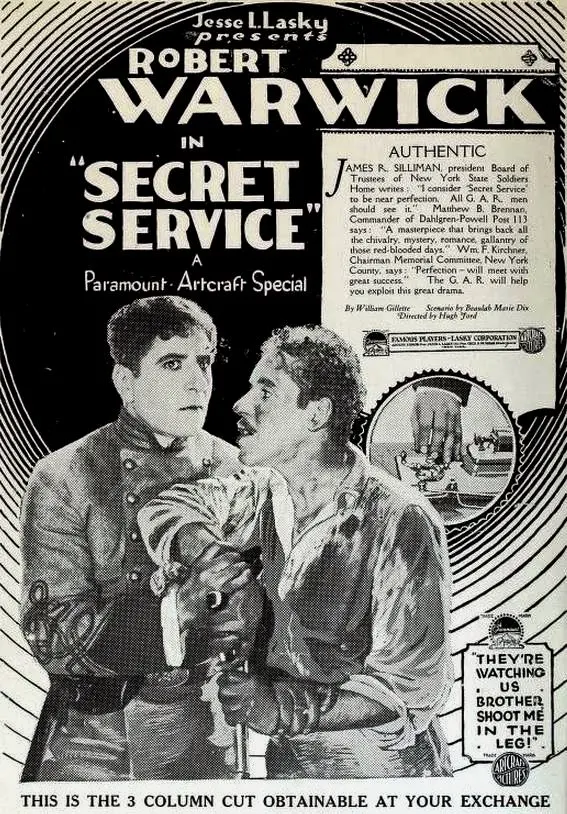
While the Russian secret police represented external terror, the 1919 film Secret Service turned the lens inward, exploring the psychological toll of the undercover agent. Starring Robert Warwick as Lewis Dumont, a Northern officer in the American Civil War, the film dives deep into the 'double life' narrative. Dumont works behind Confederate lines, his every move a calculated lie designed to lead the enemy away from a planned Northern attack.
What makes Secret Service a foundational text for the cult of paranoia is the way it treats the act of spying as a form of spiritual erosion. Dumont isn't a swashbuckling hero in the traditional sense; he is a man trapped in a performance. The film highlights the constant threat of discovery—the 'secret' in the service is a weight that threatens to crush the protagonist. This theme of the 'fractured self' is a hallmark of the cult thriller. It’s the same DNA we see in the works of John le Carré or the paranoid masterpieces of the 1970s. The silent camera, unable to rely on dialogue to explain Dumont’s inner turmoil, uses shadows and tight framing to convey the claustrophobia of his mission. He is a man who has traded his identity for a cause, a sacrifice that early audiences found both fascinating and deeply unsettling.
The Professional Shadow: 'The Ivory Snuff Box' and the French Connection
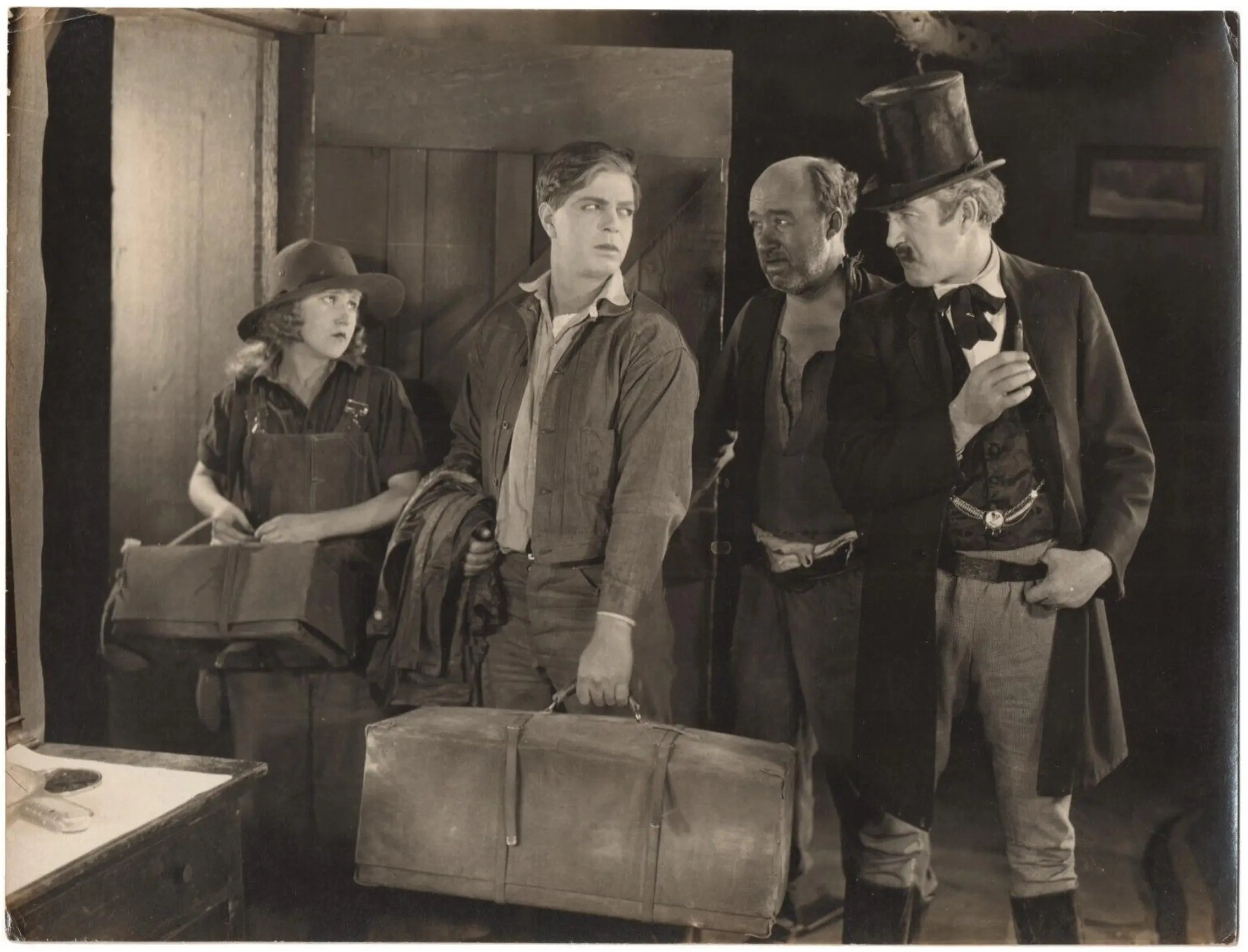
If Turov was the predator and Dumont was the martyr, then Richard Duvall in The Ivory Snuff Box (1915) was the professional. As an American detective in the employ of the French Secret Police, Duvall represents the internationalization of surveillance. This film moved the 'Secret Police' narrative out of the realm of historical melodrama and into the world of the professional procedural.
The 1910s didn't just invent the spy; it invented the idea that the state has an eye in every room, and that eye is often a man who looks just like you.
The plot, involving a stolen snuff box containing vital state secrets, is almost secondary to the atmosphere of constant observation. Duvall’s marriage to Grace Ellicot is immediately complicated by his duties to the state, highlighting a recurring theme in this subgenre: the incompatibility of the private life with the 'secret' life. The French Secret Police in this era were often depicted as sophisticated, almost invisible entities—a far cry from the blunt force of the Cossacks. This shift toward the 'invisible' state is what truly fuels modern paranoia. It’s the fear that the person sitting next to you at the opera—as seen in the 1920 film Whispers—might be recording your every word for a file you will never see.
Foreign Agents and the Fear of the 'Other': The Case of 'Paws of the Bear'
In the lead-up to and during World War I, the figure of the 'Foreign Agent' became a focal point for public anxiety, and cinema was quick to capitalize on this xenophobic dread. Paws of the Bear (1917) is a quintessential example. It features Russian agent Olga Raminoff, who shoots at a German general and then hides behind the identity of an American traveler. This film plays on the terrifying idea that anyone can be a 'sleeper agent' for a foreign power.
The 'agent' in these films is often a master of disguise, a shapeshifter who can infiltrate the most sacred spaces of domestic life. This created a specific type of cult fascination with the 'femme fatale' spy—a character who uses her perceived vulnerability as a weapon for the state. In Paws of the Bear, the 'Secret Police' aren't just the ones doing the hunting; they are the ones being hunted by agents of rival nations. This web of mutual suspicion is the bedrock of the modern espionage thriller. It’s a world where trust is a liability and the only constant is the mission. The way these films framed the 'foreign' agent—often with heavy shadows and suspicious glances—cemented the visual tropes of the spy genre for decades to come.
Identity as the Ultimate State Secret: 'Pudd'nhead Wilson' and the Switched Life
Perhaps the most unsettling aspect of the state-paranoia subgenre is the idea that the state can define who you are better than you can. While not a 'spy' film in the traditional sense, the 1916 adaptation of Mark Twain’s Pudd'nhead Wilson touches on the core of surveillance culture: the collection of data to prove identity. The story of a slave switching her light-skinned baby with her master's baby is a nightmare of identity erasure.
The film’s use of fingerprints as a way to 'unmask' the truth is a direct precursor to the forensic obsession of modern thrillers. In the world of the secret police, you are not a person; you are a set of data points—a fingerprint, a photograph, a signature. Pudd'nhead Wilson captures the moment when science and the state joined forces to ensure that no secret could remain hidden forever. This 'unmasking' of the protagonist is a recurring motif in cult cinema, from the reveal of a hidden past in film noir to the digital 'de-cloaking' in modern cyber-thrillers. It all leads back to this early anxiety about the state’s ability to 'know' the individual better than the individual knows themselves.
The Legacy of the Watchers: From Nitrate to the Digital Panopticon
Why do we continue to return to these stories of secret police and state paranoia? Perhaps it’s because the technology has changed, but the fear has remained remarkably consistent. The silent era gave us the visual vocabulary for this fear. It taught us to look for the man in the dark coat, to distrust the official report, and to understand that the most dangerous place to be is in the crosshairs of a bureaucracy with a grudge.
Films like The Black Envelope (1919), where a politician’s career hangs on a hidden document, or Social Hypocrites (1918), where a false accusation by an Earl ruins a man's life, show us that the 'Secret Police' mindset extends far beyond the literal police force. It’s a culture of surveillance, of 'whispers' and 'hidden fires' (as the titles of the era so aptly put it). These films are the ancestors of every cult movie that dares to question the authority of the state. They remind us that before we were being tracked by satellites and algorithms, we were being watched by men with ivory snuff boxes and Cossack whips. The nitrate may be decaying, but the paranoia is as fresh as ever.
As we dig through these forgotten reels, we find more than just entertainment; we find the blueprints for our modern cinematic nightmares. The silent era’s 'Secret Police' thrillers were the first to realize that the most effective way to scare an audience isn't with a jump-scare, but with the steady, unblinking gaze of an all-seeing eye. It’s a gaze we’ve been trying to hide from for over a century, and as long as the state continues to watch, we will continue to watch these films.
Community
Comments
Log in to comment.
Loading comments…