Summary
Stone ribs of a forgotten monastery rise from ochre scrubland like the petrified carcass of some medieval leviathan; into this cathedral of absence staggers a nameless cartographer, his sextant cracked, his coat stitched with the dust of three empires. He is hunting a city that vanished from every map after the last plague, yet keeps sending back rumors—bells at dusk, a woman’s voice reciting forgotten psalms. The cartographer’s inked parchment soon becomes a palimpsest of hallucinations: frescoes bleed, cloisters rearrange themselves overnight, and the cloister’s fountain gushes red wine that tastes of iron and confession. One dawn he encounters a mute novice who wears the same scar in the shape of a keyhole; together they descend the subterranean ossuary where monks once bricked themselves alive, their skulls still humming plainsong that rattles the marrow. Each torch reveals a new layer: Roman mosaics, Visigoth gold, a cinema projector from 1913 looping a lost melodrama on the sweating stone. The cartographer realizes the ruin is not abandoned but pregnant—every footstep births another corridor, every breath adds another arch. At the epicenter they find a reliquary containing a single 35 mm frame: the moment of their own discovery, already developed, already flickering. Time folds; the novice speaks for the first time, reciting the cartographer’s dying words in a child’s voice. He understands that cartography is merely delayed necromancy: to draw a place is to exhume it. The final shot reverses the opening: the camera retreats uphill until the monastery shrinks to a blight on the skin of the earth, while underground the cartographer’s silhouette keeps walking through endless vaulted corridors that exist only between sprocket holes, forever expanding the labyrinth that is now his bloodstream.
Review Excerpt
"
Spoiler-rich excavation ahead. Enter the cloister at your own risk.
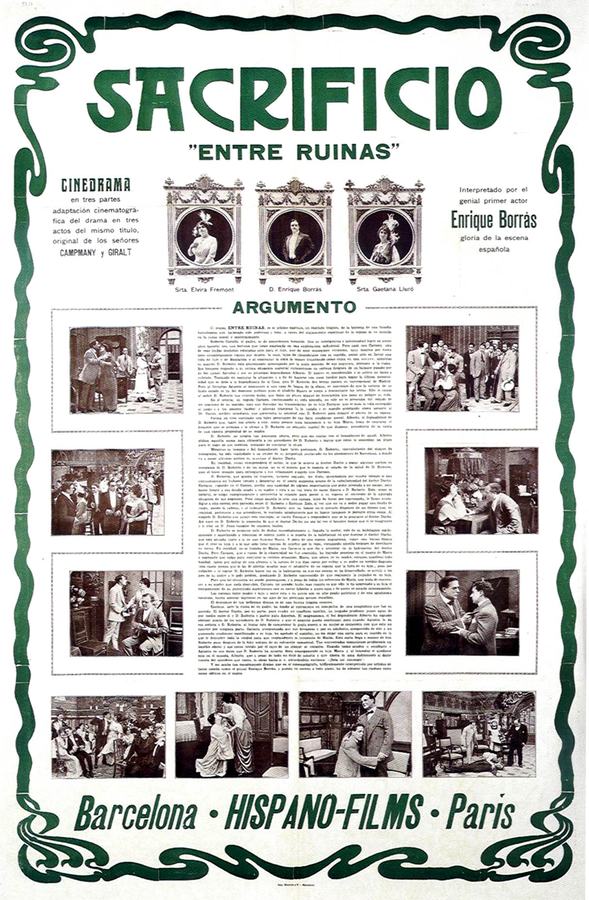
There are films you watch and films that watch you—Entre ruinas belongs to the latter species, a 1911 Spanish one-reeler that feels as if someone drilled a peephole through a thousand years of limestone and let you stare straight into the collective unconscious of European trauma. Running a mere twelve minutes, it nonetheless stretches like a black hole, warping every assumption about early cinema’s innocence.
Director Ricard..."